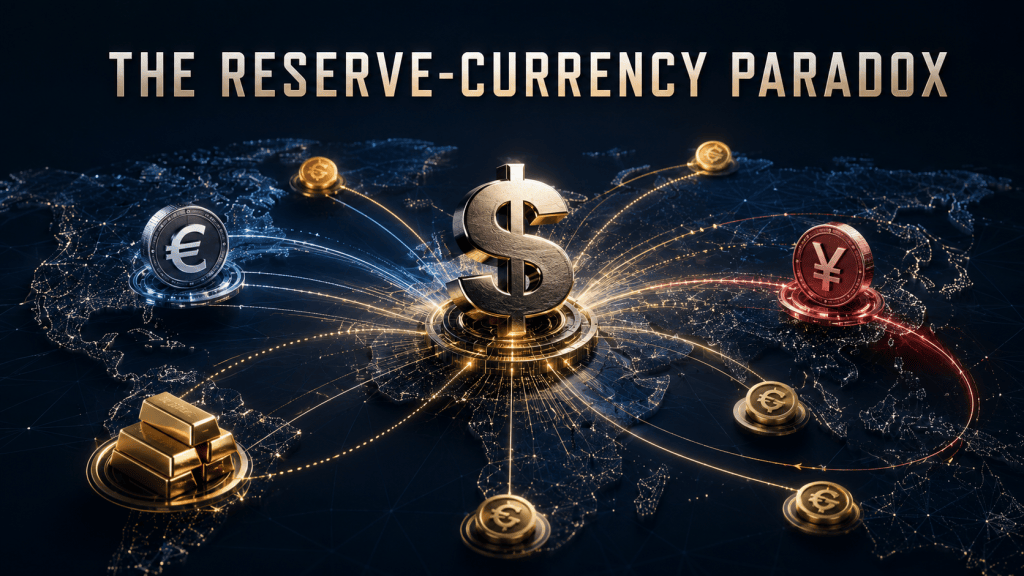
The world is searching for an alternative to the US dollar. Governments worry that excessive dollar dependence exposes them to American interest rates, financial sanctions, asset freezes and political pressure. Central banks are buying more gold. Countries are settling some bilateral trade in local currencies. New payment systems are being discussed. The BRICS grouping continues to demand a more balanced monetary order.
Yet when fear enters financial markets, money frequently moves towards the very currency the world claims it wants to escape.
This is the reserve-currency paradox. Countries want monetary independence, but global markets continue to value the liquidity, institutional depth and enormous scale of dollar-based assets. Governments may dislike the political power attached to the dollar, but they still need a currency that can store hundreds of billions of dollars, finance international trade, settle financial contracts and be converted quickly during a crisis.
The dollar is therefore not surviving because the world is satisfied with American leadership. It is surviving because dissatisfaction alone cannot create a credible monetary alternative.
From British Sterling to the Dollar
Reserve currencies have changed before, but never through slogans or diplomatic declarations. The British pound dominated international finance during the nineteenth century because Britain stood at the centre of global trade, shipping, insurance and banking. London offered deep financial markets, and the British Empire extended the use of sterling across continents.
The dollar gradually displaced sterling only after the economic foundations of British power had weakened through two world wars. By 1944, the United States possessed much of the world’s industrial capacity and official gold reserves. The Bretton Woods system placed the dollar at the centre of the post-war monetary order, linking it to gold and connecting other currencies to it.
When the United States ended the dollar’s convertibility into gold in 1971, many expected the system to collapse. Instead, the dollar became even more important. Oil continued to be priced mainly in dollars. International banks expanded dollar lending. US government debt became the world’s most important pool of liquid assets. Financial globalisation converted the dollar from a currency backed by gold into a currency backed by networks, markets and the absence of a complete substitute.
That history carries an uncomfortable lesson. A reserve currency does not disappear merely because the country issuing it makes mistakes. It declines when another system becomes capable of performing the same functions at comparable scale.
Decline Without Displacement
The dollar’s share in official foreign-exchange reserves has fallen substantially from its position around the beginning of this century. But decline must not be confused with replacement. IMF data show that the dollar still accounted for 57.13 per cent of allocated global foreign-exchange reserves in the first quarter of 2026. The increase from the preceding quarter also shows why short-term changes must be interpreted carefully: exchange-rate movements can alter reported shares even when central banks make no major strategic shift. “IMF COFER data” (https://data.imf.org/en/news/imf%20data%20brief%20july%201)
The euro remains the second-largest reserve currency but is constrained by the incomplete financial and political union behind it. Europe has a large economy, credible institutions and sophisticated markets, but it does not provide a single, unified safe asset comparable in scale to the US Treasury market.
China has become central to global trade, but the renminbi remains a relatively small part of official reserves. Capital controls, limited currency convertibility, state influence over financial institutions and questions about transparency restrict its international role. A country cannot easily ask the world to hold its currency freely while continuing to control how that currency enters and leaves its own financial system.
Other currencies, including the Japanese yen, British pound, Canadian dollar and Australian dollar, offer diversification but not replacement. Gold provides protection from political and currency risk, but it cannot perform every function of a modern international currency. It does not generate interest, its price can fluctuate sharply, and moving or settling it at scale is less convenient than transferring financial claims electronically.
The world is therefore diversifying across several assets without discovering a single new centre.
The Architecture Beneath the Currency
Debates on de-dollarisation often treat currency as if it were a national product that could be replaced by political choice. In reality, the dollar is part of a vast financial infrastructure.
US Treasury securities provide governments, banks, pension funds and institutional investors with a large and actively traded store of value. Dollar funding is deeply embedded in banking, corporate borrowing, commodity markets, trade finance and financial derivatives. The Bank for International Settlements reported that global over-the-counter foreign-exchange trading reached roughly 9.6 trillion dollars per day in April 2025. This is not simply a market for currencies. It is an enormous web of contracts, collateral arrangements, risk-management systems and established habits. “Bank for International Settlements” (https://www.bis.org/statistics/rpfx25_fx.htm)
This produces powerful network effects. The dollar is widely used because other participants use it. Banks hold dollars because customers require dollars. Exporters invoice in dollars because lenders, insurers and commodity exchanges already operate in dollars. Central banks accumulate dollar assets partly because their economies may require dollar liquidity during a crisis.
Replacing the dollar would therefore require more than creating a new unit of account. It would require building trusted bond markets, transparent regulation, open capital accounts, reliable payment infrastructure, strong legal enforcement and a large supply of safe assets. It would also require governments to tolerate the loss of control that comes with allowing foreigners to hold and trade their currency freely.
Many aspiring reserve-currency powers want the prestige of internationalisation without accepting its domestic costs.
America’s Privilege Is Also Its Burden
The dollar system provides the United States with exceptional advantages. It allows the country to borrow in its own currency, supports lower financing costs and gives American financial sanctions extraordinary reach. It also permits the United States to run persistent external deficits because the rest of the world demands dollar assets.
But this privilege contains a structural contradiction. To provide the world with reserves and liquidity, the United States must continuously supply financial claims to foreign holders. That often means larger fiscal deficits, current-account imbalances and rising debt. The system requires the United States to behave both as a national economy and as the provider of a global public financial infrastructure.
The greater the international demand for dollars, the easier it becomes for the United States to postpone difficult fiscal choices. Yet prolonged debt expansion, political conflict over public borrowing, unpredictable tariffs, sanctions and institutional instability can gradually damage the confidence on which dollar leadership depends.
The most serious threat to the dollar may therefore come not from a rival currency but from the United States treating global trust as an unlimited natural resource.
Sanctions Have Changed the Calculation
The freezing of central-bank assets and the expanding use of financial restrictions have changed how governments view reserves. A reserve asset was once judged mainly by safety, liquidity and return. It is now also judged by the risk that access may be restricted during a geopolitical confrontation.
This does not make the dollar immediately unusable. It makes reserve management more political.
Countries that consider themselves exposed to Western sanctions are likely to accumulate more gold, hold a wider range of currencies, develop alternative payment channels and settle more trade bilaterally. But these measures often reduce exposure at the margins rather than eliminate dollar dependence. A payment system can redirect transactions; it cannot instantly manufacture deep and trusted capital markets.
The weaponisation of finance may therefore weaken dollar dominance slowly while strengthening it during moments of panic. Countries may reduce long-term exposure to the dollar but still demand dollar liquidity when global markets become unstable. That is another layer of the paradox.
India Should Diversify Without Performing De-dollarisation
For India, the issue should not become a symbolic campaign against the dollar. India imports large quantities of energy, raises international capital, manages a substantial foreign-exchange reserve portfolio and operates within dollar-centred trade and financial networks. A sudden attempt to reduce dollar use would create costs for banks, exporters and businesses without necessarily increasing national power.
A practical strategy would expand rupee settlement where trade flows are sufficiently balanced, strengthen domestic bond markets, improve currency-risk management and gradually increase the rupee’s regional use. India must also maintain adequate liquid reserves because geopolitical ambition cannot substitute for crisis insurance.
The rupee will become more international when foreign investors and trading partners find it useful, liquid and dependable. International currency status cannot be created through administrative pressure. It must be earned through macroeconomic stability, predictable regulation, open and deep markets, institutional trust and sustained economic scale.
The Future Is a Monetary Archipelago
The coming monetary order is unlikely to resemble a clean transfer of power from the dollar to another currency. It will look more like an archipelago: several currency and payment zones connected by bridges, but without a single new island large enough to replace the existing centre.
More trade may be settled in local currencies. Central banks may hold more gold and a broader collection of smaller currencies. Regional payment platforms and central-bank digital currencies may reduce the dollar’s role in selected transactions. Commodity exporters may accept a wider range of settlement arrangements. Companies may maintain multiple banking and payment channels as protection against sanctions and political disruption.
But invoicing, reserves, financing and payment settlement do not have to move together. Two countries may trade in their own currencies while continuing to price commodities in dollars, borrow in dollars and hold dollar assets. This means de-dollarisation will not be one event. It will be an uneven process occurring at different speeds in different parts of the financial system.
The dollar can lose share without losing centrality.
The Currency That Has Not Yet Been Invented
The real contest is not between the dollar and one challenger. It is between a concentrated system that offers extraordinary liquidity and a diversified system that may offer greater political protection but higher transaction costs.
The world wants freedom from dollar dependence, but it also wants the safety, liquidity and convenience that the dollar system provides. Until another economy is willing and able to supply open markets, trusted institutions and safe financial assets on a comparable scale, diversification will remain easier than replacement.
The future may therefore be less dollar-centred but not post-dollar. The dollar’s share can continue to decline while its strategic importance remains disproportionately large.
That is the reserve-currency paradox: the world is preparing for life beyond the dollar while continuing to build much of its financial future upon it.
ReserveCurrency #DeDollarisation #GlobalEconomy #InternationalTrade #IndianEconomy #Geopolitics #FinancialMarkets


Leave a Reply