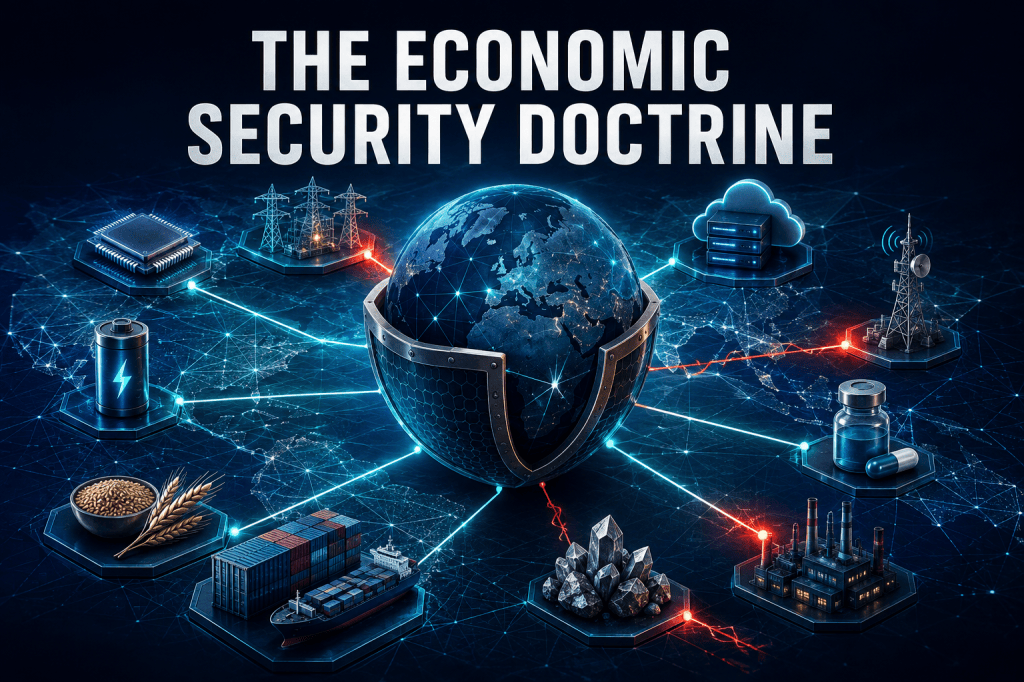
When Dependence Becomes a Threat
For much of the last four decades, economic policy was built around a comforting belief: countries that traded more would fight less. Supply chains would cross borders, capital would move freely, technology would spread, and mutual dependence would make conflict too costly. The factory, the container ship and the financial network appeared to be instruments of peace. That belief was never entirely false—but it was dangerously incomplete. Interdependence does not remove power. It relocates power into ports, payment systems, energy pipelines, digital platforms, patents, shipping routes and semiconductor supply chains. The new economic security doctrine begins with a disturbing conclusion: dependence on another country is not merely a commercial condition; under pressure, it can become a strategic vulnerability.
From the Arsenal to the Supply Chain
National security was once imagined mainly through soldiers, borders, weapons and military alliances. Economic policy belonged to a different world governed by cost, productivity and consumer choice. History, however, repeatedly showed that the separation was artificial. Empires protected sea routes because trade financed power. Industrial capacity decided the outcome of major wars. Oil shocks in the 1970s demonstrated that energy dependence could alter inflation, diplomacy and domestic politics without a single shot being fired. The food and commodity crises of later decades revealed how distant disruptions could produce instability at home. Yet the period after the Cold War encouraged governments and companies to treat these episodes as exceptions. Globalisation rewarded the cheapest supplier, lean inventories, concentrated production and just-in-time delivery. Efficiency became so dominant that resilience was often dismissed as waste.
The pandemic, geopolitical conflict, sanctions, export restrictions, shipping disruptions and technological rivalry broke that illusion. Governments discovered that hospital systems could be constrained by shortages of basic medical inputs; manufacturers could be stopped by the absence of a small electronic component; and entire economies could be exposed through fuel imports, digital infrastructure or foreign-controlled logistics. The modern arsenal is therefore no longer confined to missiles and warships. It includes export licences, payment networks, technical standards, app stores, cloud servers, satellite systems, insurance markets, undersea cables and access to critical minerals.
The New Map of Strategic Sectors
The boundaries of national security are expanding so quickly that almost every advanced industry can now claim strategic importance. Energy security is no longer only about crude oil; it includes gas, electricity grids, batteries, solar components, uranium, storage technologies and the software that manages power systems. Food security extends beyond grain stocks to fertilisers, seeds, agricultural chemicals, cold chains, farm machinery and climate-resilient genetics. Pharmaceutical security includes active ingredients, laboratory equipment, clinical data, vaccines and the specialised materials used in production.
Semiconductors have become the clearest symbol of the new doctrine because a tiny chip can determine whether a car, telecom network, medical device or defence system can be completed. Telecommunications infrastructure carries both economic activity and sensitive information. Defence production depends on civilian technologies, specialised alloys, electronics, optics and software sourced through complex international networks. Cloud computing creates another layer of dependence: a country may possess physical territory and formal sovereignty while its essential data, public services and business operations run on infrastructure controlled elsewhere. Logistics, too, has moved from the background to the centre. Control over ports, shipping, warehousing, freight data and trade finance can decide whether goods move at all.
Critical minerals expose the deepest contradiction. The transition to cleaner energy may reduce dependence on fossil fuels while creating new dependence on lithium, cobalt, nickel, graphite, copper and rare-earth processing. A green economy is not automatically a secure economy. It may simply replace one geography of vulnerability with another.
The End of Efficiency as the Supreme Value
The economic logic of the old system was simple: buy from the place that can produce most cheaply and organise the supply chain to minimise idle capacity. The new logic asks different questions. Can the supplier continue during war, sanctions, political confrontation, cyberattack, pandemic or transport closure? Is the technology controlled by an ally, a rival or a private corporation whose decisions cannot be influenced? Can production be shifted quickly? Are there alternative routes, substitute materials and emergency stocks?
This changes the meaning of economic efficiency. A cheap input that closes an entire factory when disrupted is not truly cheap. A single-source supply chain may look productive in normal times but carry an enormous hidden insurance cost. The relevant calculation is therefore moving from the visible price of production to the total cost of vulnerability. Governments and firms will pay more for geographical diversification, domestic capacity, strategic reserves, trusted suppliers and technological control. Redundancy—once treated as managerial failure—will increasingly be valued as protection.
But this protection will not be free. Duplicate factories can raise unit costs. Stockpiles can become obsolete. Domestic subsidies may protect politically connected firms rather than genuinely strategic capacity. Local production can create an illusion of autonomy when machinery, software, patents or raw materials remain imported. Economic security can therefore become a powerful justification for inefficient industrial policy unless strategic claims are tested rigorously.
Strategic Autonomy or Strategic Protectionism?
The most dangerous feature of the emerging doctrine is its flexibility. Almost any restriction can be presented as necessary for security. A tariff can be called resilience. A subsidy can be called sovereignty. A ban can be called risk reduction. Governments may protect weak industries, discriminate against foreign competitors or reward favoured corporations while avoiding the language of conventional protectionism.
The distinction between genuine security and political convenience will become increasingly difficult to maintain. A sector should not be declared strategic simply because it has influential producers. The critical test is whether disruption would cause severe and immediate damage, whether supply is highly concentrated, whether substitutes are limited, and whether rebuilding capacity would take too long. Without such tests, economic security may become an unlimited doctrine—one that fragments markets, weakens competition, increases public expenditure and transfers the cost to consumers.
There is also a democratic risk. Decisions about foreign investment, technology access, data localisation and industrial subsidies are often made in the language of classified threats. This can reduce transparency and weaken public scrutiny. Security institutions may gain influence over areas once governed through open economic debate. The future state may be more economically interventionist but not necessarily more publicly accountable.
The Unequal Price of a Safer World
Rich economies can spend heavily on semiconductor plants, energy transitions, defence supply chains and large industrial subsidies. Smaller and poorer countries cannot easily duplicate every critical capacity. If self-reliance becomes the universal rule, the countries with the least capital and technology will pay the highest price. They may face more expensive imports, restricted access to advanced technologies and pressure to choose between rival economic blocs.
This creates a two-level global economy. Powerful states will attempt to secure strategic autonomy, while weaker states remain dependent but with fewer choices. Developing countries may be asked to open their mineral resources while being denied the technology needed to move into processing and manufacturing. They could become strategically important without becoming economically powerful. The old centre–periphery relationship may return in a greener and more digital form: raw materials flow outward, high-value technology flows inward, and control remains concentrated elsewhere.
For countries such as India, the answer cannot be complete self-sufficiency. No large modern economy can domestically reproduce every mineral, machine, component, medicine and technology at a reasonable cost. The stronger strategy is selective autonomy: identify a limited number of truly critical dependencies, develop domestic capability where feasible, diversify imports where it is not, build reserves for temporary shocks, and form international partnerships that do not create a new single point of dependence. Strategic autonomy should mean the ability to choose—not the ambition to produce everything.
The Corporate Balance Sheet Is Becoming Geopolitical
Companies can no longer treat geopolitics as an external issue handled only by governments. A firm may be financially healthy yet strategically fragile because one supplier, shipping corridor, software provider or export market controls its survival. Procurement departments will have to map not only vendors but also the ownership, location, political exposure and technological dependencies behind those vendors. A product labelled domestic may still rely on imported chips, foreign cloud infrastructure, licensed design software or a mineral processed in one distant country.
This will change accounting and investment. Firms may need to value resilience even when it reduces short-term returns. Boards will ask whether supply chains can survive sanctions, cyber disruption, currency restrictions or sudden regulatory separation. Banks and insurers may price geopolitical concentration as a financial risk. Traceability will become as important as price. The competitive company of the future may not be the one with the leanest supply chain, but the one that can continue operating when the world becomes less predictable.
MSMEs face a particular danger. Large corporations can maintain multiple suppliers, hold inventory and relocate production. Smaller firms often lack the finance and information to do so. If economic security policy is designed only around national champions, it may make supply chains appear stronger at the top while pushing the cost of resilience downward onto smaller suppliers. Shared testing facilities, common warehouses, cluster-level risk intelligence, joint procurement and public credit support will be necessary if resilience is to extend beyond a few dominant firms.
The Next Contest Is Over Control, Not Trade Alone
The global economy is not moving toward the end of trade. It is moving toward managed interdependence. Countries will continue to exchange goods, capital, energy and technology, but they will increasingly ask who controls the network, who can deny access and who can survive disconnection. Alliances will become partly industrial. Trade agreements will include minerals, data, technology standards and trusted supply chains. Development policy will merge with defence planning. Competition authorities, investment-screening agencies, cyber institutions and industrial ministries will operate in the same strategic space.
By the 2030s, national power may be judged less by how much a country produces than by how many essential systems it can keep functioning during disruption. The decisive capabilities will include reliable electricity, secure digital infrastructure, domestic technical knowledge, adaptable manufacturing, diversified logistics and institutions able to coordinate rapid responses. Economic strength will mean continuity under pressure.
Security Without Economic Paranoia
The economic security doctrine responds to real vulnerabilities, but it can also create the insecurity it seeks to prevent. If every dependency is treated as a threat, trade becomes suspicion, investment becomes intrusion and technology becomes a weapon by default. Countries may spend vast sums duplicating capacity, restrict innovation and divide the world into hardened blocs. The pursuit of absolute security can produce permanent economic tension—and absolute security will remain impossible.
The central challenge is therefore not to eliminate interdependence but to redesign it. Dependence becomes dangerous when it is concentrated, opaque, irreplaceable and controlled by an actor willing to use it coercively. A resilient system needs diversity, transparency, substitution capacity and rules that limit abuse. It also needs international cooperation, because climate change, pandemics, financial instability and digital disruption cannot be solved within national borders.
The coming age will sacrifice some efficiency for resilience; that shift is already unavoidable. The real question is whether the sacrifice will create genuine public capability or merely expensive nationalism. Economic security must not become a slogan under which every subsidy is justified and every foreign connection is feared. Its strongest form is neither isolation nor unrestricted dependence. It is disciplined openness: connected enough to prosper, diversified enough to endure, and capable enough to refuse coercion. In the economy of the future, sovereignty will not mean standing alone. It will mean remaining free to act even when the networks around us are under pressure.
EconomicSecurity #StrategicAutonomy #India #GlobalTrade #SupplyChain #FutureEconomy


Leave a Reply