The Hidden Energy System Beneath Every Farm
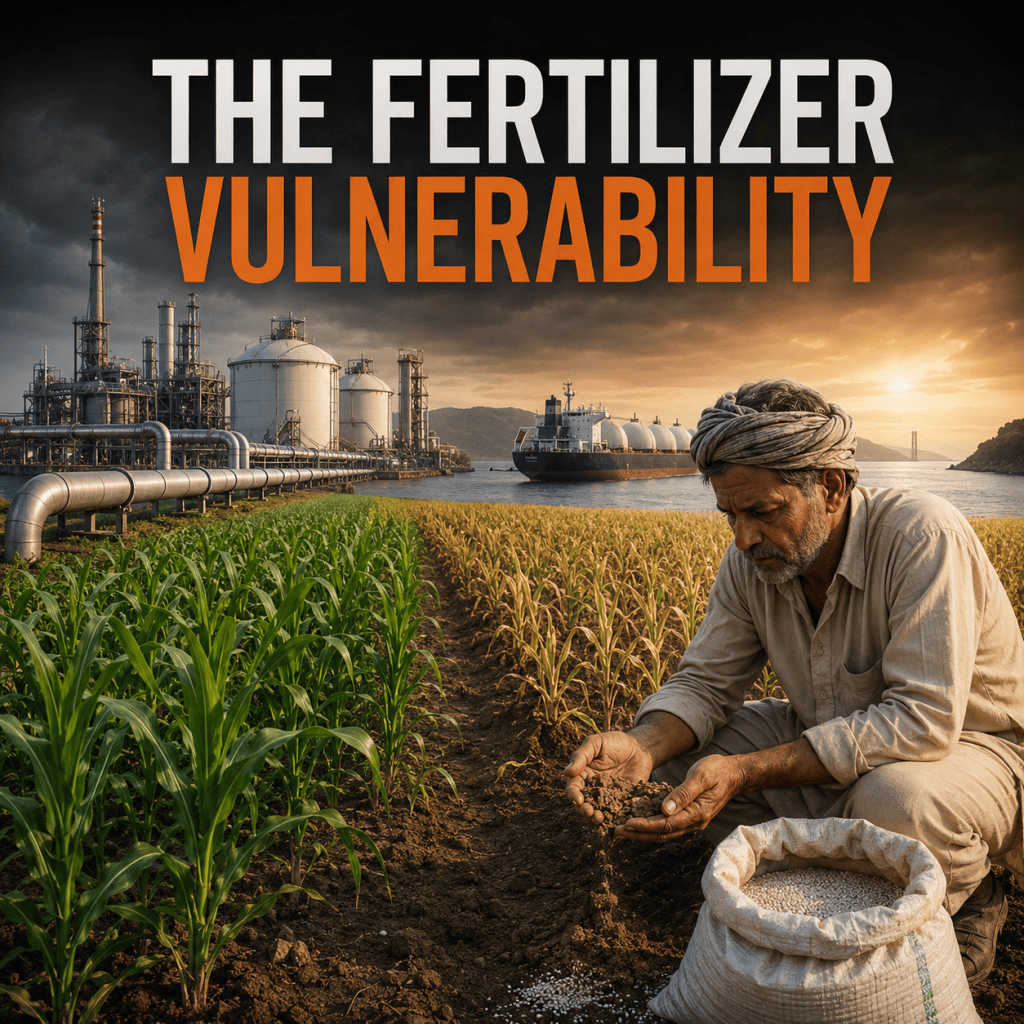
Agriculture still looks natural from a distance. There is soil, rain, sunlight, seed and human labour. But modern farming is also an industrial system built on natural gas, mined minerals, global shipping, credit and government subsidy. A farmer may sow wheat in India, maize in Kenya or rice in Bangladesh, yet the cost of that crop can be influenced by a gas facility thousands of kilometres away or by the closure of a strategic sea route.
This is the uncomfortable truth behind modern food security. Much of the nitrogen fertilizer used by farmers is produced through an energy-intensive process that relies heavily on natural gas. Gas is both a source of energy and a basic raw material. Phosphate fertilizers depend on phosphate rock, ammonia, sulphur and complex processing chains. Potash production is concentrated in a limited number of countries. Diesel is needed to operate farm machinery and transport agricultural inputs. Shipping costs connect all these elements.
Therefore, an energy shock does not remain an energy shock. It travels from gas markets to fertilizer factories, from fertilizer dealers to farmers, from farms to food markets and finally into household kitchens.
The Old Lesson That the World Keeps Forgetting
The vulnerability is not new. The oil shocks of the 1970s showed that energy prices could disturb production, inflation and political stability at the same time. The global food crisis of 2007 and 2008 demonstrated how energy costs, biofuel demand, export restrictions and financial speculation could combine to push staple prices upwards. The disruptions of 2021 and 2022 again exposed the close relationship between natural gas, fertilizer and food.
Yet every crisis is treated as an isolated accident. Once prices soften, governments return to the same concentrated supply chains. Farmers remain dependent on imported nutrients. Countries continue to subsidise fertilizer consumption without building enough domestic production, recycling capacity, soil intelligence or alternative nutrient systems.
The world has modernised agriculture without fully securing the industrial foundations beneath it. It has increased crop yields but also increased dependence on a small number of energy producers, fertilizer exporters and maritime routes.
The 2026 Shock and the Price of Concentration
The Middle East disruption of 2026 has brought this structural weakness back into view. The World Bank projected that overall commodity prices would rise by 16 per cent during 2026, with energy prices increasing by 24 per cent. Its fertilizer price index had already risen by more than 12 per cent during the first quarter, while March prices reached their highest level since 2022. The Bank expected fertilizer prices to increase by more than 30 per cent over the year, with particularly severe pressure on urea. World Bank Commodity Markets Outlook, World Bank analysis
These numbers matter, but the transmission is more important than the headline. When natural gas becomes expensive, fertilizer plants face higher production costs. When strategic shipping passages are disrupted, even fertilizer available in one country may not reach another at the right time. When freight and insurance charges rise, import bills grow further. When currencies of poorer countries weaken, the same tonne of fertilizer becomes even more expensive in domestic money.
The farmer then faces an impossible choice. Apply the recommended quantity and accept a lower income, apply less and risk a weaker harvest, change crops without sufficient knowledge, or borrow more at a time of uncertainty.
A fertilizer crisis is therefore not simply a problem of high prices. It can become a problem of lower application, declining productivity, greater debt and reduced food supply in the following season. The shock arrives in stages. Energy markets react first, fertilizer markets follow, farmers adjust their decisions and consumers experience the consequences months later.
The Farmer Pays First but the Poor Consumer Pays Last
Large agricultural economies can soften the shock through subsidies, public procurement, strategic stocks and domestic production. Rich countries can support farmers through insurance, credit and direct income assistance. Large agribusinesses can buy inputs in advance or negotiate long-term supply contracts.
Small farmers and low-income countries have far fewer protections. A country importing fuel, fertilizer and food can be hit three times. Its energy bill rises, agricultural production becomes more expensive and imported food costs more. At the same time, governments collect less fiscal space because greater resources are required for subsidies, debt servicing and emergency imports.
This is where fertilizer vulnerability becomes a social crisis. Families do not experience it through a commodity index. They experience it through smaller meals, cheaper diets, withdrawal of children from school, distress migration and the sale of productive assets. Urban workers demand higher wages because food becomes expensive. Governments attempt to control prices. Traders hold stocks. Exporting countries may restrict shipments to protect domestic consumers. Each defensive action can make the global shortage worse.
The poorest food-importing countries are thus exposed not because they consume the most fertilizer, but because they possess the fewest economic shock absorbers.
India Is Protected but Not Secure
India has significant domestic fertilizer production, a large subsidy system, public institutions and the purchasing power to negotiate international contracts. These provide an important layer of protection. But protection should not be confused with independence.
India remains exposed to imported natural gas, potash, phosphate inputs, ammonia and other raw materials. When global prices rise, the government can prevent the full increase from reaching farmers, but the cost does not disappear. It moves into the public budget. Fertilizer security is then maintained through a larger subsidy burden, which can reduce the fiscal space available for agricultural research, irrigation, extension, storage and rural infrastructure.
There is also a deeper imbalance. Cheap or heavily protected fertilizer can encourage excessive use of certain nutrients, especially nitrogen, while soils become deficient in others. The result may be rising subsidy expenditure without a matching improvement in soil health or crop productivity.
The future challenge for India is therefore not merely to secure more fertilizer. It is to use nutrients more intelligently. Soil testing must become a working farm service rather than a certificate-generating exercise. Balanced fertilization, nano and specialty products, biological inputs, composting, crop-residue management and the recovery of nutrients from urban and agricultural waste all need serious evaluation. No single alternative will replace conventional fertilizer, but together they can reduce wasteful dependence.
The Next Food Crisis May Begin Before the Harvest Fails
Food policy usually reacts after retail prices rise. By then, much of the damage may already have occurred. The critical moment is earlier, when farmers decide how much land to cultivate, which crops to plant and how much fertilizer to apply.
Governments therefore need forward-looking fertilizer intelligence. Energy prices, factory shutdowns, export restrictions, shipping movements, inventories, currency movements and planting calendars should be monitored as one connected system. Fertilizer reserves should be designed around crop seasons rather than annual averages. Import sources must be diversified, but diversification alone is insufficient if several suppliers depend on the same gas market or sea route.
Poor countries also need international financing facilities that release support before an input shortage becomes a hunger emergency. Waiting for malnutrition to rise before providing assistance is economically irrational and morally indefensible.
From Food Security to Nutrient Security
The fertilizer vulnerability reveals a larger contradiction. The world wants agriculture to feed more people, adapt to climate change, use less water, reduce emissions and protect soil. Yet the system remains dependent on energy-intensive inputs moving through geopolitically fragile networks.
The answer cannot be a return to low-productivity farming. Billions of people depend on the yields made possible by modern agricultural inputs. But the answer also cannot be endless dependence on concentrated industrial supply chains.
The next agricultural revolution must therefore be a nutrient-security revolution. It will require more efficient fertilizer use, stronger regional production, renewable energy in fertilizer manufacturing, green ammonia, nutrient recycling, better crop planning and scientific support for small farmers. It will also require governments to stop treating fertilizer policy as a yearly subsidy calculation.
The central lesson is simple. A country that cannot protect the nutrients required for its soil cannot fully protect the food required by its people. In the coming decades, fertilizer will no longer be viewed only as a farm input. It will become part of national security, social stability and economic sovereignty.
Agriculture #FertilizerCrisis #FoodPrices #FoodSecurity #Farmers #EnergyCrisis #India
 "Connecting communities, empowering nations: Unifying the Regional and Global Economy ."
Leave a comment