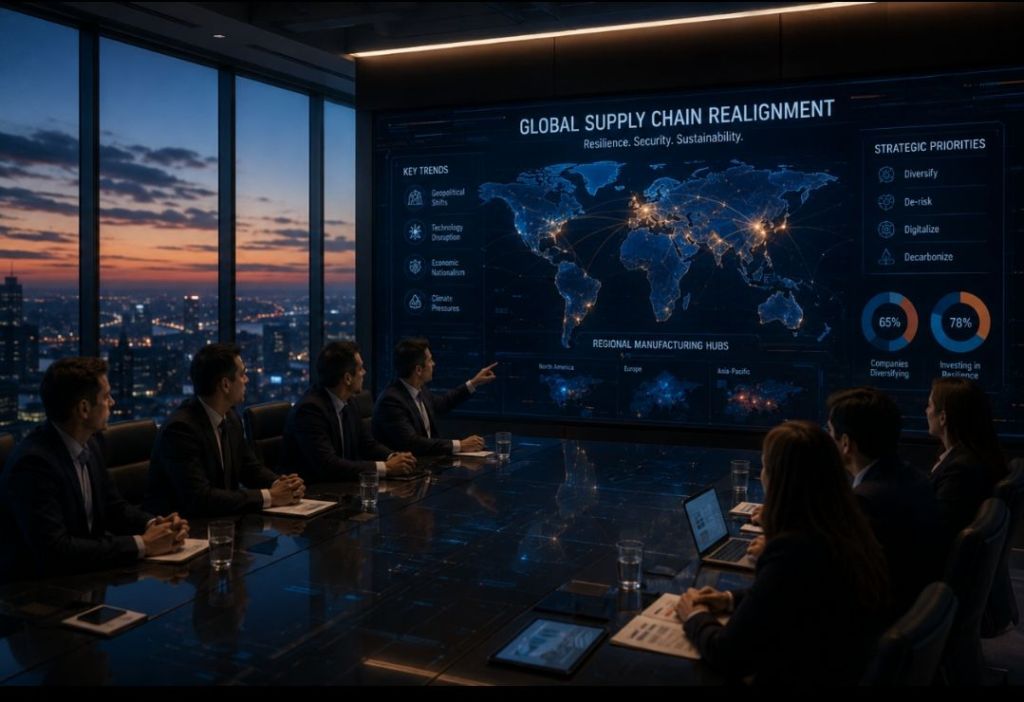
For much of the last four decades, the world economy appeared to move in a predictable direction. Countries specialized according to their strengths, businesses chased efficiency, and global supply chains stretched across continents. The assumption was simple: economics would dominate politics. Today, that assumption is rapidly breaking down. The world is entering a period where strategic interests, national security concerns, technological rivalry, and economic sovereignty increasingly shape trade, investment, and industrial policy. What appears to be a supply-chain adjustment is, in reality, a much deeper restructuring of the global economic order.
From Comparative Advantage to Strategic Advantage
The modern trading system was built on the principle that countries should produce what they do best and trade for the rest. This framework helped lift hundreds of millions out of poverty and accelerated globalization. Yet recent years have revealed the vulnerabilities of excessive dependence on distant suppliers. The pandemic, geopolitical conflicts, semiconductor shortages, energy disruptions, and trade wars exposed how fragile efficiency-driven systems can be.
Today, governments are asking different questions. Instead of asking where products can be produced most cheaply, they are asking where products can be produced most securely. This shift marks one of the most significant transformations in international economics since the end of the Cold War. Supply chains are increasingly being redesigned around resilience, trusted partnerships, and strategic autonomy rather than purely cost considerations.
The Growing Contest for Economic Influence
A new era of great-power rivalry is emerging, where trade, technology, finance, energy, and critical minerals are becoming instruments of geopolitical influence. Nations are investing heavily in domestic manufacturing, strategic industries, artificial intelligence, semiconductors, batteries, and defense-related technologies.
The consequences are visible everywhere. Export controls, sanctions, investment restrictions, technology bans, and industrial subsidies have become common policy tools. Economic relationships that once appeared purely commercial are increasingly viewed through a security lens. The result is a world economy that is becoming more fragmented, more regionalized, and potentially less predictable.
For businesses, this means that geopolitical intelligence is becoming as important as market intelligence. Understanding political risks may soon become a prerequisite for surviving in international trade.
The Emerging Distance Across Traditional Alliances
For decades, many assumed that major Western economies would move in lockstep on economic issues. However, differences are becoming increasingly visible. Debates over industrial subsidies, climate policies, defense spending, digital regulations, and economic sovereignty are creating new tensions among long-standing partners.
While these differences may not fundamentally break alliances, they demonstrate that even close partners are prioritizing domestic economic interests. In an era of slower growth, aging populations, and fiscal pressures, governments are becoming more protective of strategic industries and employment opportunities. Economic nationalism is no longer limited to developing countries; it is increasingly visible across advanced economies as well.
This trend creates uncertainty for global firms attempting to navigate multiple regulatory systems and competing policy priorities. The future may involve overlapping economic blocs rather than a single integrated global marketplace.
The Manufacturing Question and China’s Enduring Influence
No discussion of global supply chains is complete without examining China’s manufacturing ecosystem. Over several decades, China built one of the most comprehensive industrial networks in human history. Its strengths extend far beyond low-cost labor. Deep supplier networks, advanced logistics, infrastructure, skilled workforce availability, and manufacturing scale create advantages that are difficult to replicate quickly.
Many countries and corporations are seeking diversification, yet diversification does not automatically mean replacement. Building alternative manufacturing ecosystems requires enormous investments, policy consistency, skilled human resources, and time. As a result, the global economy may witness a gradual redistribution of production rather than a dramatic exodus from existing manufacturing hubs.
The challenge for competing economies is not merely attracting factories. It is creating complete industrial ecosystems that can innovate, adapt, and compete sustainably over the long term.
India’s Strategic Moment
For India, the changing landscape presents both opportunity and responsibility. The country stands at a unique intersection of demographics, market size, technology capabilities, and geopolitical relevance. Global companies seeking diversification increasingly view India as a potential manufacturing and innovation destination.
However, attracting investment is only the first step. The larger challenge lies in building competitive ecosystems that combine infrastructure, logistics, skilled manpower, research capabilities, quality standards, cluster development, and regulatory efficiency. History shows that manufacturing success is rarely created through incentives alone. It emerges through decades of institution building and industrial learning.
India’s future competitiveness will depend on whether it can transform its large workforce into a highly productive workforce and convert its domestic market into a platform for global innovation.
The Silent Battle for Economic Sovereignty
Perhaps the most important transformation is occurring beneath the surface. Nations are increasingly seeking greater control over critical technologies, data infrastructure, energy systems, financial networks, and strategic resources. Economic sovereignty is becoming a central policy objective.
This does not necessarily mean the end of globalization. Instead, globalization may evolve into a more selective and strategically managed system. Countries will remain interconnected, but they may become more cautious about the areas in which they choose to depend on others.
The next decade may therefore be defined not by the expansion of globalization but by its redesign.
Looking Beyond the Headlines
The headlines often focus on tariffs, trade disputes, or investment announcements. Yet these are only symptoms of a deeper transformation. The global economy is moving from an era defined by efficiency to one increasingly defined by resilience, security, trust, and strategic positioning.
The nations that succeed in this environment will not necessarily be those with the lowest costs. They will be those capable of balancing economic openness with strategic preparedness, innovation with resilience, and growth with long-term national capability.
History may eventually view this period not as a temporary disruption of globalization, but as the beginning of a new economic architecture where power, technology, and production become inseparable. The choices made today by governments, businesses, and institutions will shape the global economic map for generations to come.
#GlobalEconomy #SupplyChains #Geopolitics #IndiaGrowthStory #ManufacturingStrategy #EconomicSovereignty #TradePolicy #IndustrialDevelopment #StrategicEconomics #FutureOfGlobalization


Leave a Reply