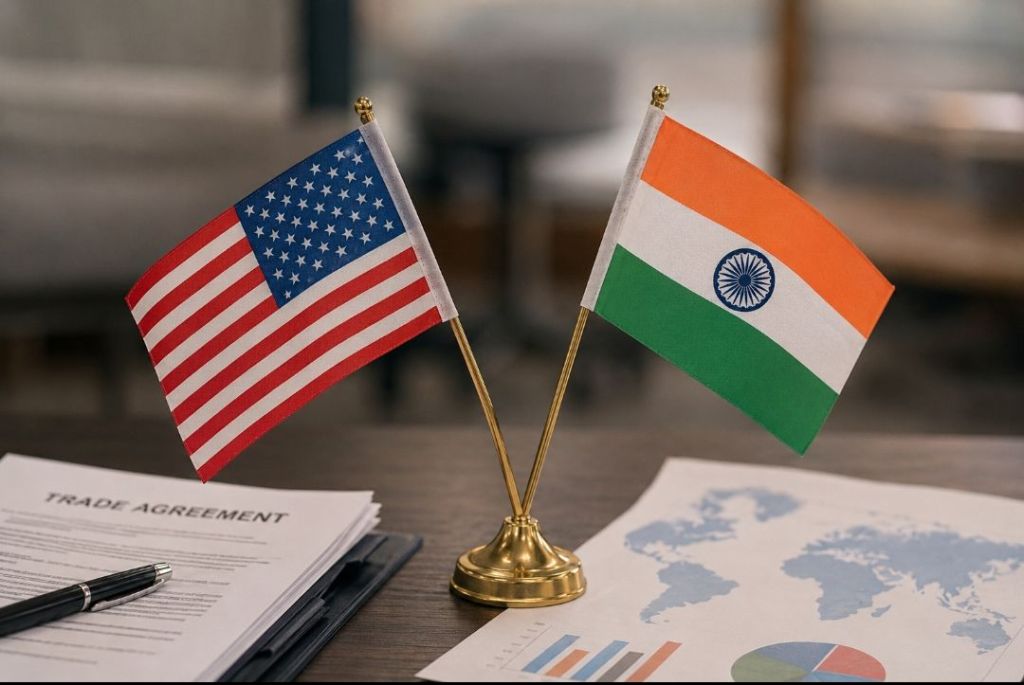
A New Chapter in India–US Economic Relations
Trade negotiations between India and the United States have often moved through cycles of optimism, disagreement, compromise, and strategic recalibration. The latest discussions surrounding the first phase of an India–US trade agreement appear to be following a similar pattern. Yet beneath the headlines lies a much larger story. This is no longer merely a negotiation about customs duties or market access. It is increasingly becoming a negotiation about how economic power, industrial policy, supply chains, technology, and national security will interact in the decades ahead.
The current linkage between the proposed trade arrangement and the United States’ Section 301 investigations demonstrates how trade policy has evolved. What was once largely governed by tariff schedules and market access commitments is now deeply connected with concerns about industrial overcapacity, supply-chain resilience, labor practices, technology transfers, and strategic competitiveness.
From Free Trade to Strategic Trade
Historically, trade agreements were designed to reduce barriers and increase economic efficiency. Countries sought comparative advantages, specialized production, and lower consumer prices. The globalization wave of the 1990s and early 2000s was largely driven by this philosophy.
However, the global economic environment has changed dramatically. The financial crisis of 2008, the pandemic-induced supply-chain disruptions, geopolitical tensions, and the rapid rise of new industrial powers have transformed how governments view trade. Today, economic policy is increasingly shaped by concerns about resilience rather than efficiency alone.
In this changing environment, the India–US trade negotiations represent more than a bilateral arrangement. They reflect a broader effort by both countries to redefine economic cooperation in a world where strategic interests often influence commercial decisions.
The Growing Importance of Section 301
Section 301 investigations have become one of the most influential instruments in American trade policy. Originally designed to address unfair trade practices, they now serve as a broader mechanism through which the United States examines issues ranging from market distortions and industrial subsidies to supply-chain vulnerabilities.
For India, the outcome of these investigations is significant because it may determine whether additional tariffs or trade restrictions emerge. The temporary tariff measures currently under discussion create uncertainty for exporters who require long-term visibility to make investment decisions.
For industries such as engineering goods, chemicals, textiles, electronics, and automotive components, predictability often matters as much as tariff levels themselves. Investors are generally willing to adapt to regulations if they remain stable. Uncertainty, however, discourages investment and expansion.
Why India Wants Faster Progress
India’s interest in concluding an interim trade agreement stems from both economic and strategic considerations. The country is attempting to position itself as a major manufacturing destination at a time when global companies are seeking alternatives to concentrated supply chains.
The opportunity is significant. Multinational firms are increasingly diversifying sourcing locations, reducing dependence on single-country production networks, and looking for politically stable partners. India has emerged as one of the major beneficiaries of this trend.
However, attracting global investment requires more than large domestic markets. Investors compare tariff structures, logistics efficiency, regulatory certainty, labor productivity, and trade access across multiple countries. If competing economies secure more favorable market access arrangements, India’s relative attractiveness could weaken despite its inherent advantages.
This explains the urgency behind efforts to conclude at least the initial phase of a broader agreement.
The Hidden Challenge of Competitiveness
While public debate often focuses on tariffs, the deeper issue for India remains competitiveness.
Even if additional tariffs are avoided, long-term export success will depend on factors such as infrastructure quality, logistics efficiency, innovation capacity, workforce skills, quality certification systems, and regulatory predictability.
Many Indian industries continue to face higher logistics costs than their global competitors. Small and medium enterprises frequently struggle with certification requirements, traceability standards, and compliance obligations that increasingly determine access to international markets.
Therefore, the trade agreement should not be viewed as a substitute for domestic reforms. Rather, it should be seen as an opportunity that can only be fully utilized if structural competitiveness improves simultaneously.
The Parallel Story of India–UK Trade Relations
The ongoing discussions regarding implementation issues in the India–UK trade arrangement reveal another important reality. Modern trade agreements do not end when they are signed.
Issues such as carbon adjustment mechanisms, safeguard measures, sustainability requirements, and sector-specific protections are becoming increasingly common. These measures reflect growing concerns among developed economies regarding climate policy, industrial competitiveness, and employment protection.
For Indian exporters, this signals a future where compliance capabilities may become as important as production capabilities. Market access will increasingly depend not only on price and quality but also on environmental performance, traceability, and adherence to emerging global standards.
The era when exporters competed solely on cost advantages is gradually giving way to an era where compliance advantages can determine success.
Looking Toward 2035
By 2035, global trade may look very different from today’s system. Tariffs are likely to become less important than regulations, standards, digital governance frameworks, carbon accounting systems, and supply-chain transparency requirements.
Trade agreements themselves may evolve into broader economic partnership frameworks covering artificial intelligence, digital commerce, critical minerals, cybersecurity, data governance, clean energy technologies, and advanced manufacturing ecosystems.
In such a world, India and the United States are likely to find increasing areas of cooperation. India’s demographic strength, expanding consumer market, engineering capabilities, and growing digital ecosystem complement America’s technological leadership, innovation capacity, and capital resources.
Yet this partnership will succeed only if both countries move beyond transactional negotiations and create a framework built on long-term strategic trust.
Beyond the Current Negotiations
The significance of the current trade discussions extends far beyond the immediate question of tariffs or market access. What is being negotiated today may influence investment flows, industrial development, technology partnerships, and supply-chain architecture for many years.
The real test is not whether the first phase of the agreement is signed. The real test is whether it helps create a more competitive, innovative, and resilient economic relationship capable of adapting to the profound changes reshaping global commerce.
Trade agreements have traditionally been instruments of economic exchange. In the emerging world order, they are becoming instruments of economic strategy. The India–US negotiations may therefore be remembered not merely as another trade deal, but as an early step in shaping the architecture of a new economic era where competitiveness, resilience, technology, and trust become the defining currencies of international trade.
#IndiaUSTrade
#Section301
#GlobalTradePolicy
#SupplyChainResilience
#StrategicTrade
#ManufacturingCompetitiveness
#TradeNegotiations
#EconomicDiplomacy
#MarketAccess
#FutureOfGlobalTrade


Leave a Reply