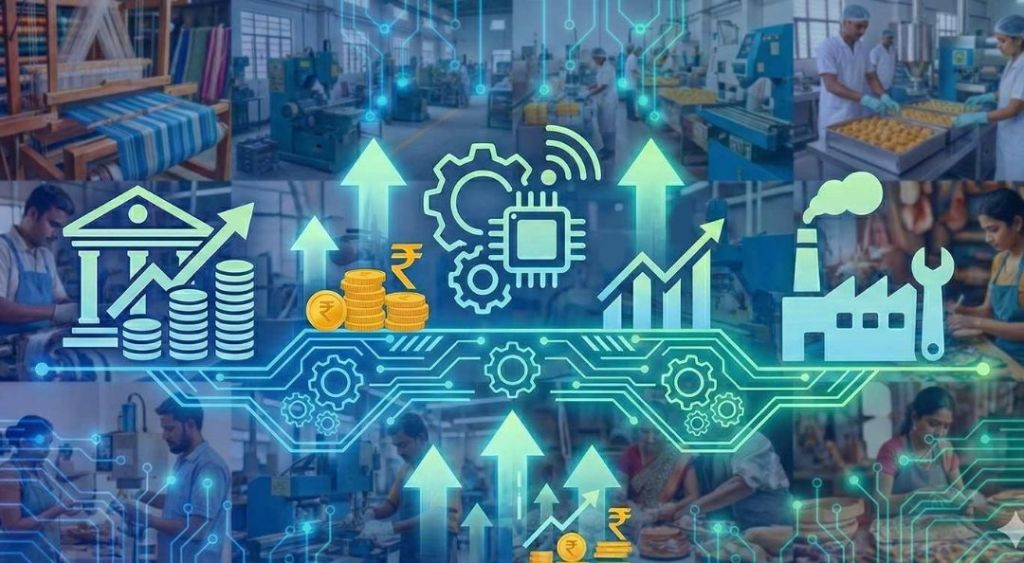
India often celebrates its large corporations, unicorn startups, and rising stock market valuations. Yet the real story of the Indian economy is hidden in small workshops, family-run factories, repair units, local service providers, artisans, food processors, and thousands of enterprises operating in industrial estates, villages, and market towns. These Micro, Small and Medium Enterprises are not merely business entities. They are the livelihood engines of millions of families and the social glue holding together local economies across the country.
The journey of Indian MSMEs has been remarkable. For decades they have survived despite limited resources, complicated regulations, infrastructure bottlenecks, and intense competition. They have adapted through ingenuity rather than capital. Many have succeeded because of entrepreneurial courage rather than institutional support. However, the challenges confronting them today are fundamentally different from those of the past.
The Productivity Question Nobody Wants to Discuss
A difficult reality lies beneath the impressive numbers often associated with the MSME sector. While the sector contributes significantly to employment and economic activity, a large proportion of enterprises continue to operate with relatively low productivity levels. Many businesses still depend on outdated machinery, informal management practices, and limited use of digital technologies.
Historically, low labour costs helped compensate for technological shortcomings. That advantage is gradually shrinking. As global markets become increasingly driven by automation, precision manufacturing, artificial intelligence, and data-driven decision-making, productivity gaps become more visible and more costly.
The challenge is no longer simply producing goods at a lower cost. The challenge is producing better products, faster, more consistently, and with greater adaptability. In this new environment, efficiency becomes a survival requirement rather than a competitive advantage.
Finance Remains Available, But Not Equally Accessible
Over the years India has introduced numerous schemes aimed at improving access to finance for MSMEs. Credit guarantees, priority sector lending, fintech innovations, digital lending platforms, and government support mechanisms have expanded the availability of financial resources.
Yet the reality on the ground remains uneven. Many enterprises continue to face difficulties obtaining affordable working capital. Smaller firms, especially those operating outside major industrial centres, often struggle with collateral requirements, delayed payments, and inadequate financial documentation.
For many entrepreneurs, the problem is not simply the absence of credit. The problem is obtaining the right credit at the right time and at a cost that allows the business to remain competitive. In an increasingly fast-moving marketplace, delayed finance can be as damaging as no finance at all.
The Missing Bridge Between Production and Markets
One of the most overlooked weaknesses of Indian MSMEs is not production capability but market connectivity. Across the country there are enterprises capable of producing excellent products, yet many remain invisible beyond their local markets.
Quality standards, packaging, branding, certification, digital marketing, logistics management, and export readiness continue to pose significant barriers. A product that succeeds in a district market may not automatically succeed in a national or international marketplace.
The future will reward businesses that can tell compelling stories about their products, demonstrate traceability, maintain quality consistency, and build consumer trust. Manufacturing alone will not be enough. Market intelligence and brand building will become equally important assets.
The Forgotten Power of Clusters
Perhaps one of India’s most underutilized development tools is the cluster approach. History demonstrates that industrial success rarely emerges in isolation. Successful economies across the world have benefited from networks of interconnected enterprises, suppliers, service providers, training institutions, and knowledge centres operating within concentrated geographic regions.
India possesses hundreds of natural industrial clusters, from textiles and handicrafts to engineering and food processing. Yet many remain fragmented and under-supported. Enterprises often compete with one another when collaboration could create greater collective strength.
The future may belong not to individual firms but to ecosystems. Clusters that successfully integrate technology providers, financial institutions, universities, testing laboratories, logistics providers, and market access platforms could become the real engines of regional economic transformation.
The New Threat Is Not Competition, But Distance From Technology
The next decade may witness a widening divide between enterprises that embrace technology and those that do not. Artificial intelligence, advanced manufacturing, robotics, predictive maintenance, digital commerce, and supply chain analytics are becoming increasingly accessible to larger firms.
For smaller enterprises, however, the adoption journey remains uneven. The risk is not that technology will replace MSMEs. The greater risk is that technology will create a productivity gap so large that smaller enterprises become progressively less competitive.
This technological divide may become one of the most important economic fault lines in India. Firms that fail to adapt may find themselves excluded from modern supply chains, export markets, and procurement networks.
Compliance: The Invisible Cost of Doing Business
Another challenge emerging globally is the growing complexity of compliance requirements. Environmental standards, labour regulations, sustainability reporting, product traceability, cybersecurity requirements, and quality certifications are becoming central features of global commerce.
While these standards are often necessary and beneficial, they can create disproportionate burdens for smaller enterprises. Large corporations typically possess dedicated compliance teams. Small businesses often rely on the owner to manage production, finance, marketing, human resources, and regulatory obligations simultaneously.
The danger is that compliance may evolve into a hidden barrier that excludes smaller players from high-value markets. Without adequate support systems, many MSMEs could find themselves locked out of opportunities despite producing competitive products.
Looking Toward 2040
The future of Indian MSMEs will not be determined solely by government schemes or financial incentives. It will depend on how effectively India builds productive enterprises, technology-enabled ecosystems, collaborative clusters, and globally connected local economies.
The coming years will test whether India’s MSME sector can move from survival entrepreneurship to growth entrepreneurship. The difference is profound. Survival businesses create livelihoods. Growth businesses create prosperity, innovation, and long-term competitiveness.
The story of India’s economic rise will ultimately be written not only in boardrooms of large corporations but also in small factories, workshops, and enterprises spread across thousands of towns and villages. If these enterprises become globally competitive, India’s growth story could become far more inclusive and resilient. If they remain trapped in low-productivity cycles, the nation may continue growing while leaving a significant portion of its economic potential unrealized.
The future of India’s MSMEs is therefore not merely a business issue. It is one of the defining questions of India’s development journey in the twenty-first century.
#MSMEDevelopment #ClusterDevelopment #IndianEconomy #ManufacturingCompetitiveness #ProductivityGrowth #DigitalTransformation #ExportReadiness #Entrepreneurship #IndustrialClusters #FutureOfWork


Leave a Reply