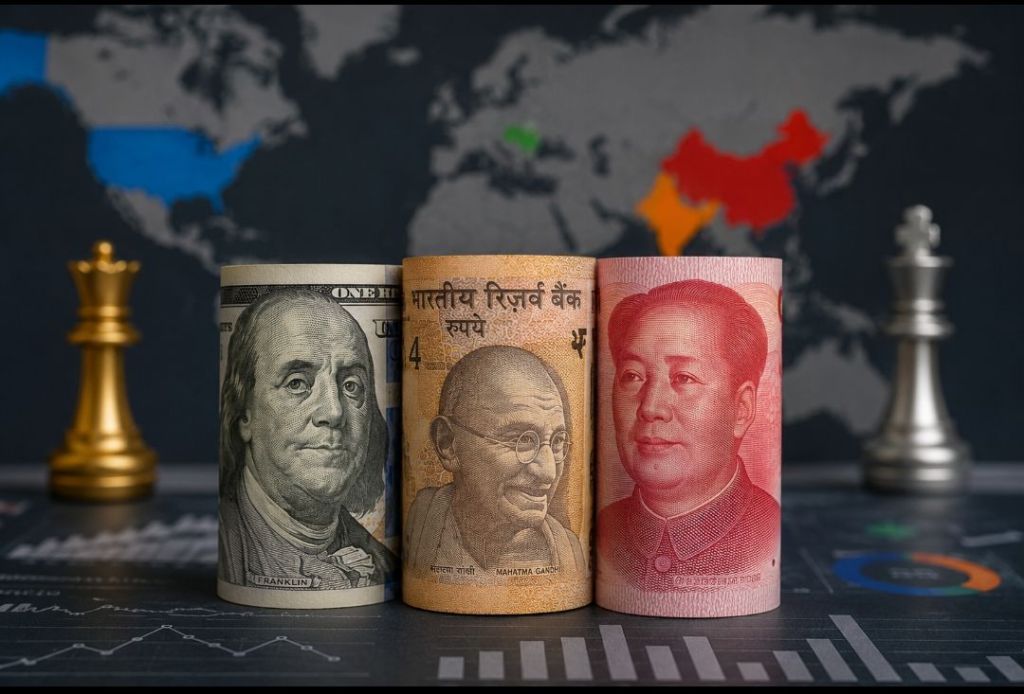
For decades, currencies were treated largely as economic instruments linked to trade balances, inflation control, and monetary stability. Today, currencies are slowly transforming into geopolitical weapons. Exchange rates are no longer merely numbers decided by markets or central banks. They are becoming instruments of strategic influence, economic pressure, export competitiveness, and even diplomatic signalling. The global economy is entering a phase where the battle for economic dominance is increasingly being fought through currencies, payment systems, sanctions, and financial networks rather than only through traditional military or trade conflicts.
The post-Second World War global order created a financial architecture dominated by the US dollar. The Bretton Woods system and later the rise of globalized finance allowed the dollar to become the backbone of international trade, oil settlements, sovereign reserves, and global debt markets. Even after the formal gold link was broken in the 1970s, the dollar remained dominant because of the strength of the American economy, military influence, deep financial markets, and global trust in US institutions. This dominance allowed the United States to enjoy enormous strategic advantages. America could finance deficits more easily, influence global liquidity conditions, and impose sanctions with extraordinary reach. The global financial system effectively became interconnected with US geopolitical priorities.
Today, however, the world is showing signs of discomfort with excessive dollar dependence. Countries facing sanctions, geopolitical tensions, or trade vulnerabilities are exploring alternatives. Discussions around de-dollarisation are increasing across Asia, the Middle East, Latin America, and parts of Africa. China is strategically expanding yuan-based trade settlements, especially through energy deals, Belt and Road partnerships, and bilateral currency arrangements. Russia accelerated non-dollar trade mechanisms after Western sanctions. Gulf economies are increasingly experimenting with local currency trade settlements. Yet despite all these discussions, the reality remains that the dollar continues to dominate because no alternative currently possesses the same combination of liquidity, trust, legal depth, military backing, and financial integration.
This contradiction is creating a highly unstable transition period. The world wants diversification away from the dollar, but it lacks confidence in alternatives. The euro faces political fragmentation risks. The yuan remains constrained by capital controls and concerns over transparency. Emerging market currencies lack scale and trust. As a result, global investors still rush toward the dollar during crises, reinforcing the very dominance many countries seek to reduce. This creates a paradoxical global system where criticism of dollar hegemony coexists with continued dependence on it.
India finds itself in a particularly delicate position within this changing currency order. The Indian economy is deeply integrated into global trade and capital flows, yet it also seeks strategic autonomy. The Reserve Bank of India is continuously balancing inflation management, growth stability, foreign capital volatility, and exchange-rate pressures. This balancing act is becoming increasingly difficult in a world where currencies are affected not only by economic fundamentals but also by geopolitical tensions, wars, sanctions, and global interest-rate divergence.
India’s strong foreign exchange reserves provide an important psychological and financial cushion. They improve investor confidence and help the RBI manage excessive volatility in the rupee. However, reserves are not a permanent shield. They reduce vulnerability but cannot completely isolate India from global dollar cycles. Whenever the US Federal Reserve raises interest rates aggressively, global capital tends to move toward dollar assets, putting pressure on emerging-market currencies including the rupee. India may have stronger macroeconomic fundamentals than many countries, but it still operates within a dollar-centric financial system.
The weakening of the rupee itself reflects a complex economic reality. A weaker currency can support exports by making Indian goods cheaper globally. Sectors like IT services, pharmaceuticals, textiles, and some manufacturing industries may benefit in the short term. But the gains are neither automatic nor equally distributed. India remains heavily dependent on imports for crude oil, advanced electronics, semiconductors, industrial machinery, and strategic inputs. A weak rupee therefore increases import costs, raises production expenses, widens inflationary pressure, and affects ordinary citizens through higher fuel, transport, and food costs.
This is where the political economy of currency management becomes deeply human. Currency depreciation is not only a technical issue discussed in central bank reports. It affects the daily life of workers, small businesses, farmers, students studying abroad, and middle-class households managing rising living costs. Inflation caused by imported commodities quietly reduces purchasing power. Small manufacturers dependent on imported inputs face squeezed margins. Families paying education fees abroad experience financial stress. Currency volatility gradually enters the emotional and social fabric of economic life.
The future may become even more volatile because the world is entering an era of fragmented monetary systems. Interest-rate divergence among major economies is widening. Geopolitical conflicts are disrupting trade routes and energy markets. Financial sanctions are altering global payment systems. Artificial intelligence and digital finance are accelerating the speed of speculative capital movements. Even social media narratives can trigger rapid investor reactions and currency fluctuations within hours.
The rise of digital currencies and central bank digital currencies may further reshape the geopolitical role of money. China is aggressively experimenting with the digital yuan. Many governments are exploring sovereign digital currencies to reduce transaction dependence on Western-controlled payment systems. In the future, currency competition may not only be about paper money or exchange rates but also about digital payment ecosystems, data control, and technological infrastructure. The country controlling payment architecture may eventually hold strategic influence comparable to military alliances.
India has important opportunities in this transition but also serious risks. The country has demonstrated remarkable success in digital public infrastructure through systems like UPI and Aadhaar-linked financial inclusion. If strategically integrated with international payment networks, India could emerge as an important player in regional financial connectivity. However, technological capability alone will not be sufficient. Currency strength ultimately depends on manufacturing depth, export competitiveness, innovation ecosystems, institutional credibility, energy security, and long-term investor confidence.
One of the biggest structural challenges for India is that its economic aspirations remain larger than its industrial base. A strong currency is rarely built only through monetary management. Historically, strong currencies emerged from strong productive economies. The US dollar rose alongside American industrial power. Germany’s economic strength supported the euro’s credibility. China’s yuan ambitions are linked to manufacturing dominance and trade integration. India cannot aspire for greater currency influence without significantly expanding its industrial productivity, technological capability, and export sophistication.
The coming decade may therefore witness an increasingly dangerous currency environment globally. Competitive devaluations, sanctions-based financial warfare, capital-flow instability, and geopolitical fragmentation could make currencies central to strategic conflict. The risk is that countries may begin prioritizing short-term exchange-rate advantages over long-term productive reforms. This could create repeated cycles of inflation, debt stress, and financial instability across developing economies.
The deeper issue is that the global financial system is slowly losing neutrality. Financial systems are becoming instruments of power. Currency trust is increasingly tied to geopolitical alignment. The future global order may no longer operate through one universally accepted economic system but through competing financial blocs. In such a fragmented world, countries like India will have to walk a very careful path between strategic autonomy and global integration.
India’s long-term currency stability will not depend only on RBI interventions or reserve accumulation. It will depend on whether the country can build a resilient economic ecosystem capable of reducing excessive import dependence, expanding high-value exports, strengthening technological sovereignty, and creating confidence in its institutional and financial systems. The future of the rupee will ultimately reflect the future of India’s economic structure itself.
#CurrencyWars #Rupee #DollarDominance #DeDollarisation #IndianEconomy #ForexReserves #Geopolitics #GlobalTrade #MonetaryPolicy #EconomicNationalism


Leave a Reply