India–UAE Economic Partnership: Opportunity or Strategic Dependency?
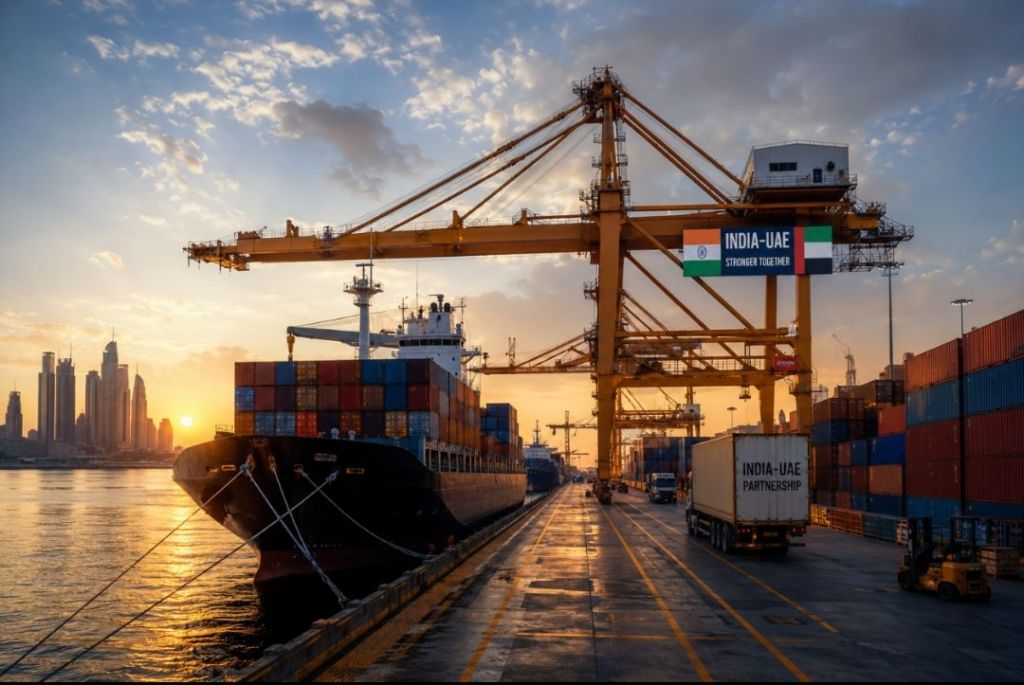
The India–United Arab Emirates economic relationship is entering a new phase where trade is no longer only about oil, gold, or remittances. It is now moving toward strategic investments, logistics corridors, ports, digital infrastructure, food systems, energy transition, and sovereign wealth participation. At first glance, this appears to be a major success story of India’s economic diplomacy. Bilateral trade between India and the UAE has expanded rapidly after the Comprehensive Economic Partnership Agreement, and both countries increasingly describe each other as long-term strategic partners. Yet beneath the optimism lies a deeper and more complicated question. Is India building a balanced strategic partnership, or is it gradually becoming dependent on external capital and logistics systems controlled outside its borders?
From Oil Relationship to Strategic Economic Architecture
Historically, India’s relationship with the Gulf was shaped by crude oil imports and migrant labour. Millions of Indian workers contributed to the growth of Gulf economies, while remittances supported Indian households and foreign exchange reserves. The relationship was transactional and largely resource-driven. However, the global economic order is changing rapidly. Oil alone can no longer define geopolitical influence. Logistics networks, ports, digital payments, food security systems, artificial intelligence, renewable energy corridors, and sovereign investment funds are becoming the new instruments of global power.
The UAE has understood this transformation earlier than many countries. Dubai and Abu Dhabi are no longer positioning themselves only as energy centres. They are trying to become global gateways connecting Asia, Africa, and Europe through finance, logistics, aviation, technology, and trade infrastructure. India, with its massive market and rising manufacturing ambitions, naturally becomes an important partner in this strategy.
But the critical issue is this: partnerships between unequal economic systems often create hidden structural imbalances. The UAE brings enormous capital power, highly efficient logistics systems, tax advantages, and globally integrated investment networks. India brings scale, labour, markets, and consumption demand. If India does not build its own institutional and industrial capacities simultaneously, the relationship may gradually shift from partnership to dependency.
Private Sector Deals: Real Growth or Corporate Concentration?
The increasing emphasis on private sector-led partnerships sounds attractive because governments alone cannot finance future growth. Joint investments in logistics, ports, warehousing, renewable energy, food processing, fintech, and urban infrastructure may indeed create jobs and improve connectivity. However, there is another side to this story that policymakers rarely discuss openly.
When large global investors enter emerging economies, economic gains are often concentrated among a few corporate groups capable of handling large-scale capital integration. Small manufacturers, MSMEs, artisans, and local logistics players frequently become peripheral participants in systems they do not control. India already faces growing concentration of economic power among a handful of domestic conglomerates. Foreign strategic capital partnerships may accelerate this concentration further.
The risk is particularly serious in logistics and infrastructure. Whoever controls logistics controls trade efficiency, pricing power, data flows, and long-term economic influence. Ports, freight corridors, warehousing systems, and digital trade platforms are not merely commercial assets anymore. They are strategic assets linked to national sovereignty. If India becomes excessively dependent on foreign-controlled logistics ecosystems, future economic policymaking may become constrained by external commercial interests.
Logistics Connectivity and the New Geography of Power
The twenty-first century global economy is increasingly being shaped by corridors rather than countries. Trade routes, maritime hubs, digital networks, and supply chain alliances are becoming more important than traditional political boundaries. The India-UAE relationship fits directly into this emerging geopolitical architecture.
Projects linking India with the Middle East and Europe through ports, rail systems, shipping routes, and industrial corridors are often projected as engines of prosperity. Yet history teaches that control over trade routes has always translated into political and economic leverage. Colonial powers once controlled sea routes to dominate trade. Today, advanced logistics systems and digital trade ecosystems may play a similar role in a more sophisticated form.
India must therefore ask difficult questions. Will these partnerships help Indian industries move up the value chain, or will India remain primarily a market and labour base within externally controlled trade systems? Will Indian MSMEs integrate into global supply chains meaningfully, or will they become low-margin subcontractors dependent on large intermediaries? Without deliberate policy intervention, the benefits may remain highly uneven.
Energy Transition and Strategic Realignment
Another major factor shaping India-UAE relations is the global energy transition. The world is gradually shifting from hydrocarbons toward renewable energy, green hydrogen, battery systems, and carbon-conscious industrial systems. Gulf countries understand that long-term oil dependence is risky. They are aggressively diversifying into technology, logistics, tourism, manufacturing, and global investments.
India simultaneously requires massive investments for energy infrastructure, smart cities, ports, data centres, and manufacturing ecosystems. This creates natural convergence. However, energy transition itself may create a new form of dependency. Countries that control clean energy financing, rare minerals, hydrogen supply chains, and green logistics may dominate the next global order.
India’s challenge is therefore not merely attracting investment. The real challenge is ensuring technological absorption, local ecosystem creation, domestic innovation, and long-term strategic autonomy. If India imports both capital and technology without developing indigenous capabilities, it may repeat earlier development patterns where growth occurred without deep technological sovereignty.
The Silent Question of Labour and Human Capital
An uncomfortable but important reality also remains hidden beneath the celebration of bilateral trade. Much of the India-Gulf relationship has historically relied on Indian labour migration. Millions of Indians contributed to Gulf construction, services, transport, healthcare, and domestic work sectors. Remittances strengthened Indian households, but the migration story also reflected India’s inability to generate sufficient high-quality domestic employment.
The future relationship must therefore move beyond labour export dependence. India cannot become a major economic power merely by supplying manpower to wealthier economies. The real success of India-UAE economic cooperation will depend on whether it creates advanced manufacturing, innovation systems, research collaboration, startup ecosystems, and skill-intensive industries inside India itself.
Otherwise, India risks remaining trapped in a dual economic structure where domestic job quality remains weak while external capital shapes internal development priorities.
The Future: Strategic Partnership or Strategic Vulnerability?
The India-UAE partnership has enormous potential. It can accelerate investments, improve infrastructure, strengthen energy cooperation, expand exports, and create global connectivity. But the success of this partnership will not depend on trade numbers alone. It will depend on who controls value chains, who owns strategic infrastructure, who captures technology, and who shapes the rules of future economic integration.
The coming decade may witness intense competition over trade corridors, digital systems, food security chains, maritime infrastructure, and artificial intelligence-linked commerce. In such a world, economic partnerships cannot be viewed only through the lens of short-term investment inflows. They must also be evaluated through the lens of sovereignty, resilience, employment quality, and technological independence.
India stands at a crucial turning point. If it negotiates strategically, strengthens MSMEs, deepens industrial ecosystems, builds domestic technological capacity, and ensures balanced participation, the UAE partnership could become a model of twenty-first century economic cooperation. But if policy becomes excessively focused on headline investment announcements without strengthening local economic foundations, India may slowly discover that integration without institutional preparedness can create vulnerabilities that are difficult to reverse.
The real debate therefore is not whether India and the UAE should cooperate. The real debate is whether India is building a partnership of equals or entering a future where strategic economic dependence quietly replaces economic diplomacy.
#IndiaUAE #EconomicDiplomacy #TradeCorridors #LogisticsEconomy #StrategicInvestment #MSME #SupplyChains #EnergyTransition #Geoeconomics #EconomicSovereignty


Leave a Reply