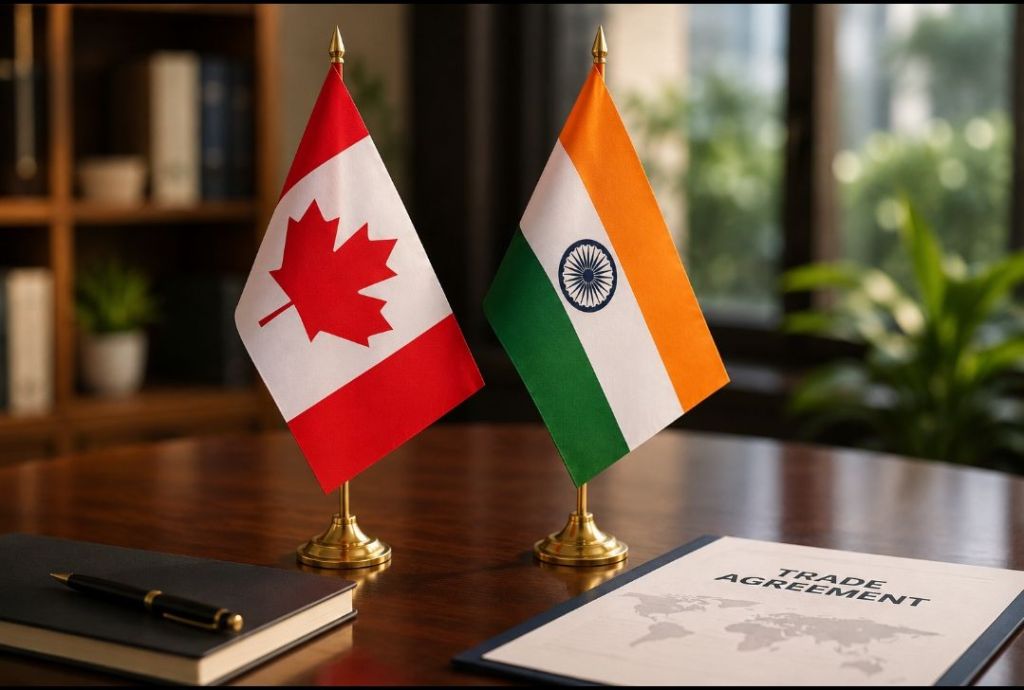
The renewed attempt by India and Canada to conclude a trade agreement before the end of the year reflects far more than a normal Free Trade Agreement negotiation. It reflects the changing psychology of the global economy itself. Countries are no longer entering trade partnerships merely for tariff reduction. They are now searching for strategic insurance in a fractured world economy where geopolitics, migration politics, technology control, energy security, and supply-chain resilience are becoming more important than traditional theories of comparative advantage.
The proposed India–Canada Comprehensive Economic Partnership Agreement appears optimistic on the surface. Bilateral trade currently remains modest for two large economies, standing below 10 billion dollars, while leaders are discussing ambitions of touching 50 billion dollars by 2030. But beneath this optimism lies a much deeper structural question. Can two democracies with repeated political trust deficits truly build a long-term economic partnership in an era where economics itself is increasingly becoming political warfare?
Trade Agreements Are No Longer About Trade Alone
Historically, Free Trade Agreements were designed to improve market access, reduce tariffs, and create efficiencies in production and exports. But the current generation of trade agreements has evolved into geopolitical instruments. The India–Canada negotiations must therefore be understood within the larger restructuring of global economic alliances.
The world after the pandemic, the Russia-Ukraine conflict, Red Sea disruptions, technology wars, and the strategic competition between the United States and China has fundamentally changed the meaning of economic cooperation. Countries now seek trusted supply-chain partners rather than merely low-cost producers. Political alignment increasingly determines economic alignment.
India is strategically important because global firms want alternatives to China. Canada is strategically important because it possesses critical minerals, advanced agriculture systems, energy resources, and a highly educated innovation ecosystem. On paper, the partnership looks naturally complementary. But the challenge lies in execution, trust, and long-term strategic consistency.
The Real Driver Is Strategic Supply Chains
The most important aspect of the India–Canada partnership is not textiles or seafood exports. It is the future of strategic supply chains.
Canada possesses reserves of lithium, cobalt, nickel, and rare earth minerals that are critical for electric vehicles, semiconductors, renewable energy systems, and advanced manufacturing. India, meanwhile, is trying to rapidly position itself as a manufacturing and technology hub under its Make in India and Production Linked Incentive strategies.
This creates a natural convergence. India needs resources. Canada needs manufacturing partnerships and market diversification. But the uncomfortable truth is that global competition over critical minerals is becoming increasingly aggressive. Major powers are treating mineral access as a national security issue rather than a commercial activity.
In the coming decade, countries controlling minerals, logistics routes, semiconductor ecosystems, and digital payment infrastructure may become more influential than countries merely controlling oil reserves.
The Silent Battle Over Technology and Digital Systems
One of the most revealing observations in the discussion was the mention of bringing India’s UPI system to Canada. This may look like a simple fintech cooperation proposal, but it represents something much larger.
Digital payment systems are becoming instruments of economic sovereignty. India’s digital public infrastructure model has emerged as one of the few globally scalable alternatives to Western platform-driven systems. UPI is no longer just a payment mechanism. It is becoming part of India’s soft economic diplomacy.
If Indian digital systems begin integrating internationally, it could gradually increase India’s influence in global fintech architecture. But this also creates strategic risks. Data governance, cybersecurity, digital taxation, financial surveillance, and platform control will become contentious issues.
The future economic battlefield may not only involve goods moving across borders. It may involve data, algorithms, digital identities, and payment ecosystems competing for global dominance.
Canada Needs India More Than Before
Canada’s economic dependence on a limited number of markets is increasingly becoming risky. Slowing global demand, tensions with China, and changing North American trade equations are forcing Canada to diversify its economic relationships.
India offers demographic strength, a large consumption base, growing digital infrastructure, and expanding manufacturing ambitions. Canadian universities, agri-food companies, pension funds, and clean-energy investors all see long-term opportunities in India.
But India must remain cautious about becoming merely a market destination. The country has historically signed agreements where imports rise faster than exports, hurting domestic manufacturing ecosystems. India’s experience with earlier trade liberalisation still carries scars in sectors where local industries struggled against cheaper imports.
This is why future trade agreements cannot simply focus on lowering tariffs. India must negotiate from the perspective of technology transfer, domestic value addition, employment generation, skill development, and supply-chain localisation.
The Political Relationship Remains Fragile
Perhaps the most critical issue is the political undercurrent behind the negotiations. The past two years witnessed serious tensions between the two countries. While both governments are now trying to stabilise relations, trust restoration takes far longer than diplomatic statements suggest.
Modern global economics increasingly depends on political predictability. Investors seek stability, not uncertainty. Businesses fear sudden regulatory shifts, diplomatic confrontations, or visa restrictions.
The statement that relationships must be nurtured like marriages may sound diplomatic, but it also indirectly reveals the fragility of the current situation. Economic agreements without political stability often fail to achieve their real potential.
India Must Avoid the Trap of Export Dependency
There is another deeper structural risk. India is aggressively pursuing multiple Free Trade Agreements simultaneously with the hope of boosting exports and attracting investment. While this may improve short-term growth, excessive dependence on external markets can also create vulnerabilities.
The world economy itself is slowing. Protectionism is rising. Developed countries increasingly use environmental standards, labour standards, carbon border taxes, and strategic regulations as non-tariff barriers. Even friendly nations protect their own industries when domestic political pressure rises.
India therefore needs a balanced strategy. Export growth is important, but domestic industrial resilience is even more important. An economy of India’s size cannot depend entirely on external demand for long-term stability.
The Future Will Be Built Around Trusted Economic Corridors
The India–Canada trade discussions reflect a broader transformation taking place globally. The next phase of globalisation may not be fully global at all. It may evolve into clusters of trusted economic corridors based on political alignment, technology compatibility, resource security, and strategic trust.
Countries that can combine manufacturing, digital systems, critical minerals, talent mobility, and geopolitical credibility will dominate the next economic order.
India has a historic opportunity to emerge as one of those pivotal economies. But success will depend not on signing agreements quickly, but on negotiating intelligently, strengthening domestic competitiveness, investing in institutional capacity, and protecting long-term strategic interests.
The real question is not whether India and Canada can sign a trade agreement before year-end.
The real question is whether both countries can build an economic relationship strong enough to survive the unstable and politically fragmented global economy that is rapidly emerging before our eyes.
#India #Canada #FTA #TradePolicy #GlobalEconomy #EconomicDiplomacy #SupplyChains #CriticalMinerals #DigitalEconomy #Geopolitics
 "Connecting communities, empowering nations: Unifying the Regional and Global Economy ."
Leave a comment