Category: GDP
-

The Global Middle-Class Squeeze: When Progress Stops Feeling Like Progress
The Class That Made Modern Capitalism Stable The great economic achievement of the twentieth century was not simply mass production. It was the creation of mass economic security. Industrialisation produced factories, but rising wages, affordable housing, public education, pensions, healthcare systems and expanding consumer credit gradually created something politically even…
-
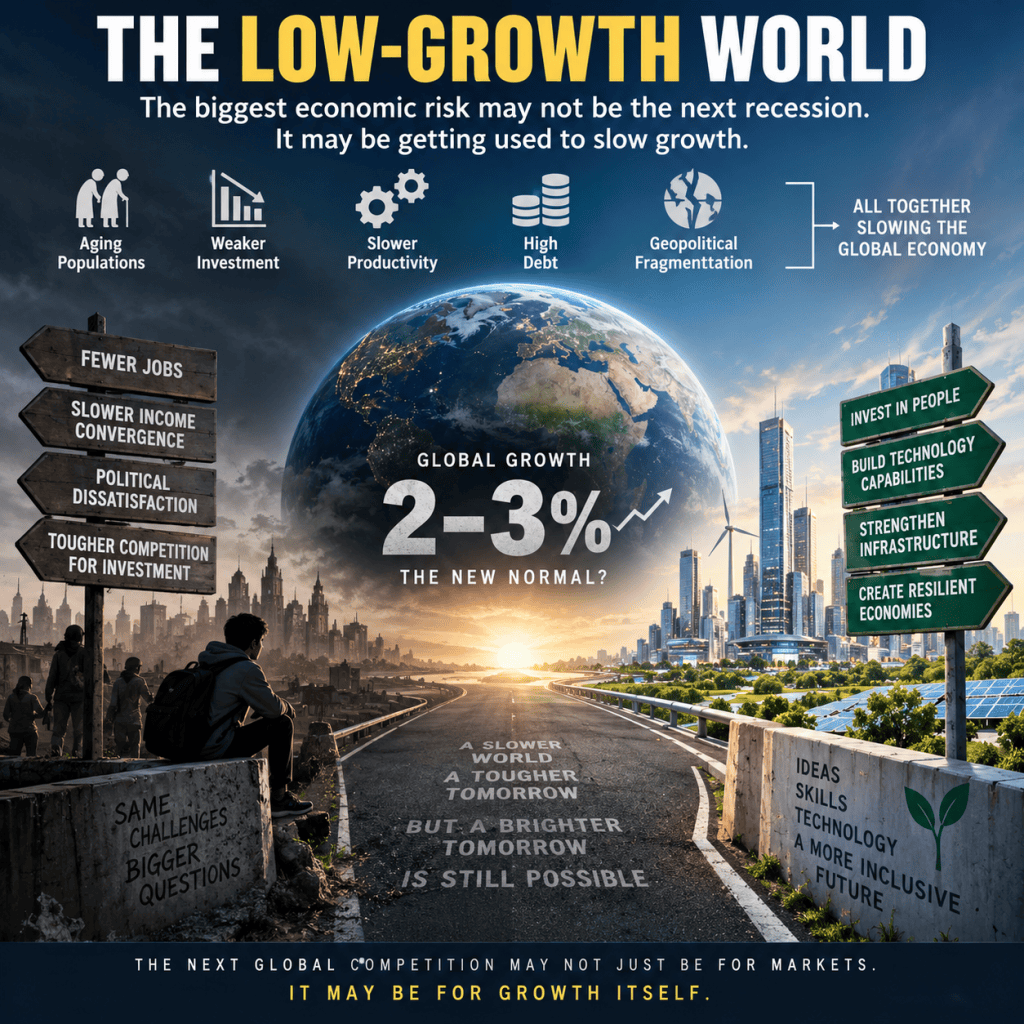
The Low-Growth World: When 2–3 Percent Becomes the New Normal
The danger is not recession. It is normality. For much of modern economic history, weak growth was treated as a temporary problem. Economies slowed, governments responded, interest rates changed, investment returned and another expansion began. The more uncomfortable possibility facing the world today is different. What if slow growth is…
-
When Economic Power Becomes More Valuable Than Economic Growth
Every generation believes that bigger companies are a sign of a stronger economy. History often supports that belief. Large corporations have built railways, automobile industries, telecommunications networks, pharmaceutical giants and digital platforms that transformed entire nations. Scale has always helped reduce costs, improve productivity and attract investment. But history also…
-
The Productivity Crisis: Growth Without Efficiency Is a Dangerous Illusion
Economic growth often dominates headlines because rising GDP creates the impression that a nation is moving forward. But history repeatedly reminds us that growth alone does not guarantee prosperity. Behind every successful economy lies one invisible force that determines long-term success: productivity. Countries become richer not simply because they produce…
-
India and the Fear of Recession in 2026
The discussion around whether India is moving towards a recession in 2026 reflects a deeper anxiety about the changing global economic order rather than an immediate collapse of the Indian economy itself. Historically, India has faced multiple moments where fears of economic slowdown created psychological uncertainty among businesses, investors, and…
-
The Cost of Missing Vision, Strategy and Policy in Indian Economic Development
India has often achieved growth despite policy complexity, institutional fragmentation, and strategic inconsistency rather than because of a fully aligned long-term economic vision. The country has repeatedly demonstrated entrepreneurial energy, demographic strength, and technological adaptability, yet many opportunities have either arrived late, remained incomplete, or failed to scale due to…
-
AI and India’s Next Growth Curve: Why the Next Five Years Will Redefine the GDP Trajectory
By 2026, the global economy has reached an inflection point where AI is no longer a competitive advantage—it’s the baseline for competitiveness. Countries that embed AI into production, governance, and services will outpace those that lag. As the world recalibrates supply chains, labour markets, and digital governance around AI, GDP…
-
India’s Growth Frontier in a Fragmented World: A Critical Outlook Based on Economic Survey 2025–26
India enters FY26-27 at a rare intersection of structural stability and global turbulence. Chapter 1 of the Economic Survey 2025-26, “State of the Economy: Pushing the Growth Frontier,” captures this paradox sharply: while the world remains caught between tariff wars, geopolitical realignments, and supply-chain volatility, India’s domestic engines continue to…
-
The End of Easy Growth
Global business is moving into a structurally different phase—one where growth is slower, shocks are more frequent, and predictability is scarce. The post-Cold War era of liberalized trade, abundant liquidity, and volume-driven expansion is fading. In its place is an economy shaped by tighter monetary conditions, fragmented geopolitics, and policy…
-
The US Economy in 2025: A Surge, a Slowdown, and a Strategic Crossroads
The United States entered late-2025 on a surprising note: GDP growth accelerated to 4.3% (annualized) in Q3, the strongest pace in two years and far above market expectations. This resurgence—impressive on the surface—comes after a volatile period marked by policy reversals, tariff redesigns, and recession anxieties. Historically, such late-cycle surges…

