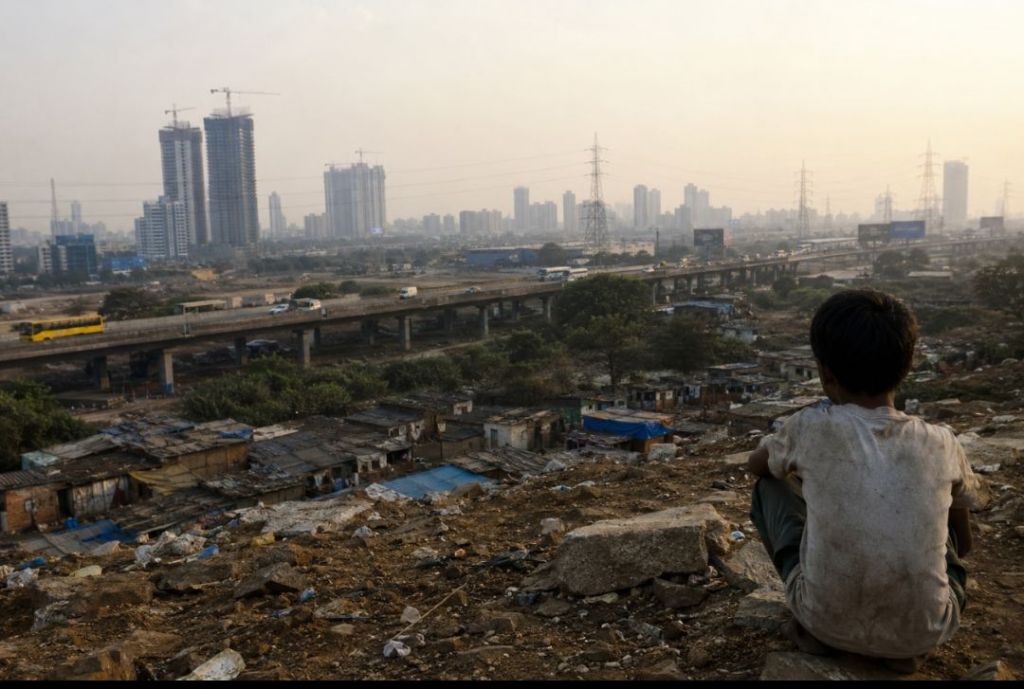
India has often achieved growth despite policy complexity, institutional fragmentation, and strategic inconsistency rather than because of a fully aligned long-term economic vision. The country has repeatedly demonstrated entrepreneurial energy, demographic strength, and technological adaptability, yet many opportunities have either arrived late, remained incomplete, or failed to scale due to the absence of continuity between vision, strategy, and execution. The real cost of this gap is not only measured in GDP numbers. It is visible in lost manufacturing ecosystems, unstable investment cycles, uneven regional development, weak urban planning, import dependence, unemployment pressures, and delayed institutional transformation.
The Historical Burden of Reactive Development
Since independence, India has moved through multiple economic phases without always building continuity between them. The early decades focused heavily on state-led industrialisation and public sector dominance. While this created foundational industries and scientific institutions, excessive licensing and regulatory controls slowed competitiveness. The liberalisation reforms of 1991 transformed the economy and unleashed private sector energy, but reforms remained uneven across sectors and states.
India became globally respected in IT services, pharmaceuticals, and space technology, yet manufacturing never reached the scale seen in countries like China, South Korea, or Vietnam. Large policy ambitions were often announced, but institutional coordination remained weak. Economic direction frequently changed with political cycles, administrative reshuffles, or global shocks. This created uncertainty for investors and industries.
The Economic Survey of India itself acknowledged that policy uncertainty reduces investment growth and can affect investment cycles for several quarters.
Vision Without Institutional Alignment
India has no shortage of slogans, missions, or developmental aspirations. Digital India, Make in India, Startup India, Skill India, Atmanirbhar Bharat, and Viksit Bharat all reflect ambitious intent. The problem has often been the absence of deep institutional alignment between ministries, state governments, regulators, universities, industry, and finance systems.
For example, India wants to become a global manufacturing power, yet logistics costs remain relatively high, electricity quality varies by state, MSMEs face compliance burdens, and industrial clusters still lack technology ecosystems. Semiconductor ambitions emerged strongly only after global supply chain disruptions exposed strategic vulnerabilities. Electric vehicle policy evolved after countries like China had already built dominance across batteries, minerals, and supply chains.
This delay creates enormous economic cost. In strategic industries, being late often means becoming dependent on foreign technology, imported machinery, and external capital.
Policy Uncertainty and Investment Paralysis
Economic development requires predictability. Investors may tolerate taxation, regulation, or labour standards if they remain stable and transparent. What damages long-term investment most is uncertainty.
Research on Indian economic policy uncertainty shows that unpredictable policy environments reduce investment, weaken market confidence, and delay corporate expansion.
When industries cannot predict taxation, import duties, compliance rules, land regulations, or export incentives, they postpone expansion plans. This reduces job creation and slows multiplier effects across the economy.
India has periodically experienced such uncertainty during taxation transitions, retrospective tax debates, sudden import restrictions, and abrupt regulatory shifts. Even if reforms later improve conditions, the earlier uncertainty leaves a psychological scar on investors.
The Economic Survey observed that one standard deviation increase in policy uncertainty can reduce investment growth by nearly one percentage point.
Missing Industrial Strategy and the Manufacturing Gap
Perhaps the biggest strategic cost for India has been the inability to create globally dominant manufacturing ecosystems at scale. India succeeded in software exports because human capital and English-speaking services aligned naturally with global demand. Manufacturing requires far deeper coordination involving ports, logistics, labour systems, technology transfer, industrial finance, export diplomacy, standards, and supplier ecosystems.
Countries like China built long-term industrial strategies spanning decades. South Korea strategically nurtured chaebols. Taiwan developed semiconductor ecosystems through coordinated state support and research institutions. India often relied more heavily on market spontaneity than strategic industrial coordination.
As a result, India imports significant quantities of electronics, high-end machinery, semiconductor components, energy equipment, and advanced industrial technologies. The trade deficit in several advanced manufacturing sectors reflects not merely market failure but strategic hesitation.
Human Capital Without Employment Absorption
India possesses one of the world’s youngest populations, yet demographic advantage alone does not guarantee prosperity. Without a coherent employment strategy, demographic strength can transform into social stress.
The mismatch between education systems and industrial demand remains severe. Millions graduate annually, but industries frequently report shortages of employable skills. Informal employment remains dominant. Gig work is expanding faster than stable industrial employment.
The absence of integrated planning between education, skilling, urbanisation, industrial policy, and technological transition is creating a structural disconnect. Northern states continue to experience high population growth while southern states are aging more rapidly. This demographic imbalance may increasingly shape fiscal transfers, labour migration, and political tensions.
Infrastructure Growth Without Urban Strategy
India has invested heavily in roads, airports, railways, and digital infrastructure. Yet urban planning remains fragmented. Cities are expanding without adequate transport integration, affordable housing, sewage systems, climate resilience, or employment zoning.
Economic growth without spatial planning creates hidden costs:
- congestion,
- pollution,
- productivity losses,
- health burdens,
- rising logistics expenses,
- declining urban quality of life.
Many Indian cities are becoming economically large but institutionally weak. Future competitiveness will depend not only on GDP growth but on how efficiently cities function.
The Strategic Cost of Import Dependence
Energy dependence remains one of India’s deepest vulnerabilities. Imported crude oil continues to influence inflation, fiscal pressure, exchange rate stability, and geopolitical positioning.
Similarly, dependence on imported electronics, semiconductor inputs, solar components, and critical minerals creates strategic exposure. Global geopolitical fragmentation is now reshaping trade routes, supply chains, and technology access.
Countries are increasingly using tariffs, subsidies, export controls, and industrial policy as tools of geopolitical competition. In such an environment, economic strategy cannot remain separated from national security strategy.
Federal Imbalance and Uneven Growth
Economic growth in India is increasingly concentrated in a limited number of states. Southern and western states contribute disproportionately to manufacturing, exports, services, and tax revenue, while several northern and eastern states continue struggling with weaker industrialisation and lower productivity.
Without a strong national strategy for balanced regional development, inequality between states may widen further. This has implications for migration, political stability, fiscal federalism, and social cohesion.
The challenge is not only economic. It is institutional. India requires stronger coordination between the Union government, states, industrial clusters, local governments, and universities.
The Future Risk: Strategic Delay in the Age of AI and Geoeconomics
The next phase of global competition will revolve around:
- artificial intelligence,
- semiconductors,
- critical minerals,
- biotechnology,
- energy systems,
- data governance,
- advanced manufacturing,
- climate technologies.
The danger for India is not lack of talent. The danger is delayed strategic execution.
Countries that move early build ecosystems, standards, patents, supply chains, and capital dominance. Late entrants often become dependent consumers instead of technology leaders.
India stands at a critical moment where incremental policymaking may no longer be sufficient. The world economy is shifting from pure globalisation toward strategic economic blocs and technology nationalism. In this environment, nations without long-term vision and institutional coordination may experience growth but still remain strategically vulnerable.
Towards a Coherent Developmental State
India’s next developmental leap requires more than reforms. It requires coherence.
A successful long-term strategy would require:
- stable and predictable policy environments,
- coordinated industrial policy,
- deeper state capacity,
- export-oriented manufacturing ecosystems,
- integrated skilling and employment planning,
- climate-resilient urbanisation,
- technology sovereignty,
- stronger MSME integration into global value chains,
- regional balance in development,
- and institutional continuity beyond electoral cycles.
The true cost of missing vision and strategy is invisible because it represents opportunities never realised. India may still grow rapidly because of its scale and demographic momentum. But without strategic clarity, the country risks remaining a large economy without fully becoming a structurally powerful one.
The coming decade may determine whether India evolves into a globally influential industrial and technological power or continues operating as a partially transformed economy navigating permanent transition.
#IndianEconomy #EconomicPolicy #IndustrialStrategy #ViksitBharat #Manufacturing #MSME #Infrastructure #Employment #PolicyUncertainty #EconomicDevelopment


Leave a comment