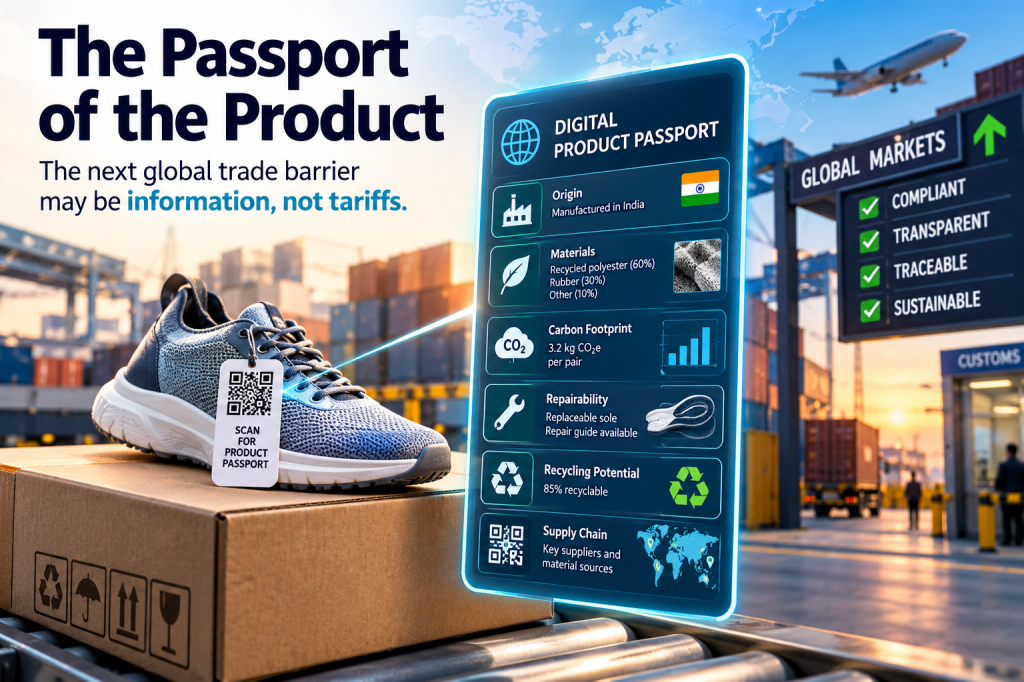
The Next Global Trade Barrier May Not Be a Tariff, but the Absence of Information
From the Movement of Goods to the Movement of Evidence
For centuries, international trade was built around the physical movement of goods. Ships carried spices, textiles, metals and machinery across borders. Customs authorities examined their origin, value and classification. Buyers judged products largely by price, quality and delivery. A competitive product was one that could be manufactured efficiently and delivered reliably.
That understanding of trade is undergoing a fundamental transformation. The product of the future may no longer travel alone. It will increasingly carry a digital identity containing information about where it was manufactured, which materials were used, how much carbon was emitted, whether it can be repaired, and what happens when its useful life ends.
This emerging system is commonly described as the Digital Product Passport. It could become one of the most consequential changes in international commerce since the introduction of modern product standards and global supply-chain management.
The economic significance is enormous. A product may be physically competitive but commercially unacceptable because its manufacturer cannot provide reliable information about it.
The next generation of trade barriers may therefore be built not at ports but inside databases.
From Made in a Country to Made Through a System
Industrialisation was traditionally associated with national manufacturing capabilities. A product carried a country-of-origin label, even when its components came from several countries. Globalisation complicated this arrangement. A shirt could use Indian cotton, Chinese yarn, Bangladeshi stitching and European design. An electric vehicle could combine minerals from Africa, batteries from Asia, software from America and assembly in Europe.
Country-of-origin labels cannot explain these complex production relationships.
Digital product passports represent an attempt to make such relationships more visible. Instead of identifying only the final manufacturing location, they may connect products with information about materials, suppliers, environmental performance, repair instructions and recycling possibilities.
The European Union has already established an important regulatory foundation through its Ecodesign for Sustainable Products Regulation, adopted in 2024. Its framework enables digital product passport requirements to be introduced progressively for specified product groups. The EU Battery Regulation also provides for battery passports for certain categories from February 2027.
However, requirements will differ across products and implementation schedules. A universal digital passport for every traded product does not yet exist.
Nevertheless, the direction is clear. Markets are gradually moving from trusting a manufacturer’s declaration to demanding structured and increasingly verifiable evidence.
The Factory Will Produce Two Outputs
The factory of the future may produce two things simultaneously: a physical product and a digital record of that product.
The physical product will contain materials, components, labour and technology. Its digital counterpart will contain information about those materials, components, production processes and relevant environmental characteristics.
Consider a garment manufacturer. Producing a high-quality shirt at a competitive price may no longer be sufficient for certain buyers. The manufacturer could also be expected to provide information on fibre composition, chemical processing, material origins, resource use and recyclability.
A machinery manufacturer may need to document components, energy performance, maintenance procedures and replacement parts. A battery producer may need to demonstrate material provenance, carbon footprint and recovery characteristics.
These developments could fundamentally change factory economics.
Historically, manufacturers invested in machinery to improve productivity. In the emerging system, they may also need to invest in data collection, digital identification, supplier mapping, testing and verification.
The cost of manufacturing will increasingly include the cost of proving how manufacturing was done.
The Invisible Cost of Transparency
Digital product passports are frequently presented as instruments of sustainability and circular economic development. Their potential benefits are real. Better information can support repair, reuse, recycling, safer materials and more responsible sourcing.
But transparency is not free.
A large multinational company can establish digital systems, employ sustainability specialists, negotiate information-sharing arrangements with suppliers and distribute compliance costs across millions of products.
A small manufacturer may face a very different reality.
Imagine a small Indian engineering enterprise supplying precision components to a European machinery company. Its product meets every technical specification. Its price is competitive, and its delivery performance is excellent.
However, the buyer requests product-level information on material origin, embedded carbon, recycled content and component traceability.
The manufacturer may possess invoices, production records and material certificates, but not in the required digital format. Its suppliers may not have the information at all.
The company then confronts an uncomfortable situation. Its manufacturing capability remains competitive, but its information capability does not.
This creates a new form of industrial inequality.
The dividing line may no longer be between enterprises that can manufacture and those that cannot. It may increasingly be between enterprises that can document their production systems and those that cannot.
When Information Becomes a Trade Barrier
Traditional protectionism used tariffs, quotas and import licensing. Modern trade restrictions increasingly operate through technical regulations, sustainability requirements, certification and supply-chain due diligence.
Digital product passports could add another layer.
Unlike conventional tariffs, the cost of meeting information requirements may not be visible in the final customs duty. It can appear through software subscriptions, laboratory testing, third-party verification, supplier audits, documentation and specialised personnel.
For developing-country exporters, these costs can be substantial relative to their sales.
The deeper concern is that digital transparency may unintentionally favour enterprises already integrated into sophisticated information networks.
Large firms could gain easier access to international buyers, while smaller firms remain outside because they lack the resources to establish credible data systems.
This is particularly important for India, where millions of MSMEs operate through subcontracting, informal supplier relationships and geographically concentrated industrial clusters.
A manufacturer may know its immediate supplier but not the full upstream production chain. It may understand its electricity bill but not the carbon intensity of every purchased component.
Requiring comprehensive product information without affordable supporting infrastructure could transform sustainability compliance into a new mechanism of market exclusion.
The paradox is striking: a system designed to make global trade more responsible could also make global trade less inclusive.
The Product Passport Will Create a New Economic Geography
Industrial competitiveness has historically depended on access to raw materials, labour, infrastructure, finance and markets.
A new factor is emerging: access to trustworthy industrial data.
Regions with strong testing laboratories, digital infrastructure, traceability providers, certification services and interoperable information systems could gain advantages over manufacturing locations that lack them.
This may alter the geography of global value chains.
International buyers could increasingly prefer suppliers that provide dependable product information, even when alternative suppliers offer slightly lower prices.
Over time, data reliability could become part of supplier selection alongside quality, cost and delivery.
This does not necessarily mean production will return to advanced economies. It may instead encourage production to concentrate in developing-country industrial ecosystems that can demonstrate credible compliance.
The competition could shift from individual factories to entire manufacturing networks.
A textile cluster with shared chemical testing, traceability infrastructure and carbon-accounting services may become more attractive than a larger cluster without these facilities.
The future competitive unit may therefore be not simply the factory, but the factory connected to a trusted information ecosystem.
India Must Build Digital Infrastructure Around Its Clusters
India’s industrial policy has traditionally emphasised common facility centres, technology upgrading, industrial estates, testing facilities and physical infrastructure.
These investments remain necessary, but they may no longer be sufficient.
The next generation of cluster development should include common digital infrastructure.
Textile clusters could establish shared systems for material traceability, chemical documentation and product-level environmental data. Engineering clusters could develop common material databases, component identification systems and energy-accounting services.
Leather, electronics, pharmaceuticals, automotive components and other export-oriented clusters could adopt sector-specific approaches.
The objective should not be to require every small enterprise to purchase expensive software or employ its own compliance specialists.
Instead, cluster associations, accredited laboratories, technology institutions and service providers could develop shared platforms that allow enterprises to generate reliable information at affordable cost.
Government support should focus on common data standards, interoperability, trusted verification, training and low-cost access.
India should also participate actively in international standard-setting so that its manufacturers are not forced to adapt separately to multiple incompatible systems.
The policy question is no longer merely how to improve manufacturing productivity. It is how to improve the productivity of manufacturing information.
The Danger of Digital Dependency
Another risk deserves attention.
If product passports become essential for international market access, the companies controlling the software, data formats, verification infrastructure and information exchanges could acquire considerable economic influence.
Manufacturers might become dependent on proprietary platforms. Small suppliers could face repeated demands to upload similar information into different buyer systems.
Sensitive commercial information could also become exposed through poorly designed data-sharing arrangements.
Digital product passports therefore raise questions beyond environmental sustainability. They involve data ownership, cybersecurity, confidentiality, interoperability and the distribution of economic power.
Who owns the product information? Who can access it? Who verifies its accuracy? Who pays for correcting errors? Can a manufacturer transfer its records when it changes customers or technology providers?
These questions will influence whether digital product passports become public-interest infrastructure or another concentrated market for specialised intermediaries.
A successful system must distinguish between information that consumers, recyclers and regulators genuinely need and confidential commercial information that should remain protected.
Transparency should not become an excuse for unlimited access to industrial knowledge.
From Compliance Burden to Commercial Opportunity
The emerging product passport economy also creates substantial business opportunities.
Testing laboratories, digital traceability providers, industrial software developers, carbon-accounting specialists, recycling companies and certification agencies could become important participants in global manufacturing.
For India, this presents an opportunity to combine its manufacturing base with its information technology capabilities.
Indian technology companies could develop affordable product-data systems for MSMEs. Technical institutions could create sector-specific methodologies. Cluster associations could establish common data services.
New enterprises could specialise in verifying recycled content, tracking material flows, calculating product footprints or connecting manufacturers with international reporting systems.
These services could eventually become exportable capabilities in their own right.
However, the greatest opportunity lies in integrating such services directly into manufacturing operations rather than treating them as an additional paperwork industry.
A product passport should be generated from normal business processes wherever possible, not reconstructed through expensive documentation after production has ended.
The most competitive firms will be those that make reliable information a natural output of production.
The Future: Every Product May Have a History
Over the next decade, digital identities could become increasingly important across batteries, electronics, textiles, machinery, construction materials and other product categories, although adoption will vary by sector and regulation.
A buyer may be able to scan a product identifier and access relevant information about its composition, environmental characteristics, repair options and end-of-life treatment.
Recyclers may use the same information to recover valuable materials. Repair businesses may identify compatible components. Manufacturers may use product data to improve designs and reduce waste.
Eventually, the economic value of a product may depend not only on its physical characteristics but also on the credibility and usefulness of its digital history.
Yet a digital passport is only as trustworthy as the information behind it. Incorrect supplier declarations, weak measurement methods and unreliable verification could produce sophisticated-looking records without genuine transparency.
The future challenge is therefore not simply digitisation. It is building systems that generate accurate, affordable, secure and verifiable information.
The Final Question: Who Will Be Allowed to Sell?
The industrial revolutions of the past transformed how products were manufactured. The next transformation may redefine how products establish their right to enter markets.
The first industrial revolution mechanised production. The second introduced mass manufacturing. The third brought automation and information technology. The fourth connected machines, data and intelligent systems.
The emerging product passport economy could connect all these developments to a new commercial requirement: products must increasingly explain their own origins, characteristics and environmental consequences.
For advanced manufacturers, this could improve efficiency, customer confidence and circularity. For smaller enterprises, it could become a costly obstacle unless appropriate systems are developed.
Governments must therefore recognise that digital product information is becoming part of industrial infrastructure, not merely an administrative requirement.
For India and other developing economies, the strategic priority should be to build shared data capabilities before information requirements become widespread market-entry conditions.
The ultimate danger is not that developing countries will lose the ability to manufacture competitive products. It is that they may continue manufacturing them efficiently while losing the ability to demonstrate compliance with the information demands of global buyers.
In the economy of the future, a product without a credible digital identity may be like a traveller without a passport: capable of crossing the distance, but unable to cross the border.
And that may become one of the most important, least visible barriers in twenty-first-century international trade.
DigitalProductPassport #GlobalTrade #MSME #IndustrialClusters #ExportCompetitiveness #Sustainability #DigitalTransformation #CircularEconomy #MakeInIndia #FutureOfManufacturing


Leave a Reply