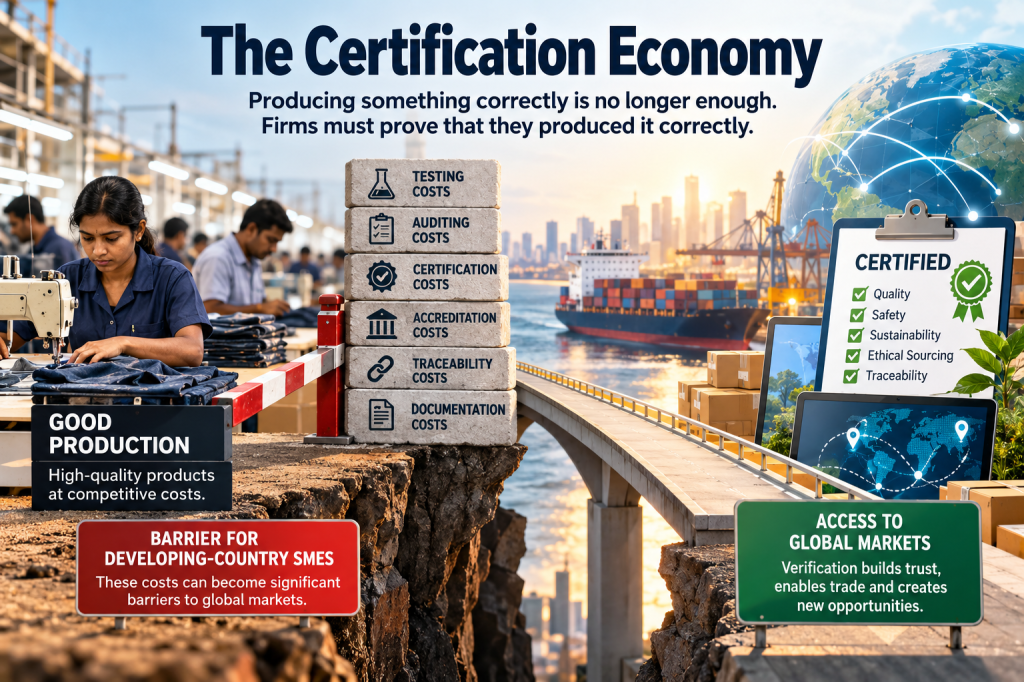
The next global trade divide may not be between countries that can produce and countries that cannot. It may be between those that can prove compliance and those that cannot afford to prove it.
From the Industrial Economy to the Evidence Economy
For nearly two centuries, industrial competitiveness was built around a relatively simple principle: produce better goods at lower costs and deliver them faster than competitors. The Industrial Revolution rewarded mechanisation, the twentieth century rewarded mass production, and globalisation rewarded efficient supply chains. Developing countries entered international markets by combining affordable labour, manufacturing skills and access to raw materials.
That economic logic is changing. A manufacturer may produce an excellent garment, a safe pharmaceutical ingredient, a precision engineering component or an environmentally responsible agricultural product. Yet none of these qualities automatically guarantees market access. Buyers, regulators and consumers increasingly demand independent evidence that products meet specified standards, materials are traceable, workers are protected and environmental claims can be substantiated.
The world is moving from an economy of production to an economy of verified production.
This transition is creating an enormous, often underestimated economic ecosystem around testing laboratories, certification agencies, accreditation bodies, inspection services, sustainability auditors, digital traceability platforms and regulatory consultants. These institutions are becoming increasingly important intermediaries between factories and markets.
The critical question is whether this emerging certification economy will improve global production or create another layer of economic inequality.
The Historical Shift: From Quality Control to Market Permission
Historically, quality control was largely an internal manufacturing responsibility. Companies inspected finished products, tested materials and developed procedures to reduce defects. International standards such as ISO 9001 helped institutionalise quality management, while sector-specific requirements gradually became more sophisticated.
Globalisation transformed this arrangement. As production moved across countries, buyers could no longer directly observe every manufacturing process. Certification became a practical instrument for managing distance, uncertainty and risk.
Today, the challenge extends far beyond product quality. Companies may need to demonstrate chemical safety, environmental performance, responsible sourcing, labour compliance, cybersecurity, carbon emissions and supply-chain traceability.
European sustainability requirements, carbon-related trade measures, food safety systems and product-specific technical regulations illustrate this wider transformation. Their legal obligations differ, but they share an important economic consequence: access to certain markets increasingly depends on reliable and verifiable information.
Certification is no longer merely a statement about product quality. It is becoming part of the infrastructure of international commerce.
However, an important distinction is necessary. Not every certificate is legally mandatory, and certification alone does not establish compliance with every regulation. Some requirements arise from law, others from industry standards and still others from private buyers. For smaller exporters, navigating these overlapping demands can be almost as difficult as meeting the underlying standards.
The New Cost of Entering Global Markets
Traditional economic analysis divides production costs into labour, capital, materials, energy, logistics and finance. A new category deserves equal attention: the cost of proving compliance.
Consider a small garment exporter in India. Its production process may already meet the expectations of international customers. Yet supplying a major overseas buyer could require fabric testing, chemical compliance documentation, social audits, environmental assessments, traceability records and periodic certification renewals.
Each requirement may be individually reasonable. Together, they can create substantial fixed and recurring costs.
Large multinational companies can distribute these expenses across enormous production volumes. A small enterprise producing limited quantities cannot.
This creates a structural disadvantage. Two manufacturers may produce identical goods at comparable quality, but the larger company may secure international orders because it possesses the documentation, audit history and recognised certifications demanded by buyers.
The smaller company is not necessarily less efficient in production. It is less capable of financing verification.
This distinction could fundamentally alter the future of developing-country exports.
The danger is that international trade may increasingly reward the ability to demonstrate compliance rather than the actual quality of production alone.
The Certification Paradox: Standards Can Protect and Exclude
Standards perform essential economic functions. They protect consumers, reduce information asymmetry, improve safety and create trust between distant trading partners. Environmental and labour standards can also discourage irresponsible production practices.
Without credible verification, markets would face greater uncertainty and potentially higher transaction costs.
Yet standards can simultaneously become barriers to participation.
A technically justified requirement may have unequal economic consequences when compliance costs are largely fixed. A multinational corporation may maintain dedicated compliance departments, sophisticated digital systems and long-term relationships with accredited laboratories. A small manufacturer may depend on external consultants, expensive testing facilities and fragmented documentation.
There is also a deeper contradiction.
Developed economies increasingly demand sustainable, ethical and traceable products, but developing-country suppliers are often expected to finance the necessary verification themselves.
The economic benefits of verified supply chains may be shared across retailers, consumers and brands, while a disproportionate share of the compliance burden can fall on producers with the weakest financial capacity.
This is not an argument against standards. It is an argument against designing verification systems without considering their distributional consequences.
A standard that improves product safety is economically valuable. A verification system that unnecessarily excludes capable producers can undermine the very development objectives that responsible trade claims to support.
The Rise of a New Global Service Industry
The certification economy is also creating significant business opportunities.
As regulations and buyer requirements become more sophisticated, demand will expand for specialised testing, product certification, environmental auditing, carbon accounting, cybersecurity assessments, laboratory services, digital traceability and regulatory advisory services.
These activities require skilled professionals, specialised equipment, internationally recognised procedures and credible institutions.
Countries that build strong verification capabilities could develop an entirely new segment of knowledge-intensive exports.
India, for example, has opportunities to strengthen its testing and certification ecosystem across pharmaceuticals, textiles, engineering goods, electronics, food processing, medical devices and renewable-energy equipment.
However, the real opportunity is not simply to establish more certification agencies. It is to build internationally trusted institutions whose test results and conformity assessments are accepted across major export markets.
Accreditation, international recognition, laboratory competence and regulatory credibility will determine whether domestic certification infrastructure reduces export costs or merely adds another administrative layer.
A country may have hundreds of testing laboratories and still force exporters to undertake repeated testing abroad if their results are not recognised by importing markets.
Therefore, the future competitiveness of the certification industry will depend as much on international acceptance as on domestic capacity.
MSME Clusters: The Missing Institutional Solution
Industrial clusters have historically improved competitiveness through shared infrastructure, specialised labour markets, common suppliers and collective learning.
The certification economy requires a new generation of cluster institutions.
Instead of expecting every small enterprise to establish separate testing facilities, hire compliance specialists and independently develop traceability systems, industrial clusters should create shared verification infrastructure.
Common testing laboratories, digital product records, environmental monitoring facilities, certification advisory centres and collective training programmes could substantially reduce the fixed costs of compliance.
But shared facilities must go beyond physical infrastructure.
Clusters need professionally managed compliance services capable of tracking changing regulations, maintaining recognised testing arrangements, assisting enterprises with documentation and negotiating practical solutions with international buyers.
A textile cluster could establish common chemical-testing and traceability services. An engineering cluster could share metrology and materials-testing facilities. A food-processing cluster could develop collective laboratory services and digital batch-tracking systems.
Individual firms would remain responsible for their own compliance, but shared institutions could make that responsibility more affordable.
This represents a fundamental change in cluster-development thinking.
The traditional industrial cluster was organised around production efficiency. The future industrial cluster must also be organised around verification efficiency.
Without this transition, many existing clusters could become increasingly disconnected from high-value global supply chains.
Digital Traceability: A Solution That Could Become Another Barrier
Artificial intelligence, digital product passports, connected sensors, blockchain-based records and automated reporting systems could significantly reduce the cost of collecting and verifying production information.
A future manufacturer may maintain a digital record linking raw-material origins, production batches, energy consumption, testing results, transportation and final delivery.
Rather than repeatedly assembling documents for different buyers, companies could provide controlled access to standardised records.
This could make verification faster, cheaper and more reliable.
However, technology introduces another risk.
If global brands impose incompatible proprietary traceability systems, small suppliers may be required to maintain several digital platforms simultaneously. Software subscriptions, cybersecurity requirements, data-management expenses and integration costs could create new dependencies.
A manufacturer might become compliant with environmental standards but financially dependent on a private technology provider simply to demonstrate that compliance.
The next generation of trade barriers may therefore be digital rather than physical.
Open standards, interoperable systems, secure data sharing and affordable verification technologies will be essential if digital compliance is to become an instrument of inclusion rather than exclusion.
The Future Risk: Certification Without Accountability
There is another uncomfortable possibility.
As certification becomes commercially valuable, the number of certificates may increase faster than the reliability of the underlying assessments.
Weak audits, conflicts of interest, superficial inspections and misleading sustainability claims could damage confidence in the entire system.
Certification agencies are often paid by the organisations they assess. Although safeguards and accreditation requirements can reduce conflicts, commercial incentives still require careful management.
A factory may possess impressive documentation while actual workplace conditions remain poor. A product may carry environmental claims that do not adequately reflect its full life-cycle impact.
This raises a difficult question: who verifies the verifiers?
The future certification economy will require stronger accreditation, risk-based oversight, transparent methodologies and credible enforcement.
Otherwise, global trade could develop an expensive market for certificates without achieving corresponding improvements in actual production practices.
The purpose of verification must remain better outcomes, not simply more documentation.
The Next Global Divide: Certified and Uncertified Economies
The historical division between developed and developing economies was largely explained through differences in capital, technology, productivity and industrial capabilities.
A new divide may emerge around institutional trust.
Countries with internationally recognised laboratories, credible regulators, digital infrastructure and strong accreditation systems could integrate more easily into sophisticated global markets.
Countries without these capabilities may face rising costs even when their producers are technically competitive.
This could produce a troubling development pattern.
Low-income countries may remain confined to lower-value markets, while high-value buyers increasingly concentrate procurement among suppliers capable of demonstrating complex compliance requirements.
The result would be a new form of market segmentation in which certification capability becomes a determinant of industrial upgrading.
Developing economies must therefore treat quality infrastructure as a strategic national asset, comparable to roads, ports, electricity and digital connectivity.
Public investment should focus on credible laboratories, internationally recognised accreditation, technical skills, regulatory intelligence and accessible services for smaller enterprises.
At the same time, importing countries and multinational buyers should examine how compliance costs are distributed. Mutual recognition, proportionate requirements, reduced duplication and buyer-supported upgrading could make verification more effective without weakening legitimate standards.
Beyond Certificates: Building an Economy of Trust
By the 2030s, certification and traceability may become embedded in routine commercial transactions across an expanding range of products and services.
For many industries, a product’s commercial identity may increasingly include not only its physical characteristics and price but also its documented environmental footprint, material origins, production conditions and conformity assessments.
This could reshape international competition.
The winners will not necessarily be the countries with the greatest number of certificates. They will be those that build credible, affordable and internationally accepted systems of verification.
For developing countries, the challenge is particularly urgent. They must improve compliance capabilities without allowing compliance costs to destroy the competitiveness of smaller producers.
For multinational buyers, the challenge is to distinguish genuine accountability from excessive documentation.
For governments, the challenge is to ensure that standards encourage technological upgrading rather than reinforce existing inequalities.
And for MSMEs, the challenge is to transform compliance from a recurring external expense into an integrated business capability.
The deeper economic lesson is that the world is beginning to trade not only in goods and services, but also in evidence, assurance and institutional credibility.
The central danger is that the right to participate in global markets could increasingly depend on the ability to purchase proof.
The certification economy will become a powerful force in international trade. Whether it produces safer products, more sustainable industries and wider prosperity—or merely creates another expensive gatekeeper—will depend on how its institutions are designed.
The next great industrial challenge is no longer simply to produce competitively.
It is to ensure that proving competitiveness does not become more difficult than achieving it.
The future of global trade should belong to enterprises that meet credible standards, not merely to those wealthy enough to navigate the machinery of certification.
CertificationEconomy #GlobalTrade #MSMEs #ExportCompetitiveness #IndustrialClusters #Sustainability #DigitalTraceability #QualityInfrastructure #FutureOfTrade #EconomicDevelopment


Leave a Reply