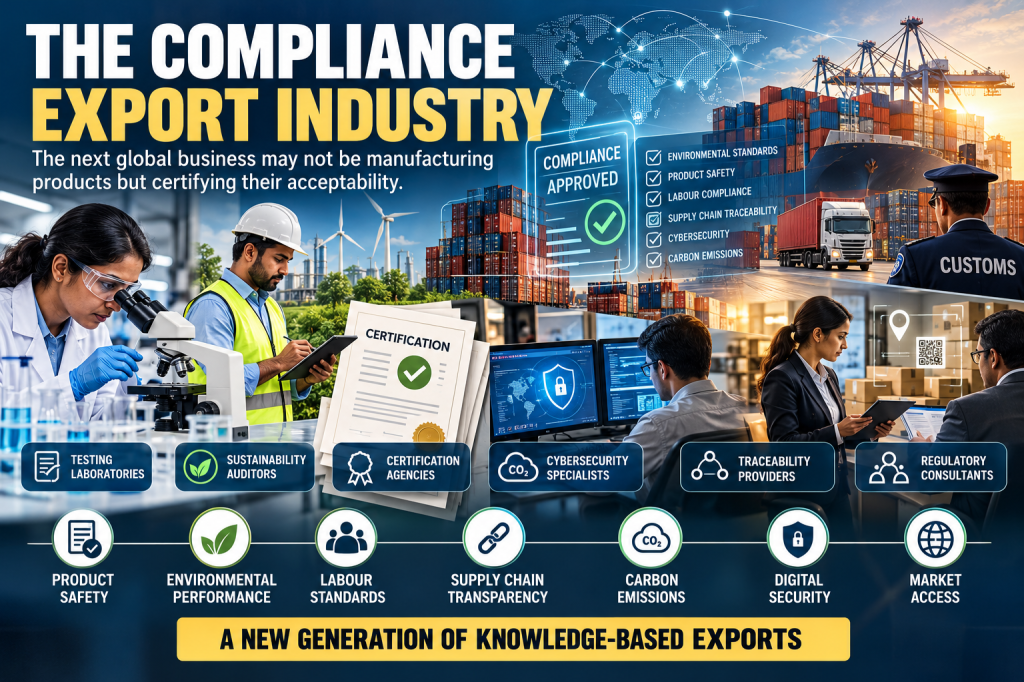
The Next Global Business May Not Be Manufacturing Products but Certifying Their Acceptability
The Changing Economics of Global Trade
For decades, international trade followed a relatively simple economic logic. Countries produced goods, competed on prices, improved quality and searched for overseas buyers. Governments negotiated tariffs, exporters managed logistics, and international competitiveness was largely determined by production costs, technology and market access.
That world is gradually disappearing.
A product manufactured at a competitive price may no longer be competitive in international markets unless its producer can demonstrate how it was manufactured, where its raw materials originated, how much carbon was emitted, whether workers were treated fairly, whether chemicals were properly managed and whether the digital systems supporting production are secure.
The emerging reality is that manufacturing a product and proving that the product meets market requirements are becoming two separate economic activities.
The first creates the product. The second creates its permission to enter the market.
This distinction is giving rise to an entirely new global knowledge economy: the Compliance Export Industry.
From Tariff Barriers to Evidence Barriers
Historically, international trade barriers were visible. Import duties, quotas, licensing restrictions and foreign exchange controls determined whether goods could cross national borders. The establishment of the General Agreement on Tariffs and Trade in 1947 and subsequently the World Trade Organization in 1995 encouraged countries to reduce conventional trade restrictions.
But the reduction of tariffs did not eliminate barriers. It gradually changed their character.
Technical standards, environmental requirements, product safety regulations, labour-related obligations, data protection rules and supply-chain transparency requirements have become increasingly important.
The European Union illustrates this transition. Its Carbon Border Adjustment Mechanism entered its definitive phase in January 2026, placing carbon-related reporting and financial obligations on covered imports, subject to applicable thresholds and rules. The EU Deforestation Regulation, sustainability reporting requirements, product regulations and emerging digital product passport systems represent different dimensions of a broader movement towards evidence-based trade.
The United States increasingly uses supply-chain scrutiny, forced-labour restrictions, product safety requirements and national-security considerations in regulating imports. Other advanced economies are developing their own approaches to sustainability, traceability and digital security.
These requirements are not identical, and their implementation schedules differ. Nevertheless, their cumulative economic significance is considerable.
The future international border may increasingly be crossed through verified information before it is crossed by physical goods.
A shipment may leave a factory only after passing through multiple layers of documentation, testing, certification, digital verification and regulatory scrutiny.
This is creating a second export economy operating alongside the traditional movement of merchandise.
The Birth of a Global Compliance Services Market
Every additional regulatory obligation creates demand for specialised knowledge, technology and verification services.
A textile exporter may require chemical testing, fibre traceability, wastewater monitoring, labour compliance assessments and sustainability documentation. A pharmaceutical producer may need validation, regulatory submissions, quality audits and data-integrity systems. An engineering manufacturer may require material certification, product testing, carbon measurement and conformity assessments.
Similarly, electronics exporters increasingly face requirements relating to product safety, hazardous substances, cybersecurity and responsible sourcing.
Behind each of these obligations lies a potential commercial service.
Testing laboratories, certification agencies, sustainability auditors, carbon accountants, cybersecurity specialists, traceability software developers, regulatory consultants and technical training institutions are becoming part of an expanding international business ecosystem.
The economic significance extends beyond individual certificates.
A manufacturer may purchase a product-testing service once, but regulatory monitoring, emissions measurement, supply-chain verification and digital record management may require continuous engagement.
Consequently, compliance services could increasingly move from occasional transactions towards recurring contracts and subscription-based business models.
The next generation of international service companies may not manufacture anything physically. Their principal assets could be technical expertise, accredited systems, regulatory intelligence, specialised software and the ability to convert complicated regulations into commercially acceptable evidence.
The Hidden Transfer of Value from Producers to Verifiers
There is, however, a deeper economic issue.
As compliance becomes more complicated, a growing share of the value generated through international trade may move away from physical producers towards organisations that verify, document and certify production.
Consider a small apparel manufacturer supplying international retailers.
The manufacturer invests in machinery, workers, electricity, raw materials and working capital. It carries the commercial risks associated with production, delivery schedules and changing demand.
Yet market access may increasingly depend on external organisations that provide laboratory testing, environmental verification, social audits, traceability systems and certification services.
These organisations may have relatively limited physical production assets, but they control specialised knowledge and recognised verification capabilities.
This creates an emerging imbalance.
The producer carries the burden of manufacturing, while an expanding network of service providers earns revenue from establishing whether that manufacturing is acceptable.
Some of these services create genuine public and commercial value. They can improve product safety, environmental performance, labour conditions and supply-chain reliability.
But compliance can also become unnecessarily repetitive, expensive and fragmented.
A factory supplying several international buyers may face overlapping audits, different reporting formats and repeated requests for substantially similar information.
In such circumstances, compliance becomes not merely a safeguard but a transaction cost that can reduce competitiveness.
The critical question is whether global regulation will improve production standards or create a permanent commercial dependency on verification intermediaries.
The answer will depend on regulatory design, mutual recognition, data interoperability and the competitive structure of compliance markets.
The New Geography of Knowledge-Based Exports
The emerging compliance economy could also change the geography of international services.
Historically, advanced economies dominated certification, specialised testing, regulatory consulting and technical standards because they possessed established institutions, internationally recognised accreditation systems and strong professional networks.
Developing economies concentrated primarily on manufacturing and exporting physical goods.
This division is no longer inevitable.
India, Vietnam, Indonesia, Bangladesh, Mexico and other manufacturing economies have an opportunity to build internationally competitive compliance service industries.
India has several potential advantages.
Its engineering workforce, information technology capabilities, professional services sector, pharmaceutical regulatory experience and expanding testing infrastructure provide a foundation for developing specialised compliance businesses.
Indian enterprises could provide carbon accounting, product traceability, supply-chain data management, environmental monitoring, cybersecurity assessments and regulatory documentation services to manufacturers across Asia, Africa and other emerging markets.
However, technical expertise alone will not guarantee international market acceptance.
Laboratories require credible accreditation. Certification bodies need recognition under relevant international arrangements. Auditors require independence and professional competence. Digital systems must satisfy demanding data security and reliability requirements.
An Indian certificate will have limited export value if the importing market does not recognise the issuing institution or its accreditation.
Therefore, the real export opportunity lies not simply in creating more laboratories and consultants but in creating internationally trusted compliance institutions.
Trust itself becomes an economic asset.
Artificial Intelligence Could Industrialise Compliance
Artificial intelligence may fundamentally change the economics of regulatory compliance.
Today, many manufacturers depend on consultants to interpret regulations, prepare documents, review records and identify gaps in compliance.
Much of this work is repetitive, fragmented and labour-intensive.
AI-enabled systems could increasingly monitor regulatory changes across countries, identify product-specific obligations, examine supplier records, organise technical documentation, estimate emissions and highlight inconsistencies before formal audits.
A small manufacturer could eventually access regulatory intelligence that previously required a large compliance department.
Digital product passports, machine-readable standards, automated reporting systems and interoperable traceability platforms could reduce the cost of demonstrating compliance.
This would create opportunities for specialised technology companies serving entire industrial sectors.
A compliance technology platform designed for textile exporters in Tirupur could potentially serve apparel producers in Bangladesh, Vietnam, Cambodia and East Africa.
Similarly, software developed for pharmaceutical regulatory documentation or engineering-product certification could be adapted for international markets.
But AI will not eliminate the need for independent verification.
Physical testing, professional judgement, legally recognised certification and accountability will remain important.
AI can help prepare and analyse evidence. It cannot automatically make that evidence reliable or legally acceptable.
The larger opportunity lies in combining digital automation with credible technical institutions.
MSME Clusters Could Become Compliance Service Economies
The implications for industrial clusters are particularly significant.
Traditional cluster development focused on common infrastructure, technology upgrading, skills, marketing, finance and collective procurement.
These interventions remain necessary, but they may no longer be sufficient.
An industrial cluster could possess modern machinery, skilled workers and competitive production costs while still losing export orders because individual enterprises cannot afford the systems needed to demonstrate compliance.
This suggests a new direction for cluster development.
Common Facility Centres could gradually evolve into shared compliance infrastructure.
A textile cluster could establish common chemical-testing facilities, carbon accounting services, wastewater monitoring systems and digital traceability platforms.
An engineering cluster could develop shared product-testing laboratories, material certification facilities and technical documentation services.
A food-processing cluster could integrate residue testing, food safety systems, batch traceability and export-market regulatory intelligence.
A pharmaceutical cluster could strengthen shared analytical testing, validation support and specialised regulatory services where legally permissible.
The economic logic is straightforward.
A small enterprise may not be able to employ a full-time sustainability specialist, cybersecurity expert or regulatory affairs professional.
But a cluster of several hundred enterprises can collectively sustain a sophisticated technical service institution.
This creates economies of scale in compliance.
More importantly, such institutions could eventually become independent commercial businesses serving enterprises beyond their original clusters.
The next generation of successful industrial clusters may export not only manufactured products but also the knowledge required to make those products internationally acceptable.
This would represent an important shift from production-oriented cluster development towards knowledge-intensive industrial ecosystems.
The Risk of a New Regulatory Inequality
The compliance economy also presents a serious developmental challenge.
Large multinational corporations can distribute regulatory costs across enormous production volumes. They maintain specialised legal departments, technical teams, digital systems and established relationships with certification agencies.
Small manufacturers face a different reality.
For them, even a modest increase in testing fees, documentation costs or audit requirements can substantially affect profitability.
The result could be a new form of inequality in international trade.
Countries may formally maintain low import tariffs while imposing technical requirements that are disproportionately difficult for smaller exporters to satisfy.
This does not mean environmental, labour or product safety standards should be weakened.
It means the architecture of compliance must be designed carefully.
Regulatory systems should encourage proportionality, transparency, mutual recognition and simplified reporting wherever possible.
International buyers should also share responsibility for the costs of compliance rather than transferring every new obligation to suppliers.
Otherwise, global value chains could become increasingly concentrated among larger manufacturers capable of financing expensive verification systems.
A regulatory framework intended to encourage responsible production could unintentionally exclude smaller producers from international markets.
When the cost of proving competitiveness becomes too high, competitiveness itself loses meaning for smaller enterprises.
Will Compliance Become the Next Business Process Outsourcing Industry?
India’s experience with information technology and business process outsourcing offers an interesting historical parallel.
During the 1990s and 2000s, international companies began outsourcing software development, accounting, customer support and back-office functions.
India converted its technical workforce, English-language capabilities and cost advantages into a major global services industry.
Compliance could follow a comparable path, although its commercial structure and accreditation requirements are different.
International companies increasingly need specialised support for environmental reporting, product documentation, supplier verification, regulatory intelligence and digital compliance management.
Many of these activities can be delivered remotely, while physical testing and legally recognised audits require appropriate facilities, personnel and authorisations.
This creates the possibility of a distributed international compliance services model.
An Indian company could manage sustainability data for European buyers, support product documentation for American importers and provide supply-chain traceability services to manufacturers in Southeast Asia.
Specialised firms could emerge around individual industries, regulatory systems or technologies.
Over time, compliance services could develop into a distinct export segment combining engineering, legal interpretation, environmental science, information technology and professional assurance.
However, the industry would need to avoid becoming a low-value documentation outsourcing business.
The greater commercial opportunity lies in developing proprietary technology, recognised technical expertise, trusted accreditation and sector-specific intellectual property.
The Future: From Compliance Costs to Compliance Competitiveness
Over the next decade, three broad developments could reshape this emerging industry.
First, compliance requirements are likely to become more digitally integrated. Companies may increasingly maintain continuous records of materials, emissions, suppliers and production processes rather than preparing documentation only when an audit approaches.
Second, compliance services may become more specialised. Carbon accounting, industrial cybersecurity, chemical management, product traceability and regulatory intelligence could develop into distinct professional markets.
Third, competition may increasingly emerge between different compliance systems.
Countries and economic blocs may develop competing technical standards, digital infrastructures and verification arrangements.
This could produce either greater interoperability or a fragmented international regulatory landscape.
In an optimistic scenario, internationally recognised digital systems reduce duplication, improve transparency and make responsible trade less expensive.
In a less favourable scenario, overlapping regulations and proprietary certification systems create a costly network of compliance obligations that smaller firms struggle to navigate.
The difference will depend heavily on international cooperation and the willingness of governments and large buyers to recognise credible equivalent systems.
India’s Strategic Opportunity
India should view the emerging compliance economy as more than an administrative requirement imposed by export markets.
It represents a potential new frontier of knowledge-intensive exports.
A national strategy could combine internationally accredited testing infrastructure, sector-specific compliance technology platforms, professional training, regulatory intelligence services and cluster-based shared facilities.
Public institutions, industry associations, technical universities, laboratories and private technology firms could jointly develop internationally marketable services.
Special attention should be given to MSME clusters, where shared infrastructure could simultaneously reduce exporters’ compliance costs and create commercially viable service enterprises.
India’s ambition should not be limited to helping domestic manufacturers satisfy foreign regulations.
It should extend towards building companies capable of supplying compliance services to manufacturers across the world.
This would require institutional credibility, international partnerships and investment in technical expertise rather than simply expanding the number of consultants.
The Coming Economy of Verified Production
The global economy is entering a period in which producing goods may become only one part of international competitiveness.
The ability to demonstrate how goods are produced will increasingly influence market access, buyer confidence and commercial value.
This creates an unusual economic transformation.
Regulation, traditionally viewed as a cost imposed on business, is becoming the foundation of an expanding business industry.
The winners may include countries that manufacture competitively, but also those that develop the laboratories, technologies, professional institutions and knowledge systems through which global production is verified.
Yet a warning is necessary.
An economy that spends more resources proving that products are acceptable than improving how those products are made risks creating an expensive bureaucracy around production.
The objective should therefore be to make compliance simpler, more credible and less costly while improving real production outcomes.
For developing countries, the opportunity is substantial, but so is the risk of dependence on foreign verification systems.
The strategic choice is no longer simply whether to comply with international standards.
It is whether to remain permanent purchasers of compliance services or become internationally competitive providers of those services.
The future of global trade may belong not only to those who can manufacture the best products at the lowest cost, but also to those who can provide the most credible, affordable and internationally accepted evidence of how those products were made.
And that could make compliance one of the most consequential knowledge industries of the coming decade.
Compliance Export Industry, Global Trade, Regulatory Services, MSME Competitiveness, Industrial Clusters, Sustainability Auditing, Carbon Accounting, Product Traceability, International Certification, Digital Product Passports, Artificial Intelligence, Knowledge Exports, Global Value Chains, India Services Economy.


Leave a Reply