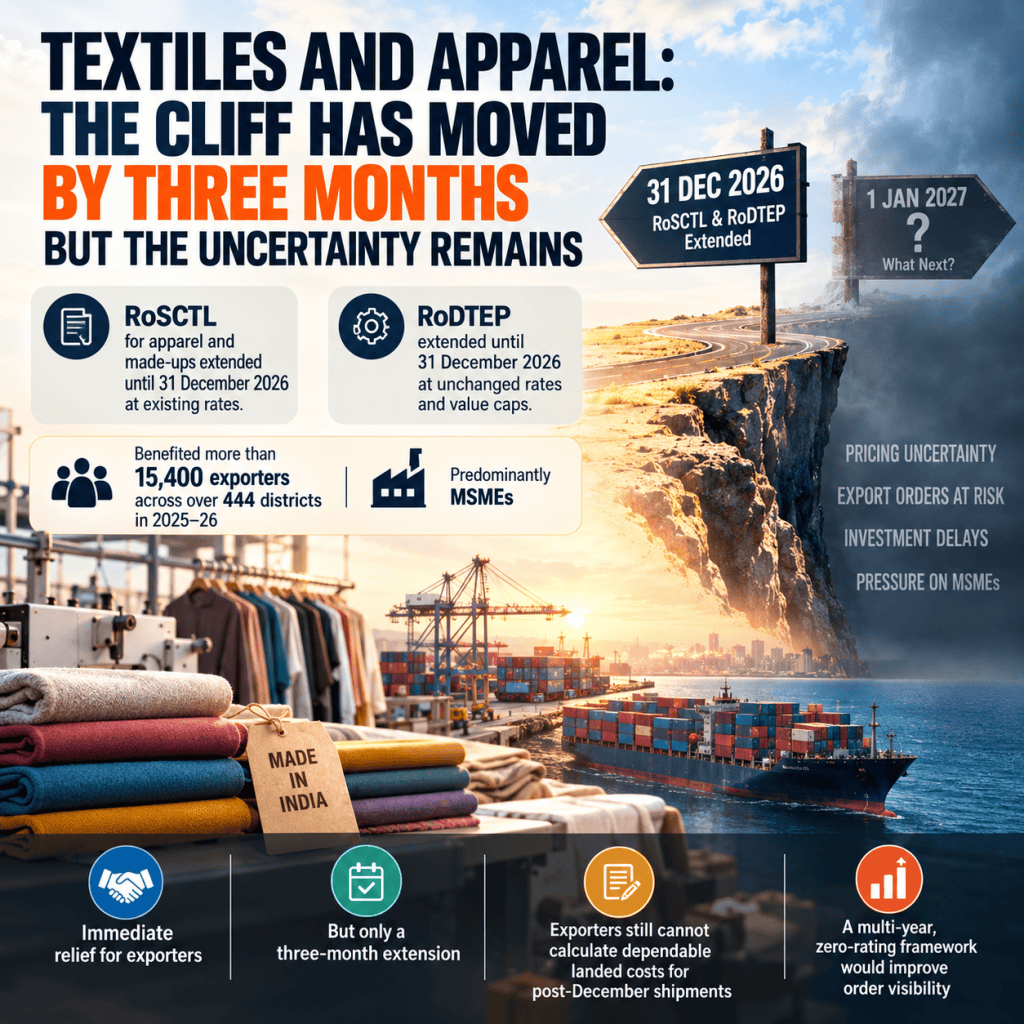
India has protected its textile exporters from an immediate policy shock. But extending an incentive is not the same as creating a predictable export environment. The real challenge is no longer simply the cost of exporting. It is the cost of not knowing what exporting will cost tomorrow.
The Relief That Does Not Resolve the Problem. India’s textile and apparel exporters have received another three months of breathing space. The government has extended the Rebate of State and Central Taxes and Levies (RoSCTL) scheme for apparel and made-ups until 31 December 2026, retaining existing rates. The Remission of Duties and Taxes on Exported Products (RoDTEP) scheme has also been extended until the same date without changing the existing rates and value caps. These extensions provide immediate relief to an industry facing intense global competition, uncertain demand, rising compliance costs and pressure on margins. But the larger question remains unanswered. What happens on 1 January 2027?
The distinction is important. A three-month extension prevents an immediate disruption, but it does not create the certainty required for investment, pricing and long-term export commitments. According to the reported government figures, RoSCTL benefited more than 15,400 exporters across over 444 districts during 2025–26, with MSMEs accounting for a substantial share. The geographical spread shows how deeply export competitiveness is connected to local manufacturing economies. Yet many of these enterprises are being asked to compete internationally without knowing the policy conditions under which their next production cycle will operate.
The Historical Problem: Incentives Have Become Part of the Business Model. India’s textile industry was once internationally competitive largely because of labour availability, traditional production skills, cotton resources and an extensive network of small manufacturers. Over time, global competition changed. China developed enormous production ecosystems, Bangladesh built a powerful garment export industry, Vietnam integrated deeply into international supply chains, and countries such as Türkiye developed advantages in speed, design and proximity to European markets.
India responded through a combination of export promotion measures, tax remission, infrastructure development, production incentives and trade agreements. RoSCTL and RoDTEP are particularly important because their underlying purpose is to address taxes and levies embedded in exported products that are not otherwise refunded. They are not simply conventional subsidies. They seek to prevent domestic taxation from becoming an additional cost in international markets.
But a structural problem has emerged. Instruments intended to neutralise embedded taxes have become uncertain variables in exporters’ commercial calculations. When their continuation is decided through short extensions, exporters cannot confidently price orders covering future delivery periods.
This is where a tax-remission mechanism begins to affect much more than taxation. It influences the willingness of manufacturers to accept orders, the ability of exporters to negotiate prices and the confidence of banks in financing production.
The Invisible Cost of Policy Uncertainty. International apparel business operates on calendars that extend well beyond three months. Buyers negotiate seasonal collections, production schedules, fabric procurement, shipping arrangements and retail delivery commitments several months in advance. A European or American buyer negotiating an order today may expect delivery in early 2027. The Indian supplier must quote a price now, even though the remission treatment applicable after December remains uncertain.
Consider a hypothetical garment exporter whose order value is ₹10 crore and whose applicable remission benefit represents 3% of that value. The benefit would amount to ₹30 lakh. If the exporter cannot establish whether that benefit will remain available, the uncertainty becomes commercially significant. The exporter can increase the quoted price, absorb the potential loss or negotiate a conditional contract.
Each option carries a cost. Increasing prices may weaken competitiveness. Absorbing the risk may eliminate profits. Conditional pricing may encourage international buyers to shift orders to suppliers offering greater certainty.
The percentage is illustrative, not a uniform scheme rate. Actual benefits depend on the product classification, applicable rates, caps and eligibility.
The most serious consequence is that uncertainty does not affect every exporter equally. Large companies can diversify markets, maintain financial reserves and negotiate longer credit arrangements. Smaller exporters often operate on thin margins, depend heavily on working capital and have limited bargaining power.
A policy extension that appears neutral on paper can therefore create unequal commercial outcomes.
The Global Competition Has Moved Beyond Cheap Labour. The textile and apparel industry is entering a period in which competitiveness will increasingly depend on reliability, speed, traceability and the ability to comply with changing market requirements.
International buyers are examining product origins, chemical use, environmental performance, labour conditions, carbon footprints and supply-chain transparency. Digital product information and sustainability documentation are becoming important commercial requirements, particularly in European markets.
The implication is significant. Indian exporters are being asked to invest in modern machinery, cleaner production, traceability systems, testing facilities, worker skills and digital documentation. These investments require predictable returns over several years.
Yet some of the policy instruments affecting their export prices are being extended for only a few months.
This creates a contradiction between the long-term transformation expected from industry and the short-term visibility provided by policy.
A manufacturer cannot confidently undertake a five-year modernisation programme if important elements of its export cost structure remain subject to repeated short-term decisions.
The Cluster Economy: Where Uncertainty Multiplies. The consequences are particularly important for India’s textile and apparel clusters. Tiruppur, Ludhiana, Surat, Jaipur, Panipat, Bengaluru and the National Capital Region represent different production systems, but many share a common characteristic: networks of specialised enterprises depend on one another.
A garment exporter may depend on separate enterprises for knitting, dyeing, printing, embroidery, washing, finishing, packaging and transportation. A change in the exporter’s expected realisation can quickly affect the entire production chain.
If exporters become cautious about accepting forward orders, fabric manufacturers may delay production. Processing units may face irregular utilisation. Subcontractors may experience payment delays. Smaller firms may postpone machinery purchases, and workers may face unstable employment.
This is why export policy uncertainty should not be measured only through the balance sheets of exporting companies. Its effects can spread across local industrial economies.
Cluster associations should now move beyond seeking periodic extensions. They need to build collective mechanisms for managing commercial uncertainty. Common costing platforms can help member enterprises prepare two post-December scenarios: one assuming continuation of current remission benefits and another assuming their withdrawal or modification.
Associations can also develop model contract clauses that specify how a material change in remission eligibility or rates would affect prices. Such clauses would require buyer acceptance and careful commercial negotiation, but they could make risk allocation more transparent.
At the same time, documentation systems for RoSCTL and RoDTEP should increasingly be connected with origin verification, chemical compliance, product traceability and sustainability records. This could reduce duplication and help smaller exporters meet increasingly complex buyer requirements.
The future textile cluster must become more than a geographical concentration of factories. It must function as a shared competitiveness system.
The Missing Reform: Predictability Is More Valuable Than Repeated Relief. India needs to distinguish between supporting exports and creating a stable framework for export competitiveness.
A multi-year remission arrangement, subject to transparent eligibility rules and periodic evidence-based reviews, would give exporters a more dependable basis for pricing and investment. Such a framework would not require the government to promise permanently unchanged rates. It would require clarity about how rates are determined, when they can change and how exporters will be informed.
Predictability can be improved without abandoning fiscal discipline.
The objective should be to establish a credible mechanism for ensuring that eligible embedded domestic taxes do not become an unpredictable burden on exported products. This would be consistent with the economic principle that exports should not carry unrecovered domestic indirect taxes, subject to applicable trade rules.
It would also shift policy attention towards the structural weaknesses that remission alone cannot solve: low productivity, fragmented production, inadequate scale, expensive logistics, technology gaps, inconsistent quality and weak integration into higher-value segments of global supply chains.
An exporter should become competitive because its production system is efficient, not because it has become skilled at anticipating the next policy notification.
The Future Scenario: Two Different Export Economies. India now faces two possible pathways.
In the first, the government moves towards a transparent multi-year remission framework while industry invests in productivity, automation, design capabilities, compliance infrastructure and supply-chain integration. Exporters gain better visibility over costs, international buyers gain confidence in delivery commitments, and smaller manufacturers become more willing to invest.
In the second, remission arrangements continue through successive short extensions. Immediate disruptions may be avoided, but uncertainty remains embedded in business decisions. Larger exporters adapt through financial buffers and diversified operations, while smaller enterprises carry a disproportionate share of the risk.
Over time, the difference could influence which firms grow, which firms remain subcontractors and which firms exit export markets.
There is also a third possibility that deserves attention. As trade agreements, sustainability requirements and technological changes reshape global apparel sourcing, traditional export incentives may become less decisive than production speed, reliable compliance and the ability to deliver smaller, customised orders. India must prepare for this transition rather than assuming that continuation of existing remission schemes will automatically secure future market share.
The Real Question Is Not Whether Support Continues, but Whether Industry Can Plan. The extension of RoSCTL and RoDTEP until 31 December 2026 is commercially important. It reduces an immediate risk and provides temporary stability. But temporary stability should not be mistaken for long-term competitiveness.
India’s textile and apparel sector needs a policy environment in which manufacturers can price tomorrow’s orders, invest in tomorrow’s technology and prepare for tomorrow’s international standards without repeatedly waiting for administrative decisions.
The deeper lesson extends beyond textiles. In an increasingly uncertain global economy, policy predictability itself is becoming a competitive advantage.
Countries that provide reliable commercial frameworks may attract orders even when they do not offer the lowest production costs. Countries that rely on repeated short-term relief may find that uncertainty gradually erodes the benefits of the relief itself.
The cliff has moved by three months. But unless India changes the way export remission policy is designed and communicated, the industry will arrive at the same cliff again on 1 January 2027.
And for thousands of smaller exporters, the real cost may not be the loss of an incentive. It may be the loss of an order that was never placed.
Policy figures and extension dates in this article are based on the information supplied for the brief; the underlying notifications have not been independently verified here.
#TextileExports #GarmentIndustry #MSMEIndia #IndianEconomy #ExportPolicy #TextileClusters #GlobalTrade


Leave a Reply