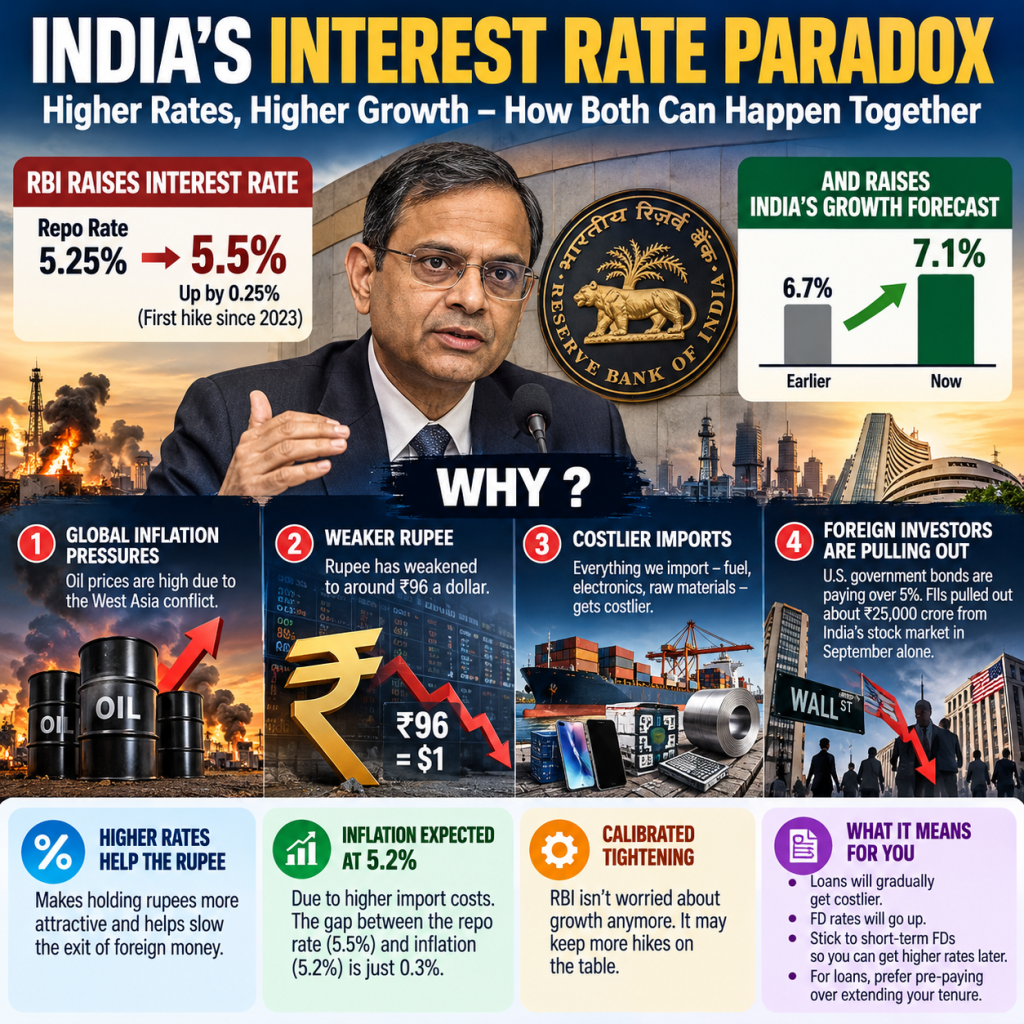
Why India may face a new economic challenge in which growth remains strong, but the cost of protecting that growth becomes increasingly high.
The New Economic Contradiction. For decades, central banks have followed a familiar economic logic. When growth weakens, interest rates are reduced to encourage borrowing, investment and consumption. When inflation rises because the economy is overheating, interest rates are increased to moderate demand. But the global economy is changing this relationship. A country can now experience strong economic growth and rising inflation simultaneously, not because its people are consuming too much, but because the world outside its borders is becoming more expensive and unstable. India increasingly faces this challenge.
Growth Is No Longer the Only Question. The conventional assumption is that higher interest rates indicate an economy that needs cooling. But what happens when inflation comes from imported oil, a weakening currency, expensive raw materials and geopolitical uncertainty? Raising interest rates cannot produce more crude oil, reopen disrupted shipping routes or end international conflicts. It can only influence domestic borrowing, spending, liquidity and investor expectations. This creates a difficult policy choice. The central bank may have to make money more expensive even when domestic businesses are performing well.
The Rupee Has Become an Inflation Transmission Channel. India imports much of its crude oil requirement and depends on international markets for several industrial inputs, electronic components and capital goods. When the rupee depreciates against the dollar, these imports become more expensive even if their international prices remain unchanged. When oil prices rise and the rupee weakens together, the economy experiences a double shock. Transportation becomes costlier, manufacturing margins shrink, logistics expenses increase and inflation gradually spreads through production and distribution chains. The problem begins internationally but eventually reaches Indian households.
The Global Capital Trap. There is another dimension that receives insufficient attention. India does not determine its monetary conditions independently of the rest of the world. When American bond yields become attractive, international investors may reconsider the additional returns they require for investing in emerging markets. Capital outflows can weaken the rupee, which increases import costs and adds to inflationary pressure. Higher Indian interest rates may support the currency by improving the relative attractiveness of rupee assets, but this relationship is neither automatic nor guaranteed. Exchange rates also depend on trade flows, investor confidence, global risk and expectations about future growth. India therefore faces an uncomfortable reality: decisions made in Washington can influence borrowing costs in Indian industrial towns.
The Real Victims May Be Small Enterprises. Large corporations can often raise funds through multiple channels, negotiate better borrowing terms or absorb temporary cost increases. Micro and small enterprises have far fewer options. A rise in interest rates increases working-capital expenses at precisely the moment when imported inputs, transportation and energy may already be becoming costlier. A textile exporter, an engineering manufacturer or a small auto-component supplier can face rising costs without having sufficient bargaining power to increase selling prices. Monetary tightening intended to stabilise the economy can therefore weaken the enterprises that generate employment and support exports.
The Hidden Problem of Strong Growth. A national growth forecast can remain impressive while economic conditions become more difficult for particular sectors. GDP growth does not reveal how the benefits and costs are distributed. Large infrastructure projects, organised manufacturing and technology-intensive services may continue expanding, while smaller businesses and indebted households experience increasing financial pressure. India must therefore distinguish between growth in aggregate output and growth in economic resilience. A country can grow rapidly while becoming more vulnerable to external shocks.
A Historical Shift in Monetary Policy. During earlier decades, inflation in developing economies was often explained through domestic fiscal deficits, excess liquidity, supply shortages and agricultural disruptions. Globalisation changed the transmission mechanism. Oil markets, financial capital, exchange rates, international supply chains and geopolitical tensions became increasingly important. The next stage may be even more complicated. Trade fragmentation, climate-related disruptions, strategic tariffs and competition for critical minerals could make supply-driven inflation more persistent. Central banks designed primarily to manage domestic demand may increasingly find themselves responding to international supply shocks that interest rates cannot directly resolve.
The Future May Be High Growth with High Financial Pressure. India could enter a period in which respectable economic growth coexists with expensive capital, volatile exchange rates and uncertain import costs. This would challenge the assumption that high GDP growth automatically creates favourable conditions for investment. Manufacturing competitiveness depends not only on demand but also on affordable finance, reliable energy, efficient logistics and stable input prices. Without improvements in these areas, monetary tightening can become a recurring response to structural vulnerabilities rather than a lasting solution.
The Policy Question India Cannot Avoid. Monetary policy alone cannot protect an economy from global instability. India needs greater energy security, diversified import sources, deeper domestic bond markets, stronger export earnings, better currency-risk management and more accessible working capital for MSMEs. Industrial clusters must increasingly develop shared procurement systems, energy-efficiency services and financial-risk management mechanisms. The objective should not simply be to control inflation after external shocks arrive, but to reduce the economy’s exposure before they occur.
The Next Economic Divide. The coming years may separate countries not merely by how fast they grow, but by how much economic stability they can preserve without making productive investment prohibitively expensive. The real measure of economic strength will increasingly be the ability to absorb global shocks while protecting employment, enterprise competitiveness and household purchasing power.
India’s future challenge is therefore larger than deciding whether interest rates should rise or fall. It is about building an economy in which every international crisis does not immediately become a domestic inflation problem, a currency problem and finally a borrowing-cost problem.
The greatest danger is not that India may grow more slowly because money becomes expensive. It is that India may continue growing while the financial foundations of that growth become progressively more fragile.
The October 2026 Turning Point. On 7 October 2026, the RBI increased its repo rate by 25 basis points to 5.5%, raised its GDP growth forecast from 6.7% to 7.1%, and revised expected inflation to 5.2%. It also shifted its policy stance to calibrated tightening. These decisions confirm the central dilemma: the economy remains resilient, but inflation risks are increasing. Importantly, the RBI also identified domestic food inflation, weak monsoon conditions and broader price pressures as reasons for concern.
The future of Indian monetary policy will depend not simply on how fast the economy expands, but on whether India can prevent international uncertainty from becoming a permanent domestic cost.#IndianEconomy #RBI #MonetaryPolicy #InterestRates #Inflation #EconomicGrowth #MSME #GlobalEconomy #EconomicResilience


Leave a comment