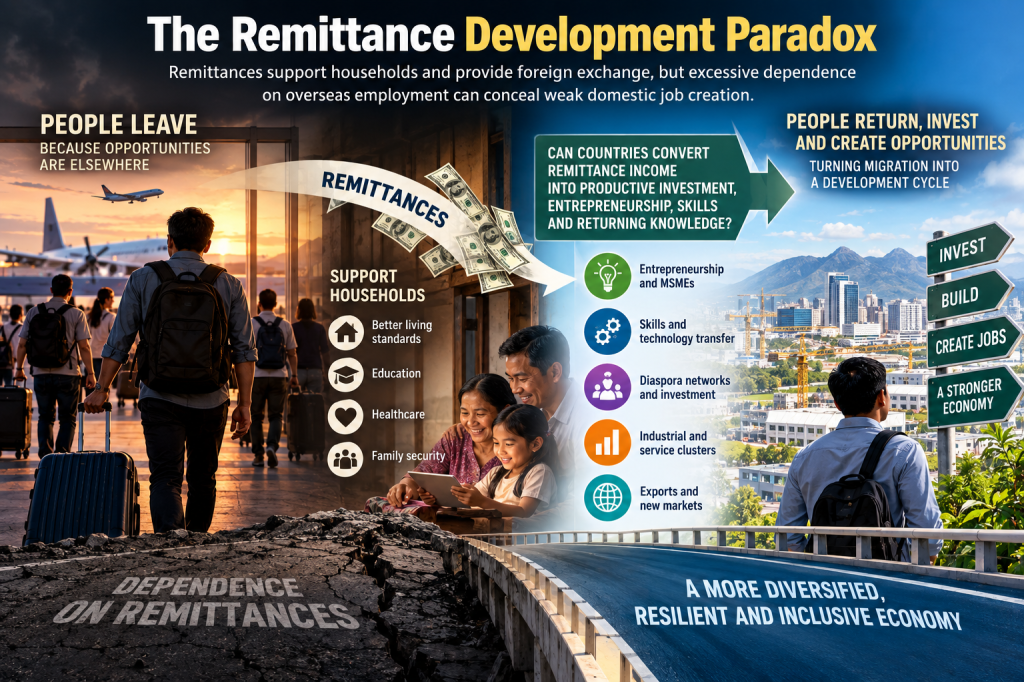
For decades, remittances have been treated as one of the quiet successes of globalisation. A worker leaves home, earns abroad and sends money back. The family gains income, the country receives foreign exchange and poverty often falls. Unlike foreign investment, remittances do not require governments to negotiate with multinational corporations. Unlike external borrowing, they create no sovereign debt. Unlike aid, they come directly into household hands. Yet behind this success lies an uncomfortable question. What happens when a country becomes better at exporting its people than creating opportunities for them at home?
From migration to an economic model. Migration itself is hardly new. Europeans crossed the Atlantic during industrialisation, workers moved from Southern to Northern Europe after the Second World War, and labour from Asia, Africa and the Middle East later moved toward the Gulf, Europe and North America. What has changed is the scale and economic importance of the money flowing back. For many developing economies, remittances have become a structural source of foreign exchange. Families begin to depend on them, housing markets respond to them, banks compete for them and governments quietly incorporate them into their economic expectations. Migration gradually changes from a household decision into part of the national development model.
The paradox begins at the household. Remittances can transform lives. They can finance better food, housing, education, healthcare and protection against emergencies. A migrant worker effectively becomes a private welfare system for the extended family. But the same money may have limited impact on the productive capacity of the local economy. If most remittance income pays for consumption, property, ceremonies, imported goods or financial savings, household welfare improves without necessarily creating enough enterprises, technologies or productive jobs. The village becomes richer, but its economic structure may remain almost unchanged.
This creates an unusual development paradox. Migration can solve unemployment for individuals while allowing the unemployment problem of the economy to survive.
Foreign exchange can hide domestic weakness. Remittances also provide something governments desperately need: foreign currency. They help finance imports and support external balances. This can create economic comfort. But comfort can sometimes postpone reform. A country receiving large and dependable remittance flows may feel less pressure to build competitive manufacturing, modern agriculture, tourism, digital services or export-oriented enterprises. The foreign exchange arrives anyway. What appears to be economic resilience can therefore partly reflect the successful employment policies of another country.
There is an even deeper danger. If the most ambitious, skilled and mobile workers continuously leave, the domestic economy can lose precisely the people most capable of changing it. Nurses, engineers, technicians, construction workers, software professionals and entrepreneurs may generate greater returns abroad than at home. Migration is rational for the individual, yet collectively it can weaken the skills base required for domestic transformation.
But brain drain is no longer the whole story. The traditional debate treated migration largely as a loss of human capital. The future could be very different. A migrant does not only send money. A migrant can accumulate technology knowledge, management practices, international contacts, language skills, quality standards, market information and business networks. The real development asset may therefore be much larger than the remittance appearing in the banking system.
This changes the central policy question from how much money migrants send home to what economic capability returns with that money.
Imagine a construction worker returning with knowledge of advanced building systems, a nurse bringing international healthcare practices, an engineer understanding automated production, a chef knowing global food markets, or a logistics worker understanding modern warehousing. Their accumulated knowledge may ultimately be more valuable than their accumulated savings. Countries that treat returning migrants simply as people coming home will waste this invisible capital.
The next generation of remittance policy must therefore move beyond banking. Governments have spent considerable effort reducing transfer costs and encouraging formal remittance channels. That remains useful, but it is no longer enough. The next institutional architecture should connect migration with enterprise development. Migrants and their families could have access to professionally managed investment vehicles, enterprise matching programmes, credit guarantees, incubation support and cluster-based business opportunities. Returning workers could receive recognition for skills acquired abroad and pathways into entrepreneurship, training or management.
The objective should not be to force families to invest their remittances. Household money belongs to households. The objective is to create attractive opportunities so that productive investment becomes economically sensible rather than administratively demanded.
Clusters offer an overlooked bridge. A migrant from a small town may not have enough capital or knowledge to establish a competitive factory alone. But hundreds or thousands of migrants from the same region may collectively possess substantial savings, skills and international networks. Industrial and service clusters can convert these fragmented resources into shared infrastructure, common processing facilities, logistics, design centres, training institutions and export enterprises. Diaspora networks can simultaneously become the first customers, distributors and market intelligence systems for these businesses.
The migration corridor could therefore evolve into a development corridor connecting overseas employment, savings, technology, entrepreneurship and exports.
The future will make this question more urgent. Aging societies in Europe, East Asia and elsewhere will increasingly need healthcare workers, caregivers, technicians and service professionals, while younger developing economies will continue producing workers seeking better incomes. International labour mobility may consequently become one of the major economic relationships of the coming decades. Countries will compete not only for investment and technology but increasingly for people.
That creates a strategic choice for labour-exporting countries. They can remain suppliers of workers to aging economies and depend increasingly on the money those workers send home. Or they can use migration as a temporary stage in domestic economic transformation.
The distinction is enormous.
In the first model, people leave because opportunities are elsewhere. In the second, people leave, learn, earn, connect and eventually help create opportunities at home.
The most successful remittance economy of the future may therefore not be the country receiving the largest amount of money. It may be the country that eventually becomes less dependent on remittances because migration helped build domestic enterprises, skills and productive employment.
That is the real test of development. Remittances should not merely finance the consequences of insufficient domestic opportunity. They should help finance its eventual replacement.
#Remittances #Migration #Jobs #EconomicDevelopment #Entrepreneurship #MSME #FutureEconomy


Leave a comment