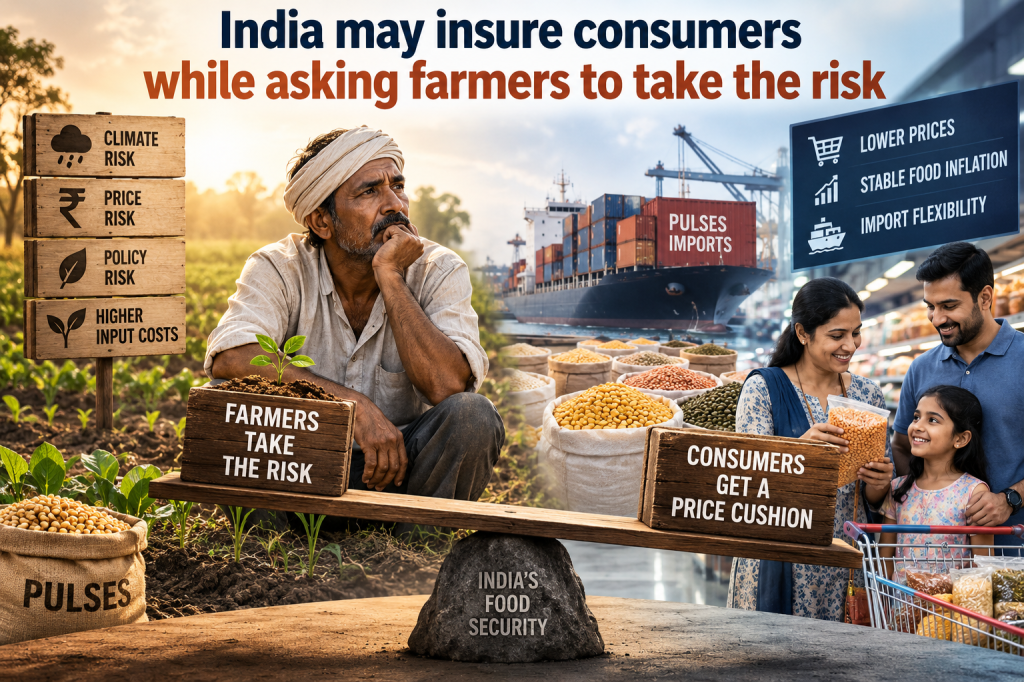
India May Insure Consumers While Asking Farmers to Take the Risk
India’s food policy is entering a difficult contradiction. The country wants farmers to produce more of the crops it chronically imports, particularly pulses, while retaining the freedom to make those same crops cheaper through imports whenever consumer prices rise. In effect, the consumer is increasingly protected from price risk while the farmer is expected to absorb production risk, climate risk and policy risk. That may control inflation today, but it can quietly weaken food security tomorrow.
The Target Itself Sends a Message
For 2026–27, the government has set a foodgrain production target of 373.93 million tonnes, about 2.63 million tonnes below the preceding year’s estimated output. The rabi target is 177.72 million tonnes. A slightly lower aggregate target is not necessarily alarming. Agricultural output cannot be expected to rise mechanically every year, particularly when rainfall, temperatures, water availability and climate volatility are becoming more difficult to predict.
But the more important question is not the total number. It is the composition of production and the incentives behind it.
India has a structural reason to encourage pulses. Imports supplied roughly 23 per cent of domestic pulse consumption in 2024–25. This means that despite being one of the world’s largest producers and consumers of pulses, India remains significantly exposed to overseas supply, international prices, exporting-country policies, currency movements and shipping costs.
Reducing this dependence requires Indian farmers to take a decision months before consumers enter the market. They must decide what to sow without knowing exactly what the government will do with import duties by the time their crop is harvested.
That is where the contradiction begins.
The Farmer Is Being Asked to Bet Against Government Flexibility
Reports on 1 October indicated that India was considering lowering import duties on red lentils and yellow peas, although no notified duty reduction had been issued at that point.
From the consumer side, the logic is perfectly understandable. If domestic pulse prices rise sharply, cheaper imports can increase supply and moderate food inflation. Pulses are an important part of household nutrition, particularly in a country where they are a major source of protein. Governments cannot simply ignore rapid food-price increases.
But agriculture operates on a different clock from retail inflation.
A consumer can change purchases tomorrow. A government can alter a tariff relatively quickly. An importer can contract cargo within weeks. A farmer cannot reverse a sowing decision so easily.
Once land, seed, fertiliser, labour and working capital have been committed, the farmer is locked into a production cycle. If cheaper imports arrive later and depress domestic prices, the adjustment burden falls disproportionately on the producer.
This creates an unusual policy asymmetry: the state retains flexibility, the importer retains flexibility, the consumer receives protection, but the farmer carries the irreversible decision.
From Food Inflation Management to Production Uncertainty
India has historically used a combination of minimum support prices, procurement, buffer stocks, trade restrictions, import liberalisation and administrative interventions to manage food markets. This system emerged from an era when the overriding national concern was food scarcity.
The challenge has changed.
The twenty-first-century food problem is increasingly about managing volatility rather than simply producing maximum quantities. Climate shocks can reduce domestic output. International conflicts can disturb shipping. Exporting countries can suddenly restrict exports. Currency depreciation can make imports expensive. At the same time, domestic inflation can force governments to open import channels precisely when Indian farmers are being encouraged to expand production.
The old food-security architecture therefore risks producing a new form of insecurity: policy uncertainty at the farmgate.
A farmer deciding whether to shift acreage towards pulses is effectively trying to forecast not only rainfall and market prices but also future trade policy.
That is too much uncertainty to place on one economic actor.
Cheap Imports Can Become Expensive Strategy
Imports are not inherently undesirable. In a country of India’s scale, imports can be an essential balancing instrument. The problem begins when emergency instruments become routine price-management mechanisms.
Suppose domestic pulse prices rise. Duties are reduced and imports increase. Consumer inflation moderates. Politically and economically, the intervention appears successful.
But the story does not end there.
Farmers observe lower prices and weaker market expectations. In the next sowing cycle, some shift acreage towards crops offering more predictable returns. Domestic pulse production then grows more slowly or falls. Import dependence rises. When the next international supply shock arrives, India becomes more exposed to precisely the global market it was using to stabilise domestic prices.
A policy designed to reduce volatility can therefore reproduce volatility one season later.
This is the deeper economics of agricultural trade intervention: today’s consumer price is connected to tomorrow’s farmer expectation.
Pulse Clusters Need Intelligence, Not Just Subsidies
This is where cluster development needs to move beyond its traditional infrastructure approach.
A pulse cluster should no longer be understood simply as farmers, traders, processors and warehouses located in the same geography. It should function as a coordinated information and risk-management system.
Major pulse-producing clusters need weekly dashboards combining sowing progress, soil moisture, rainfall, reservoir conditions, expected yields, mandi arrivals, procurement, buffer stocks, mill utilisation, wholesale prices, international prices, contracted imports and expected port arrivals.
The purpose is not to produce another government database. The purpose is to allow economic actors to see the same market.
Farmer Producer Organisations can then negotiate offtake agreements before expanding acreage. Processors can communicate quality and varietal requirements before sowing rather than rejecting produce after harvest. Mills can develop shared grading, testing and segregated storage facilities. Warehousing can allow farmers to avoid distress selling immediately after harvest.
The cluster becomes an institution for reducing uncertainty.
The Missing Institution Is an Offtake Floor
India often discusses MSP when talking about farmer protection. But the next generation of pulse policy should go further.
Farmer organisations, processors, retailers and institutional buyers should increasingly negotiate pre-season offtake floors. These need not guarantee unlimited procurement. They can establish minimum commercial commitments for specified quantities, qualities and delivery periods.
That changes the farmer’s calculation.
Instead of asking whether prices will collapse if imports suddenly increase, farmers would know that at least part of their production has a defined buyer and price floor.
This is particularly important as climate change increases production risk. Asking farmers to move into strategically important crops without creating credible demand architecture effectively asks them to perform a national food-security function with private balance sheets.
That arrangement will eventually reach its limits.
India Needs Predictable Tariff Triggers
The alternative to discretionary intervention is not rigid protectionism. It is predictable flexibility.
India could develop transparent tariff corridors for strategically important food commodities. Import duties could adjust according to publicly known indicators such as domestic stocks, wholesale prices, projected production, buffer requirements and international prices.
If stocks fall below a defined threshold and prices rise beyond a predetermined band, tariffs could decline progressively. When domestic availability recovers, the tariff could automatically normalise.
The important word is not tariff. It is predictability.
Farmers would know the circumstances under which imports could become cheaper. Importers would know when opportunities might open. Processors could plan procurement. Consumers would retain protection against extreme shortages.
Trade policy would become a rule rather than a surprise.
Food Security Is Becoming a Risk-Sharing Question
The deeper debate is therefore larger than pulses.
For decades, Indian agricultural policy focused heavily on how much the country could produce. The next phase will have to ask a more difficult question: who carries the risk required to produce it?
Climate volatility is shifting more production risk towards farmers. Consumers understandably expect governments to intervene when food inflation rises. Governments want the freedom to use international markets as a safety valve.
All three objectives are individually reasonable.
Together, however, they can become contradictory unless the risks are consciously shared.
If consumers are protected through import flexibility, farmers need protection through predictable trade rules, credible procurement, better storage, market intelligence and advance offtake arrangements.
Otherwise India could unintentionally create a system in which consumers are insured against high prices while farmers are asked to speculate on government policy.
The Future Choice: Cheap Food Today or Reliable Food Tomorrow?
The real choice is not between farmers and consumers. That framing is too simplistic.
The choice is between reactive food management and predictable food architecture.
India needs affordable pulses today. It also needs farmers willing to grow pulses next year. These objectives cannot be separated.
Transparent tariff triggers, strong farmer organisations, modern pulse clusters, shared storage and grading infrastructure, advance commercial contracts and intelligent buffer management can make imports a stabiliser rather than a shock to domestic producers.
Ad hoc interventions may deliver cheaper imports quickly. But every unexpected policy change also sends a signal into millions of future sowing decisions.
And agriculture remembers signals.
A country can import food for a season. It cannot import agricultural confidence indefinitely.
IndianAgriculture #Pulses #FoodSecurity #Farmers #FoodInflation #MSMEClusters #FPO #AgriculturalPolicy #TradePolicy #RuralEconomy


Leave a comment