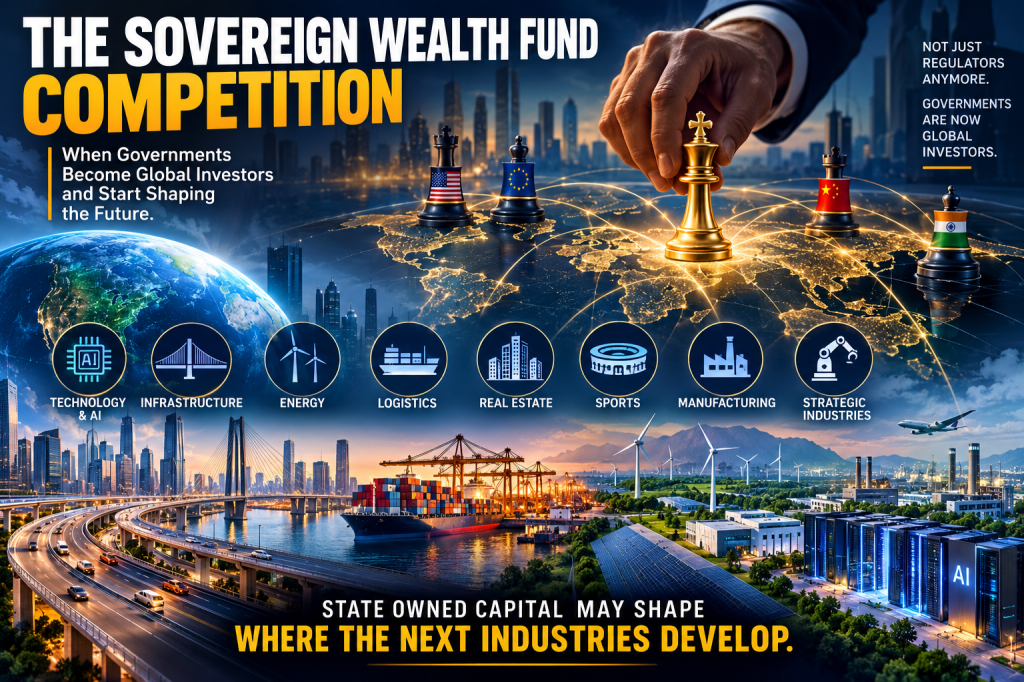
From Regulating Capital to Owning It
For much of modern economic history, governments were expected to create the rules while private companies supplied the capital. The state taxed, regulated, built basic infrastructure and occasionally rescued industries during crises. Private investors decided where factories, technologies and commercial networks would grow. That division is becoming less clear. A new form of economic power is emerging in which governments are not merely supervising markets; through sovereign wealth funds and other state investment vehicles, they are becoming some of the largest investors inside them.
This represents more than a change in financial management. It could gradually alter the geography of global capitalism.
The Historical Journey: From Surplus Management to Strategic Capital
Sovereign investment is not new. Governments with oil revenues, export surpluses or large foreign-exchange earnings have long invested national savings abroad. Kuwait established an investment institution in the 1950s, while later generations of sovereign funds emerged across the Gulf, Singapore, Norway and several Asian economies.
The original economic logic was relatively straightforward: convert temporary resource income or accumulated national savings into diversified financial assets so that future generations could benefit.
But the character of sovereign investing has evolved.
The twentieth-century sovereign investor often behaved largely as a portfolio owner. The twenty-first-century sovereign investor can increasingly behave as an economic architect.
Capital is moving beyond conventional holdings of bonds and listed shares into infrastructure, artificial intelligence, data centres, semiconductors, renewable energy, logistics, biotechnology, advanced manufacturing, real estate, entertainment and sports. This means sovereign capital is increasingly entering sectors that governments themselves consider strategically important.
The distinction between investment policy and industrial policy is therefore beginning to weaken.
Capital Is Becoming an Instrument of Economic Geography
The conventional debate about industrial policy usually focuses on tariffs, subsidies, tax incentives and regulation. But ownership of capital can be equally powerful.
Imagine a sovereign fund investing simultaneously in a port, logistics company, industrial park, renewable-energy project, data centre and technology enterprise within the same economic corridor. Each investment may appear commercial when examined separately. Together, however, they can help construct an ecosystem.
This is where sovereign wealth funds become economically significant beyond their balance sheets.
Future industries rarely emerge because a single factory receives financing. They emerge when capital, infrastructure, technology, skills, suppliers, energy and markets converge. Large sovereign investors potentially have the patience and financial capacity to assemble several pieces of this system at once.
Private capital normally asks: where is the attractive opportunity?
Strategic sovereign capital can ask a different question: where should the next opportunity be created?
That difference could become enormously important.
The New Competition May Be for Ecosystems, Not Companies
Industrial competition has historically moved through different instruments. Britain benefited from trade, finance and industrial technology. The United States combined deep capital markets, research institutions, government procurement and entrepreneurship. East Asian economies demonstrated how coordinated investment, exports, infrastructure and industrial upgrading could transform national productive capabilities.
The emerging phase may add another instrument: globally mobile state-owned capital.
The competition will therefore not simply be about acquiring profitable companies. Sovereign investors can participate in building entire economic ecosystems around technologies considered critical for the next several decades.
Artificial intelligence illustrates the point. The decisive investment is unlikely to be only in an AI company. Competitive advantage may require semiconductor capacity, computing infrastructure, data centres, electricity, cooling systems, research institutions, skilled workers and venture financing. Similar ecosystem logic applies to batteries, green hydrogen, biotechnology, defence technology and advanced logistics.
The sovereign fund capable of connecting these assets can become more than an investor. It can become an ecosystem builder.
Patient Capital Could Become a Strategic Advantage
One of the weaknesses of modern financial markets is their frequent tension between long-term industrial development and short-term financial expectations. Building semiconductor ecosystems, new energy systems, ports or advanced manufacturing capabilities can require enormous upfront investment and long periods before returns mature.
Sovereign capital can potentially operate with longer horizons.
That does not automatically make it superior. State investment can produce expensive failures, political interference, weak accountability or projects protected from commercial discipline. Governments are no more immune to bad investment decisions than private investors.
But patient capital becomes powerful when combined with commercial discipline.
This could create a new competitive distinction between countries: not simply those possessing capital and those lacking it, but those capable of converting national wealth into productive capabilities and those merely accumulating financial assets.
The Hidden Risk: Markets May Become Less Market-Driven
There is also an uncomfortable question.
What happens when increasingly large pools of government-owned money operate across supposedly private global markets?
The boundary between commercial return and national strategy can become difficult to identify. An investment may simultaneously generate profit, secure technology, deepen diplomatic relationships, create supply-chain access and strengthen a country’s geopolitical position.
This does not mean every sovereign investment should be interpreted politically. Many are commercially motivated and professionally managed. But as sovereign funds become larger and more active in strategic sectors, recipient countries are likely to examine ownership, governance and national-security implications more carefully.
The paradox is striking.
Globalisation was expected to reduce the economic importance of the state. Instead, the next stage of globalisation may feature governments participating in global markets through investment institutions possessing extraordinary financial power.
The World Could Develop a New Hierarchy of Capital
This transformation may create another inequality between nations.
Countries with enormous resource revenues, trade surpluses or accumulated financial assets can deploy capital internationally. Countries with fiscal deficits and limited savings may instead compete to attract that capital.
One group can therefore increasingly influence where infrastructure, technology and production ecosystems are created, while another negotiates the terms on which those investments arrive.
That could produce a new hierarchy in the international economy: capital-exporting states, capital-attracting states and capital-dependent states.
For developing economies, this distinction matters. Attracting sovereign capital can accelerate infrastructure and industrial development, but excessive dependence on external strategic investors may also reduce bargaining power.
The important question will therefore not be simply how much foreign capital enters an economy, but what domestic capability remains after the capital has arrived.
India: Attract Capital, but Convert It Into Capability
For India, the sovereign wealth fund competition creates both opportunity and a strategic challenge.
India’s large market, infrastructure requirements, digital economy, manufacturing ambitions and energy transition make it a natural destination for long-term institutional capital. Sovereign investors can potentially support logistics, renewable energy, industrial corridors, urban infrastructure, technology platforms and advanced manufacturing.
But investment volume alone is a poor measure of success.
The stronger test is whether incoming capital develops Indian supplier networks, technological capabilities, managerial knowledge, skilled employment, research capacity and export competitiveness.
A billion-dollar investment that creates an isolated asset may contribute less to long-term transformation than a smaller investment deeply connected to domestic enterprises and industrial clusters.
India therefore needs to think beyond attracting capital toward engineering economic spillovers from capital.
This is particularly important for MSMEs. Large sovereign-backed projects can easily become islands surrounded by weak domestic supplier ecosystems. Industrial policy should instead connect major investments with vendor development, common technology facilities, skills institutions, testing infrastructure and cluster upgrading.
The objective should be to convert global capital into local productive capability.
The Sovereign Fund of the Future May Resemble a Development Platform
By the 2030s, the distinction between sovereign wealth funds, development finance institutions, infrastructure investors and strategic investment agencies may become increasingly blurred.
The most sophisticated sovereign institutions may combine financial returns with technology partnerships, industrial development, supply-chain positioning and international economic relationships.
They could effectively become global development platforms backed by national balance sheets.
This would change the nature of international economic competition. Countries would compete not only through companies selling products abroad but through national investment institutions helping shape industries abroad.
Ports may connect to logistics investments. Energy projects may connect to industrial parks. Data centres may connect to AI ecosystems. Mining investments may connect to battery manufacturing. Financial ownership may increasingly connect entire value chains.
The Next Map of Global Power May Be Drawn by Capital Allocation
The most important consequence is therefore larger than sovereign wealth funds themselves.
Economic power has traditionally been measured through GDP, trade, military strength, technological capability and control over natural resources. The coming decades may require another measure: the capacity to deploy patient strategic capital across borders.
A country able to influence where technology is financed, where infrastructure is constructed, where energy systems develop and where manufacturing ecosystems emerge possesses a subtle form of power. It does not necessarily control another economy, but it can influence the architecture within which that economy develops.
The sovereign wealth fund competition should therefore not be understood simply as governments searching for higher investment returns.
It is potentially the beginning of a deeper transformation in global capitalism.
Yesterday, states regulated markets. Today, some states invest in markets. Tomorrow, the most financially powerful states may increasingly help design the markets, industries and economic geographies in which everyone else competes.
The critical question of the next decade may consequently shift from Who owns the company? to something much larger:
Who owns the capital that decides where the future will be built?
SovereignWealthFunds #GlobalEconomy #Investment #IndustrialPolicy #Infrastructure #Manufacturing #Technology #EconomicGeography #MSME #India #GlobalCapital #FutureEconomy


Leave a comment