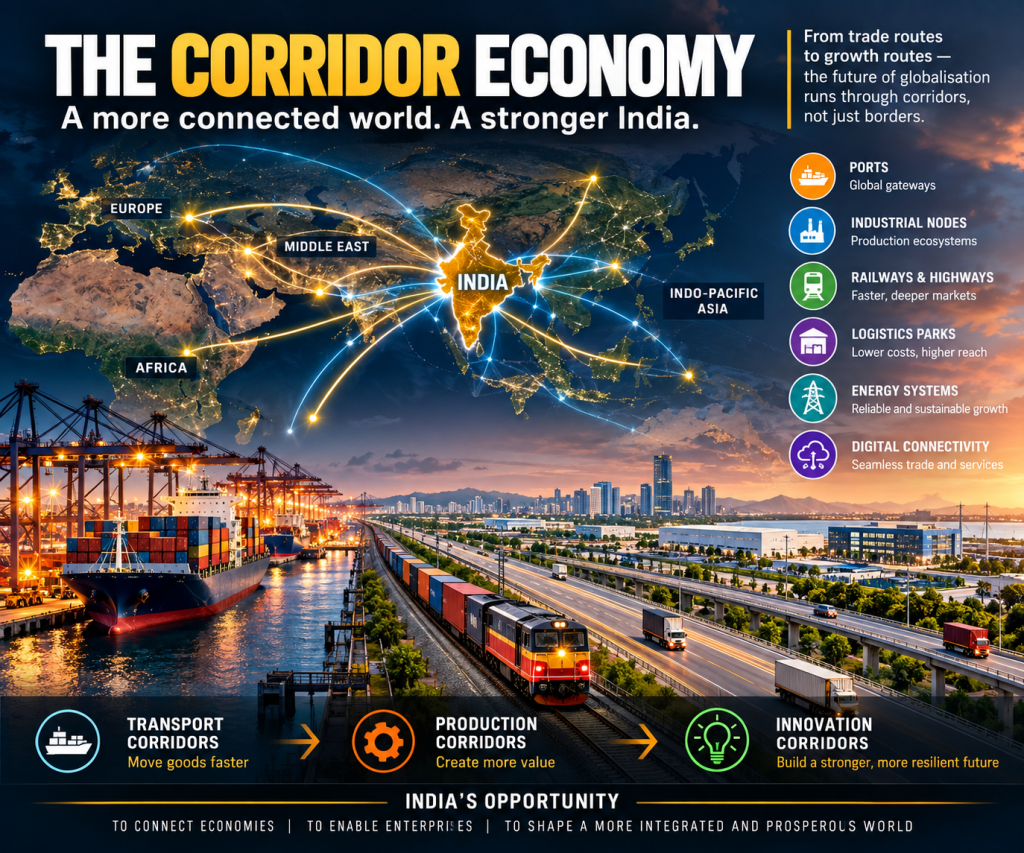
For several decades, globalisation encouraged us to imagine that geography was becoming less important. Containers reduced transport costs, digital communication compressed distance, multinational firms spread production across continents, and trade agreements lowered borders. The dominant idea was simple: capital would go where costs were lowest and goods would move wherever demand existed. But the emerging world economy is beginning to look very different. Geography is returning—not merely as territory, but as a network of corridors connecting ports, factories, cities, energy systems, data centres and markets. The economic map of the future may increasingly be drawn by corridors rather than countries.
From National Economies to Corridor Economies
Industrialisation was never geographically neutral. Britain grew around ports, coalfields, canals and railways. The American economy expanded through railway networks linking production regions with large consumer markets. Japan built powerful coastal industrial belts. Later, East Asia created perhaps the most sophisticated manufacturing geography in history, connecting Japanese technology, Korean components, Taiwanese electronics, Chinese factories and Southeast Asian production through dense maritime and industrial networks.
What is changing today is the scale of this logic.
A modern economic corridor is no longer simply a highway connecting two cities. It can combine ports, freight railways, expressways, airports, industrial clusters, logistics parks, energy pipelines, electricity networks, fibre-optic systems, digital platforms, customs systems and financial infrastructure. When these elements operate together, distance is no longer measured simply in kilometres. It is measured in time, reliability, documentation, inventory cost and commercial uncertainty.
A factory located 300 kilometres from a port with predictable logistics may effectively be closer to the world market than another factory only 80 kilometres away but trapped behind congestion, fragmented trucking, unpredictable customs and unreliable power.
This is why the next competition between countries may partly become a competition between corridors.
The Container Changed Trade. The Corridor May Change Production
The container revolution transformed international commerce because it standardised the physical movement of goods. The emerging corridor economy could go further by integrating the entire movement of production.
Consider what happens when a port is connected to an industrial node by dedicated freight rail, the industrial node has reliable renewable electricity, suppliers are located nearby, customs documentation is digital, warehouses are automated and cargo schedules are predictable. The result is not simply lower freight cost. The entire production system becomes more investible.
This distinction matters.
Governments frequently treat infrastructure as a collection of projects: build a road, expand a port, announce an industrial park, establish a logistics centre and create a digital portal. But businesses experience infrastructure as a journey. A container does not care how many infrastructure schemes exist. It cares whether it can move from factory to customer reliably.
The corridor therefore has to become an economic system rather than a construction programme.
The Missing Infrastructure Is Often Between the Infrastructure
This is where corridor strategies frequently fail.
A country can build an excellent highway leading to a congested port. It can establish an industrial park without adequate suppliers. It can construct warehouses without sufficient cargo volumes. It can digitalise customs while exporters still require multiple physical approvals elsewhere.
Every component may appear successful individually while the corridor remains commercially inefficient.
The real measure of corridor performance should therefore shift from kilometres constructed to friction removed.
How long does cargo remain inside a port? How quickly can a small exporter complete documentation? How reliably can a manufacturer obtain electricity? How many suppliers can be reached within four hours? How easily can goods cross a border? How much working capital remains trapped in inventory while products are moving?
These questions reveal something important: the most expensive part of infrastructure may sometimes be the institutional gap between two pieces of physical infrastructure.
The Corridor Is Also Becoming Digital
The future corridor will not carry only containers.
It will carry electricity, information, payments, designs, certification records, customs data and eventually large volumes of machine-generated industrial information.
Ports will communicate with warehouses. Factories will communicate with logistics platforms. Customs systems will communicate across borders. Supply chains will increasingly require product traceability, carbon information, origin verification and digital compliance records.
This means that the physical corridor and the digital corridor will gradually merge.
A highway without digital logistics will become less competitive. A port without data integration will become slower relative to automated alternatives. An industrial cluster disconnected from digital trade systems may remain physically close to global markets but commercially distant from them.
The corridor economy therefore creates a new definition of connectivity: physical movement + digital visibility + regulatory interoperability + financial settlement.
India Sits at an Unusual Economic Intersection
This transformation could have particularly large implications for India.
India occupies a geographic position between the Indo-Pacific production system, the energy economies of the Middle East, the emerging markets of Africa and the large consumer markets of Europe. For decades, this location existed largely as geographic potential. Geography creates opportunity, but infrastructure converts geography into economics.
India’s strategic opportunity is therefore not simply to become another manufacturing location. It is to become a production-and-connectivity platform linking several economic regions.
Western India could increasingly connect manufacturing clusters with Gulf markets and onward commercial routes toward Europe and Africa. Southern India can deepen integration with Indian Ocean and Southeast Asian production networks. Eastern India can become a stronger bridge toward Bangladesh and Southeast Asia. Domestic freight corridors can connect inland manufacturing locations with these international gateways.
But this opportunity should not be romanticised. Being located between important markets does not automatically make a country a commercial bridge. Trade flows through the route offering the best combination of cost, speed, reliability and political confidence.
Geography provides the invitation. Competitiveness determines whether cargo accepts it.
India Must Avoid the Transit-Country Trap
There is another danger hidden inside the corridor narrative.
Moving more containers through India is not necessarily the same as creating more Indian value.
The strongest corridor strategy would ask not only how goods can move faster, but what economic activities can develop around their movement.
Can Indian companies provide logistics services? Can engineering firms manufacture port equipment? Can MSMEs supply components to industries located along the corridor? Can Indian financial institutions finance trade? Can testing laboratories provide certification? Can repair, packaging, warehousing, cold-chain and digital services develop around major nodes?
The objective should be to convert transport corridors into production corridors and production corridors into innovation corridors.
Otherwise, India could become geographically important while capturing only a small share of the value travelling through its territory.
MSMEs Could Become the Hidden Winners—or the Bypassed Majority
Large infrastructure projects naturally attract large corporations. Yet the deeper economic effect of corridors will depend on whether smaller firms become connected to them.
An industrial corridor surrounded by thousands of disconnected MSMEs is only partially successful.
The next generation of cluster policy should therefore connect MSME clusters with corridor infrastructure through common logistics facilities, testing laboratories, digital export systems, supplier-development programmes, warehousing, design centres and shared compliance services.
Imagine a small engineering cluster located several hundred kilometres inland. If freight connectivity reduces delivery uncertainty, digital customs reduce paperwork and a nearby logistics hub consolidates smaller shipments, firms that previously could not export economically may suddenly become internationally viable.
That is when infrastructure becomes development.
The New Economic Unit May Be the Network
The twentieth century taught economics to think primarily through national economies. GDP, trade balances, industrial policy and productivity were measured within national borders.
The twenty-first century may require another layer of thinking.
A semiconductor ecosystem may connect several countries. A renewable-energy supply chain may stretch from mineral extraction in one continent to processing in another and manufacturing somewhere else. A food corridor may connect farms, cold chains, ports and urban markets across national boundaries.
Economic power may therefore increasingly belong to countries capable of occupying valuable positions inside these networks.
The strategic question changes from What does a country produce? to Where does it sit inside the system that produces it?
That is a much deeper question.
From Economic Corridors to Economic Architecture
The most successful corridors of the future will probably not be transportation projects at all. They will become economic architectures.
Around major routes will emerge manufacturing zones, energy networks, data infrastructure, financial services, logistics companies, technology centres, universities, cities and supplier ecosystems. Once such systems reach sufficient density, they become difficult to replicate elsewhere because their advantage comes from the network rather than any individual subsidy.
This could reshape globalisation itself.
The earlier phase of globalisation searched relentlessly for the cheapest supplier. The emerging phase may search for the most dependable connected ecosystem.
That shift has profound implications for India.
India does not need merely more roads, ports and industrial parks. It needs to make them function as one commercial geography. Ports must connect with factories, factories with clusters, clusters with skills, logistics with digital systems, energy with manufacturing and infrastructure with international markets.
The decisive economic question of the coming decades may therefore not be whether India is located on the world’s major trade routes.
It already is.
The real question is whether India can transform that location into an integrated economic system capable of capturing the production, services, technology and knowledge moving through those routes.
The future map of globalisation may contain fewer isolated factories and more connected corridors. Countries will remain important, but economic power may increasingly accumulate at the intersections where production, logistics, energy, data and markets meet. India’s opportunity is not simply to lie between the Indo-Pacific, Middle East, Africa and Europe. It is to become one of the places where these economic worlds actually connect.This framing deliberately moves beyond the conventional infrastructure argument: the central issue is not corridor construction but value capture—whether India merely provides the route or builds manufacturing, MSME, logistics, financial, technology and knowledge ecosystems around that route.
CorridorEconomy #India #EconomicCorridors #Manufacturing #MSME #Logistics #GlobalTrade #IndustrialCorridors #SupplyChains #Infrastructure #Exports #EconomicGeography #FutureOfTrade


Leave a comment