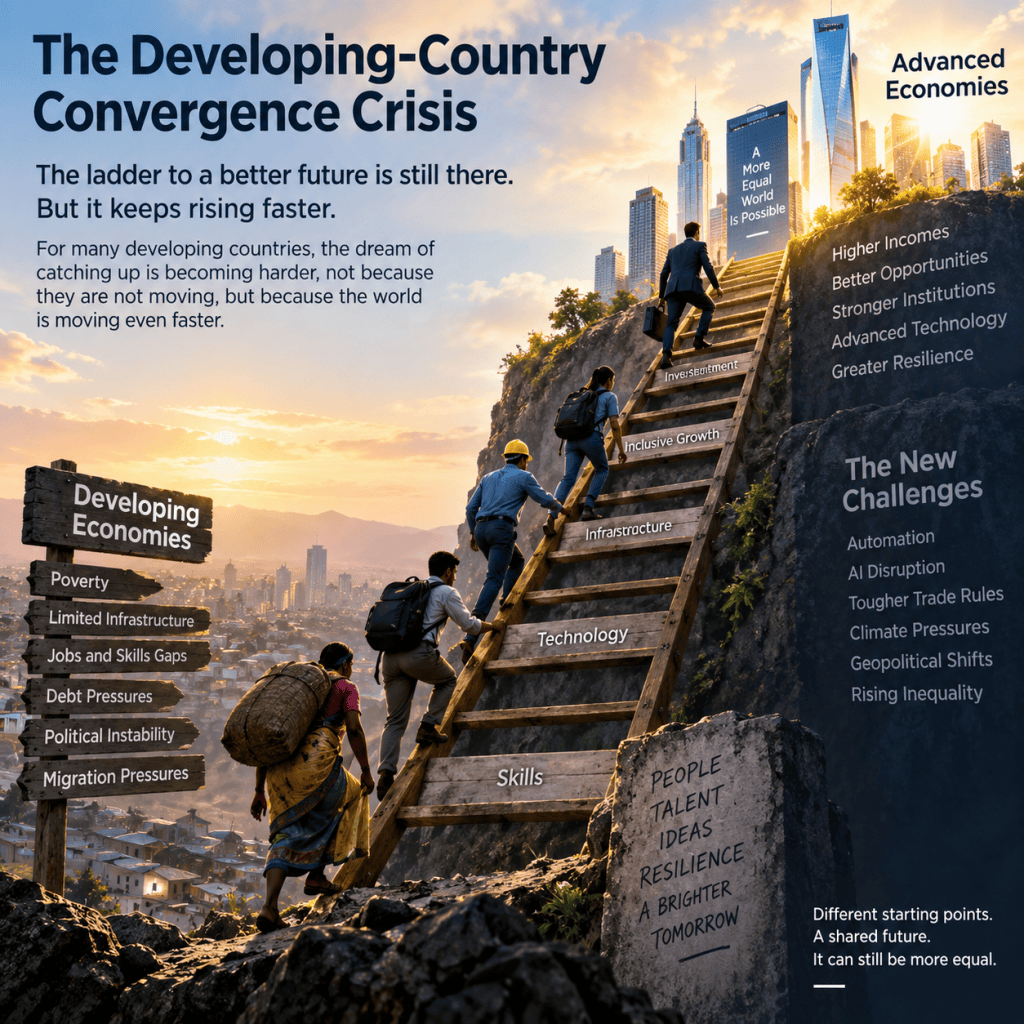
For much of the modern development story, there was one powerful assumption: poorer countries would eventually become richer. They would industrialise, export, attract investment, acquire technology, improve productivity and gradually close the income gap with advanced economies. Globalisation was expected to make this process faster.
That assumption is becoming much harder to defend.
The Ladder Is Still There, But Someone Is Removing the Steps
The old development model was relatively straightforward. Britain industrialised first. The United States, Germany and Japan followed. Later, South Korea, Taiwan, Singapore and eventually China demonstrated that countries starting far behind could transform themselves within a few decades.
Factories mattered enormously in this process. Manufacturing absorbed workers leaving agriculture, created export earnings, transferred technology and produced large productivity gains. A worker moving from a low-productivity farm to a reasonably productive factory could generate an enormous economic jump without becoming dramatically more educated overnight.
Globalisation strengthened this possibility. Production was broken into global value chains. Developing countries did not need to manufacture an entire automobile, computer or machine. They could enter through components, assembly, garments, electronics, food processing or business services and gradually move upward.
But the world that made this model possible is changing.
The Convergence Machine Is Slowing Down
The warning coming from the World Bank is particularly important. Developing economies excluding China and India risk approaching 2028 after nearly a decade in which, collectively, they have made little meaningful progress in narrowing their per-capita-income gap with advanced economies.
This is not simply another disappointing growth statistic. It suggests that one of the central expectations of the global economic system may be weakening.
Growth can continue while convergence stops.
A developing economy growing at 3 percent may appear successful. But if richer economies maintain productivity advantages, technological leadership and much higher starting incomes, the relative gap can remain enormous. Development therefore cannot be measured only by whether GDP is rising. The harder question is whether poorer countries are actually catching up.
Increasingly, many are not.
Globalisation Is Changing Before Development Is Complete
The timing could hardly be worse.
Many developing countries entered globalisation when labour was their major competitive advantage. They had young populations, relatively low wages and millions of people capable of moving from agriculture into industry.
Now technology is reducing the value of that advantage.
Automation means that factories can produce more with fewer workers. Artificial intelligence could automate parts of services that once appeared to offer developing countries a new employment ladder. Advanced manufacturing increasingly depends on semiconductors, software, robotics, intellectual property, sophisticated logistics, reliable electricity and specialised skills.
Cheap labour alone is becoming a weak development strategy.
At the same time, global trade itself is becoming more conditional. Carbon standards, industrial subsidies, local-content requirements, strategic tariffs, technology controls, supply-chain security and geopolitical alliances increasingly influence where production takes place.
The world may therefore be becoming technologically harder to enter precisely when poorer economies need global markets most.
China Was Not the Normal Story
There is another uncomfortable lesson.
The extraordinary rise of China shaped our understanding of global convergence. Hundreds of millions of people moved into more productive economic activities while China became deeply integrated into global manufacturing.
But China possessed a combination that is difficult to reproduce: enormous scale, infrastructure investment, manufacturing ecosystems, state capacity, domestic savings, export discipline and eventually a vast internal market.
India also possesses demographic and market scale unavailable to most countries.
A country of 10 million, 20 million or even 50 million people cannot simply copy China or India. Many smaller developing economies remain dependent on commodities, tourism, remittances or a narrow range of exports.
Their development problem is therefore becoming more difficult.
The New Divide May Be About Capability, Not Wages
The next global income divide may look very different from the previous one.
Countries may increasingly be separated by their ability to command technology, energy, computing capacity, logistics, finance, skills and institutions.
Imagine two countries with equally inexpensive labour.
One has reliable electricity, ports, digital infrastructure, technical universities, efficient customs, domestic suppliers, laboratories and access to international finance.
The other has cheaper workers but unreliable electricity, expensive credit, weak logistics and limited technological capability.
The second country may actually be the more expensive place to produce.
This changes the meaning of competitiveness.
The future competition between countries will increasingly be about the cost of the entire productive ecosystem rather than the wage of an individual worker.
The Most Dangerous Outcome Is Development Without Transformation
Many developing economies may continue growing without fundamentally changing what they produce.
Cities will expand. Smartphones will spread. Consumption will increase. Digital payments will become common. Shopping malls will appear. Services will grow.
Yet underneath this visible modernisation, productivity may remain weak.
A country can look increasingly modern without becoming significantly more productive.
That distinction matters enormously.
Real convergence requires workers, firms and regions to move towards activities that generate greater value. It requires domestic companies to learn, innovate and eventually compete internationally. It requires agriculture, manufacturing and services to become progressively more productive rather than simply transferring workers from rural poverty into urban informality.
Without that transformation, growth can become an illusion of progress.
The Political Consequences Could Be Larger Than the Economic Ones
People compare their lives not only with their parents but increasingly with people elsewhere.
A young person in Nairobi, Dhaka, Lagos or Kathmandu can see lifestyles, wages and opportunities available in London, Toronto, Dubai or New York almost instantly.
Digital visibility has globalised aspiration much faster than economic opportunity.
That creates a dangerous gap between expectations and possibilities.
If domestic economies cannot provide productive employment, migration pressure will rise. If education expands faster than suitable jobs, frustration among educated young people may increase. If a small globally connected elite captures most technological opportunities while large populations remain in low-productivity activities, inequality can become politically explosive.
The convergence crisis could therefore eventually become a crisis of expectations.
India Should Not Celebrate Too Early
India occupies an unusual position because its scale, services capability, digital infrastructure and expanding manufacturing ambitions provide advantages unavailable to many developing countries.
But India should treat the global convergence slowdown as a warning rather than reassurance.
India itself contains several development worlds.
Parts of Bengaluru, Hyderabad, Pune, Chennai, Gurugram and Mumbai operate close to the technological frontier. At the same time, millions of enterprises remain extremely small, informal, poorly financed and technologically weak.
The global convergence problem therefore exists inside India as well.
The important question is not merely whether India catches richer countries. It is whether Bihar catches Tamil Nadu, whether smaller cities catch metropolitan regions, whether micro enterprises become productive firms and whether ordinary workers participate in the productivity gains created by technology.
National convergence without internal convergence can produce impressive GDP alongside deep economic frustration.
Development Policy Must Move From Attraction to Capability
For years, governments have competed to attract factories through tax concessions, industrial parks, cheap land and investment summits.
These may help, but they are no longer enough.
The real development race will increasingly concern capability: supplier development, worker skills, testing facilities, standards, technology absorption, reliable infrastructure, research institutions, affordable capital and the ability of smaller firms to participate in sophisticated value chains.
This makes cluster development particularly important.
A factory can be imported. An industrial ecosystem cannot.
Machines can arrive in containers within weeks. Building hundreds of competent suppliers, technicians, designers, toolmakers, laboratories and specialised service firms can take decades.
Countries that understand this difference may still converge.
Those that confuse investment announcements with productive transformation may discover that factories exist while development remains strangely absent.
The Next Development Race Has Already Started
The twentieth-century development race was largely about industrialisation.
The early twenty-first century added globalisation.
The coming decades may be about something more demanding: technological capability under conditions of fragmented globalisation.
Artificial intelligence, clean energy, advanced manufacturing, biotechnology, digital services and automation could create extraordinary productivity gains. But they could also concentrate those gains among countries already possessing capital, infrastructure, knowledge and institutional capacity.
That is the central danger.
Technology does not automatically produce convergence. Globalisation does not automatically produce convergence. Investment does not automatically produce convergence.
Countries converge when they develop the capability to learn, produce increasingly sophisticated things and continuously raise the productivity of ordinary people and firms.
For decades, development economics asked how poorer countries could climb the global economic ladder.
The emerging question is more unsettling.
What happens if the ladder itself starts moving upward faster than poorer countries can climb it?
That may become one of the defining development challenges of the 2030s.
DevelopingEconomies #Globalisation #EconomicDevelopment #India #MSME #Productivity #Industrialisation #GlobalEconomy
 "Connecting communities, empowering nations: Unifying the Regional and Global Economy ."
Leave a comment