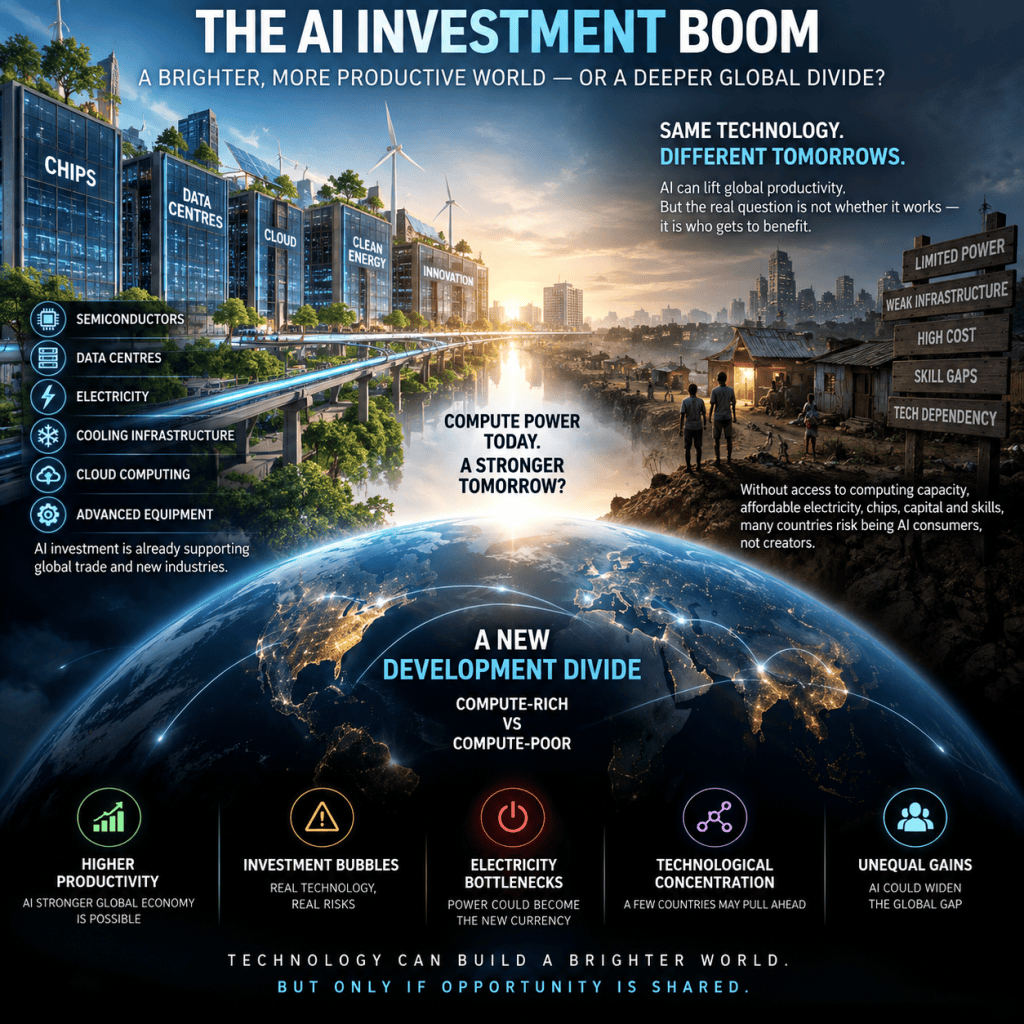
Artificial intelligence is usually discussed as a technology revolution. It may be more useful to see it as the beginning of a new economic geography. The factories of the industrial age were built around coal, steel, ports and railways. The digital economy grew around software, telecommunications and the internet. The AI economy is being built around something different: computing power, semiconductors, data centres, electricity, cooling systems, cloud infrastructure, data, research capability and highly specialised human skills. This means the AI boom is not simply creating another technology industry. It is creating an entirely new infrastructure of production.
From steam power to computing power. Every major productivity revolution has depended on infrastructure before its benefits spread across the economy. Steam required coal and railways. Mass manufacturing required electricity, machines and highways. The internet required telecommunications networks, computers and data connectivity. AI follows the same historical pattern, but with an important difference. Its infrastructure is enormously capital-intensive and technologically concentrated. A business may access an AI application cheaply, but somewhere behind that application are expensive chips, enormous computing facilities, electricity networks, cooling systems and sophisticated software. The apparent simplicity of AI therefore hides a very heavy industrial foundation.
The AI boom is becoming an investment boom. This is why AI spending is spreading far beyond software companies. Semiconductor manufacturing, advanced machinery, power generation, transmission equipment, data centres, cooling technologies, fibre networks and cloud infrastructure are becoming part of the same investment cycle. AI may therefore stimulate manufacturing and international trade even before its full productivity benefits appear. The strange feature of this revolution is that an increasingly virtual economy requires an increasingly physical infrastructure.
But investment is not the same as productivity. History offers an important warning. Railway booms, electricity expansion, telecommunications investment and the dot-com era all attracted periods of excessive optimism. Valuable technologies can still produce bad investments. Too much capital can chase too few commercially sustainable projects. Data centres can be constructed faster than profitable AI applications emerge. Computing capacity can expand faster than electricity systems. Company valuations can rise much faster than productivity. An AI investment bubble and a genuine AI technological revolution can therefore exist at the same time. One does not necessarily disprove the other.
The real question is who captures the productivity gain. AI may eventually raise global productivity, but global productivity is an average. Averages hide geography. Countries possessing advanced semiconductor access, abundant and reliable electricity, computing infrastructure, research institutions, capital, data ecosystems and skilled people could move much faster than countries that mainly consume imported AI services. The world may consequently experience rising global productivity alongside widening international inequality.
A new development divide is appearing. During the twentieth century, economists often distinguished countries according to industrial capital, infrastructure and manufacturing capability. In the coming decades, another distinction may become equally important: compute-rich and compute-poor economies. A country can have millions of internet users and still remain technologically dependent if its businesses rely on foreign chips, foreign cloud infrastructure, foreign foundation models and foreign technical standards. Digital participation should not be confused with technological capability.
This changes the meaning of economic sovereignty. Earlier, countries worried about dependence on imported oil, machinery or defence equipment. Tomorrow, dependence on computing infrastructure could become equally strategic. Electricity availability, semiconductor supply chains and access to advanced computing may increasingly determine whether a country can develop competitive pharmaceuticals, financial services, manufacturing systems, logistics networks, defence technologies or scientific research.
Electricity could become the hidden currency of AI. AI discussions often focus on algorithms while overlooking energy. Yet computing ultimately converts electricity into intelligence-like services. Countries capable of supplying reliable, competitively priced and increasingly low-carbon electricity may gain an unexpected industrial advantage. The geography of AI investment could therefore begin following the geography of energy. Renewable power, grids, storage, nuclear energy, cooling technologies and data-centre infrastructure may become parts of technology policy rather than separate sectors.
For developing countries, the danger is becoming AI consumers rather than AI producers. This distinction does not mean every country must manufacture advanced chips or build its own frontier model. That would be unrealistic. The more important challenge is developing enough domestic capability to adapt AI to local industries and capture productivity gains locally. Agriculture needs AI connected with farms and supply chains. Manufacturing needs applications connected with machines, quality systems and production planning. Healthcare requires appropriate data and institutional systems. MSMEs need inexpensive tools accompanied by implementation capability, not merely subscriptions to sophisticated foreign platforms.
India illustrates both the opportunity and the challenge. Its software base, engineering talent, digital public infrastructure, large domestic market and expanding electronics ecosystem provide important foundations. But the next stage cannot be measured simply by the number of AI users, start-ups or applications. The deeper test will be whether AI improves productivity inside factories, farms, logistics systems, hospitals and millions of smaller enterprises. If the technology remains concentrated among large corporations and digitally sophisticated firms, AI could increase productivity while simultaneously widening the productivity gap within the economy.
The next cluster policy may therefore be a compute policy. Industrial clusters traditionally shared physical infrastructure, testing facilities, training institutions and specialised services. The same logic can be extended into the AI age. Smaller firms may need shared AI infrastructure, sector-specific datasets, affordable computing facilities, common technology centres, specialised training and trusted implementation partners. Instead of expecting every MSME to independently build technological capability, clusters can become mechanisms for democratising access to AI.
This could be one of the most important changes in development strategy. The old question was whether a region had roads, electricity, finance and industrial land. The emerging question will include whether firms can access computing power, usable data, AI skills and intelligent production systems at competitive cost.
The future divide may not be between countries that have AI and those that do not. AI applications will eventually be available almost everywhere. The deeper divide will be between economies that use AI to transform production and those that merely use AI to consume information.
That is why the AI investment boom deserves both excitement and caution. It may become one of the strongest productivity forces of the twenty-first century. But technology does not automatically distribute its gains. Infrastructure, institutions, skills, energy and industrial capability determine where those gains finally accumulate.
The next global development race may therefore be less about who has access to artificial intelligence and more about who possesses the economic ecosystem capable of turning computing power into productive power.
And that could make compute capacity the industrial capital of the twenty-first century.
AI #India #FutureEconomy #Productivity #MSM
 "Connecting communities, empowering nations: Unifying the Regional and Global Economy ."
Leave a comment