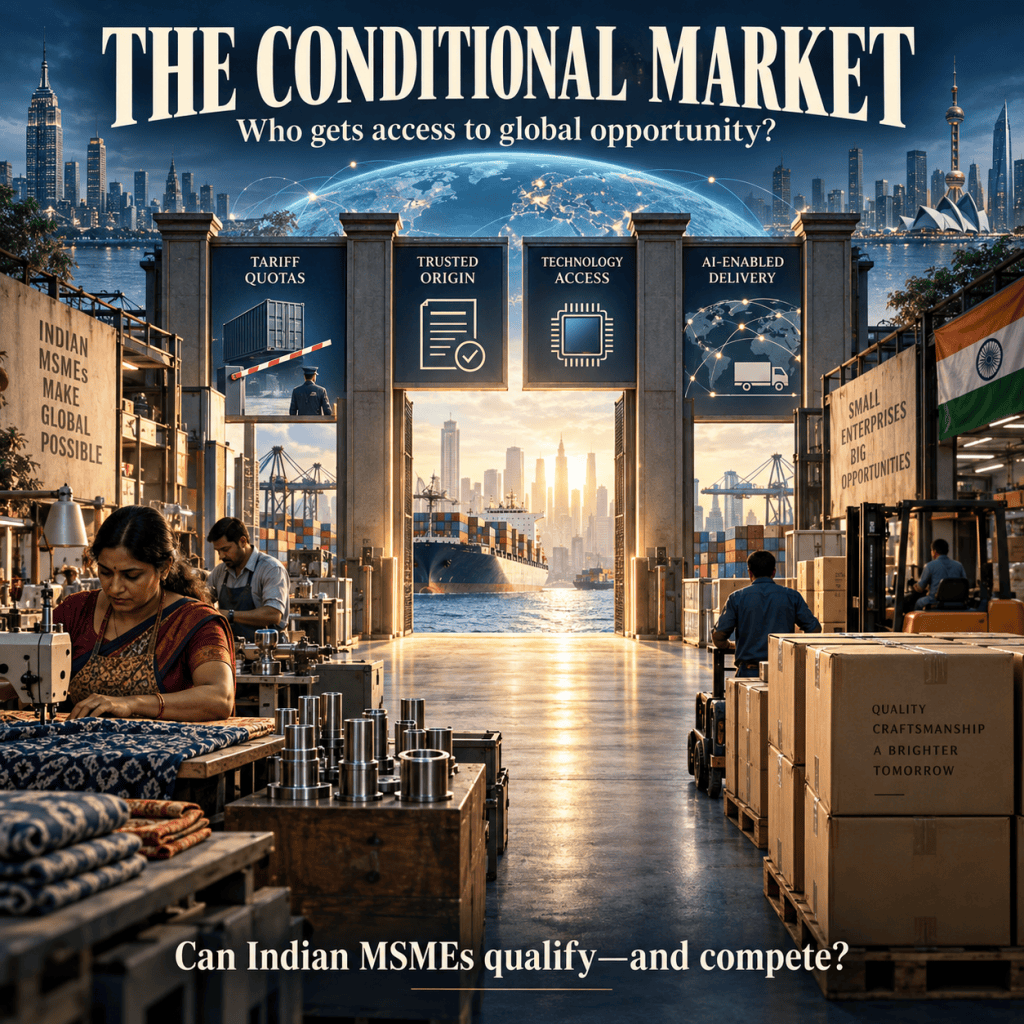
A factory can make a good product, offer a fair price and find an interested buyer—and still struggle to secure the order. Its shipment may fall outside a favourable tariff quota. Its inputs may fail an origin requirement. Its production may depend on restricted technology. Its delivery system may be too slow for a buyer whose purchasing decisions are increasingly automated.
This is the emerging problem of market access. Opportunity exists, but the conditions for capturing it are becoming more demanding. For India, the difficult question is whether more enterprises will become capable of meeting those conditions, or whether export growth will remain concentrated among those already equipped to navigate them.
From lowering borders to managing entry. Trade has never been free of conditions. Colonial commerce privileged selected routes and merchants. Post-war trade negotiations sought to reduce tariffs and make commercial rules more predictable. Later, global value chains spread production across countries, allowing firms to specialise in particular stages of manufacturing.
That expansion did not remove power from trade. It redistributed power among governments, lead firms, technology owners and distribution networks. The emerging shift is that access increasingly depends on satisfying several of these authorities simultaneously. A trade agreement may improve the terms of entry, while a buyer, technology supplier or digital platform determines whether an enterprise can use that opening.
The border is becoming a series of decisions that begins before production and continues until the customer receives the product.
An open market can still have limited room. Tariff-rate quotas illustrate this clearly. Imports within a specified quantity face a lower duty; quantities outside it face a higher rate. Unlike an absolute quota, this does not necessarily stop further imports, but it can change their commercial viability. Such arrangements have a long history, including in agricultural trade.
For a small exporter, the distinction is substantial. A favourable tariff means little if the available quota has already been used. Depending on the allocation system, established trading relationships, administrative capability and shipment timing can influence who benefits.
Consider an illustrative order with a margin of 8 per cent. An unexpected additional duty of ten percentage points on a comparable value base could eliminate that margin if the exporter has to absorb it. A competitive factory can therefore lose money because the conditions of entry changed between quotation and clearance.
Export promotion must look beyond the announced tariff. Firms need to understand allocation procedures, remaining availability, delivery windows and who bears the cost when eligibility changes. Access on paper and a profitable shipment are different achievements.
Origin is becoming part of the product. A finished item carries the history of its inputs and processing. Rules of origin determine how that history establishes its economic nationality. Requirements differ: they may involve changes in tariff classification, value-content thresholds or specified processing operations. Shipping a product from India does not, by itself, establish Indian origin.
This creates a practical challenge for production networks built around small suppliers. A garment exporter may have strong stitching capability but incomplete records from fabric and accessory suppliers. An engineering firm may produce a reliable component while struggling to document the origin and transformation of its inputs.
Trusted origin also needs careful interpretation. Customs eligibility, a buyer’s confidence in a supplier and geopolitical trust are related influences, but they are not interchangeable. Each can involve different evidence and different decision-makers.
The danger is that documentation capability becomes a substitute for judging productive capability. Verification is necessary to prevent fraud. Yet unnecessarily complex or duplicated verification can reward enterprises with large administrative teams and exclude capable smaller producers.
The policy test should be whether trust can be demonstrated credibly at a cost that ordinary firms can afford.
Technology access determines who can compete tomorrow. Market access also depends on the tools available to produce, design and improve a product. Advanced chips, software and technical knowledge can fall within export-control systems. The United States’ January 2025 measures on advanced computing semiconductors provide a concrete example of technology access being shaped by security policy and supplier due diligence.
The wider implication is strategic. A country may attract manufacturing investment while remaining dependent on externally controlled technologies. Assembly can generate employment and exports, but it does not automatically provide control over design, upgrades or the most valuable knowledge.
For India, the question must extend beyond how much is manufactured domestically. How much can domestic enterprises improve independently? How easily can they change technology suppliers? Who controls the software, maintenance and intellectual property on which production depends?
Future competitiveness will require the ability to keep adapting when access conditions change.
The next gatekeeper may be a purchasing algorithm. AI can help enterprises forecast demand, prepare quotations, translate customer enquiries, manage inventories and coordinate deliveries. These capabilities could make international business more accessible to smaller firms.
However, the starting positions are unequal. OECD figures released in January 2026 reported AI use among 52 per cent of large firms, compared with 17.4 per cent of small firms, across the economies covered. This measures adoption, rather than export success, but it exposes a substantial capability gap.
A plausible next step is that buyers increasingly use automated systems to compare suppliers on price, records, stock availability and delivery reliability. Firms whose information is incomplete or difficult for software to read could lose visibility before a human buyer examines their products.
This matters for an artisan enterprise in Jaipur as much as for a component manufacturer in an industrial cluster. Craftsmanship and engineering quality still matter, but they need to be supported by accurate catalogues, dependable stock information and credible delivery commitments.
There is also a question of control. If platforms manage discovery, customer data and fulfilment, producers may gain orders while surrendering bargaining power. Higher sales do not necessarily mean a stronger business if the route to the customer belongs entirely to someone else.
India needs to organise access collectively. Asking every MSME to build its own trade intelligence, traceability system, technology expertise and digital delivery capability is an expensive response to a shared problem.
Cluster institutions could organise common origin-documentation support, testing access, digital catalogues, logistics coordination and practical AI services. Industry associations could translate changing market requirements into decisions about inputs, pricing and shipment schedules. Such services should be judged by whether firms use them successfully and win repeat business.
This would also change how export policy measures achievement. Alongside export value, it should examine how many smaller firms use negotiated preferences, retain overseas buyers, meet delivery commitments and capture sufficient margins to invest.
More demanding market conditions can improve quality, reliability and accountability. But they can also concentrate opportunity when the cost of qualification rises faster than enterprise capability.
The central development challenge is therefore becoming sharper: India must make the ability to qualify for global opportunity widely available. Otherwise, expanding market access may continue to produce a narrow circle of winners.
MSMEs #GlobalTrade #ExportCompetitiveness #ClusterDevelopment
 "Connecting communities, empowering nations: Unifying the Regional and Global Economy ."
Leave a comment