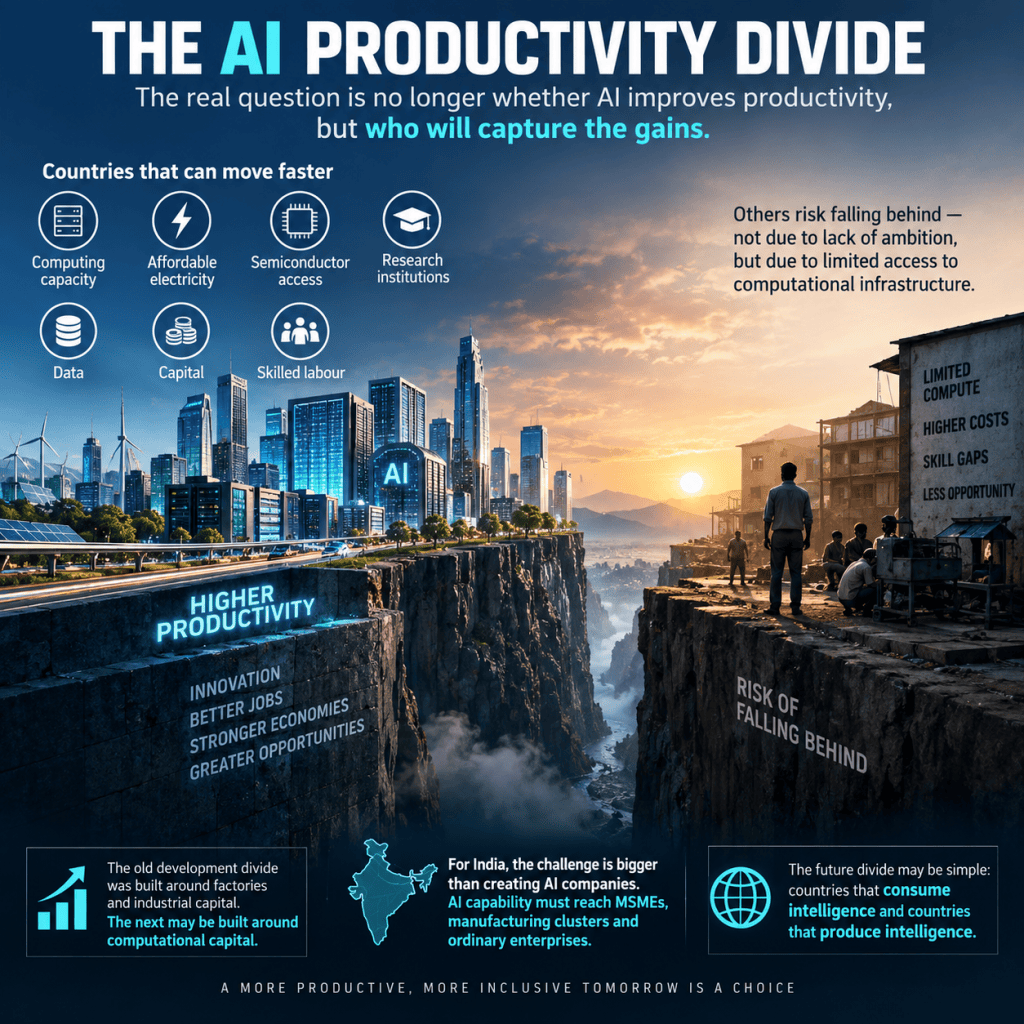
For two centuries, the global economy has repeatedly been divided by access to the technologies that raise productivity. The Industrial Revolution separated countries that could mechanise production from those that remained dependent on manual labour. Electricity created another divide. Mass manufacturing created another. Computers and the internet widened some gaps while allowing a few countries to leap forward. Artificial intelligence could produce the next great divide, but this time the scarce resource may not be factories, machines or even cheap labour. It may be computing power.
The wrong question about AI — Much of the present debate asks whether artificial intelligence will increase productivity. That question may soon become less important. AI is already moving into coding, design, finance, logistics, manufacturing, healthcare, education, research, administration and business services. The more difficult question is who will capture the productivity gains. Technology does not distribute prosperity automatically. The steam engine did not industrialise every country equally. Electricity did not produce manufacturing leadership everywhere. The internet did not create Silicon Valleys in every economy. AI is unlikely to be different.
From industrial capital to computational capital — The old development model was built around roads, ports, power plants, factories, machines and industrial skills. These will remain essential, but another layer is being added. Countries increasingly need data centres, advanced chips, cloud infrastructure, reliable electricity, research universities, skilled engineers, large pools of usable data and capital capable of financing expensive experimentation. Together, these form a new kind of economic infrastructure: computational capital. A country may have millions of educated workers and thousands of enterprises, yet still remain dependent on computing infrastructure, models and digital platforms controlled elsewhere.
Electricity quietly returns to the centre of economic power — AI is often described as a software revolution, but underneath the software is a very physical economy. Data centres need land, cooling systems, transmission networks, semiconductors and enormous quantities of dependable electricity. This creates an unusual historical circle. The nineteenth-century industrial race depended heavily on coal. The twentieth century depended on petroleum and electricity. The twenty-first-century AI race may depend on the ability to convert electricity into intelligence at enormous scale. Countries with abundant and affordable power could therefore acquire an advantage that goes far beyond their energy sector.
Semiconductors become the machines that make intelligence — During the Industrial Revolution, countries competed for machinery. In the AI economy, advanced processors increasingly perform a similar strategic function. Access to leading chips, semiconductor manufacturing equipment, packaging capabilities and specialised supply chains can influence how quickly an economy develops and deploys AI. This makes semiconductor geopolitics much more than an electronics issue. Restrictions, supply disruptions or technological dependence can ultimately become productivity constraints.
The dangerous illusion of equal access — AI tools may appear globally available because a small business in Delhi, Nairobi or Dhaka can access sophisticated applications through the internet. But using AI and owning the productive infrastructure behind AI are very different things. A country can become a large consumer of artificial intelligence while capturing only a small share of its economic value. This is similar to earlier periods when developing economies exported raw materials, imported finished products and remained trapped in the lower-value portions of global production.
A new hierarchy could therefore emerge. At the top may be economies that design chips, build models, own cloud infrastructure, generate intellectual property and finance innovation. Below them may be countries that adapt AI to industries and build specialised applications. Further down may be economies that mainly purchase AI services produced elsewhere. The deepest danger is not simply technological dependence. It is permanent productivity dependence.
AI could widen the development gap faster than earlier technologies — Industrialisation normally required factories to be built, workers trained and supply chains established. These processes took years or decades. AI can spread productivity differences much faster because software can be replicated almost instantly. Imagine two competing firms in different countries. One operates inside an ecosystem with cheap computing, specialised AI models, abundant technical talent, automated logistics and inexpensive capital. The other faces expensive cloud access, unreliable electricity, limited data and shortages of specialised skills. Even if their wage costs are very different, the first firm may produce more per worker, innovate faster and respond to customers more quickly. Cheap labour may no longer compensate for weak technological infrastructure.
This could overturn one of the foundations of the traditional development path. For decades, poorer countries could enter global manufacturing through low labour costs and gradually acquire capabilities. AI and robotics may weaken that ladder. If advanced economies can combine expensive workers with extremely high AI-assisted productivity, some labour-intensive activities may become less geographically mobile. The development question then becomes uncomfortable: what happens when labour abundance is no longer a sufficient comparative advantage?
India faces both an extraordinary opportunity and a serious warning — India has several advantages: a huge technology workforce, a large domestic market, expanding digital infrastructure, strong software capabilities, entrepreneurial depth and growing interest in semiconductors and data centres. But population size and software talent alone will not guarantee AI leadership. The real test will be whether India can convert these strengths into affordable computing capacity, reliable clean power, domestic research capability, semiconductor ecosystems, high-quality datasets and widespread adoption by ordinary enterprises.
The MSME question is especially important. If AI remains concentrated among large corporations and technology firms, national productivity statistics may improve while millions of smaller businesses fall further behind. An engineering cluster, textile cluster, food-processing cluster or handicraft ecosystem does not necessarily need to develop its own large AI model. It needs affordable access to useful intelligence: demand forecasting, quality inspection, design, translation, export documentation, energy optimisation, inventory management, compliance, marketing and production planning. The future cluster development institution may therefore have to provide shared AI infrastructure just as earlier industrial estates provided roads, testing laboratories and common facilities.
The next common facility centre may be a computing facility — This is where development policy needs unconventional thinking. India spent decades creating industrial estates, tool rooms, testing laboratories, technology centres and common facility centres because individual MSMEs could not afford certain infrastructure. The same logic can now be applied to AI. Why should every small manufacturer independently purchase computing capacity, hire data scientists and build specialised systems? Industrial clusters could develop shared AI platforms, sector-specific datasets, digital testing facilities and AI extension services.
That would turn AI from an individual-company investment into economic infrastructure.
The new development divide will not simply be digital versus non-digital — The first digital divide was about access to computers. The second was about internet connectivity. The emerging divide may be far more consequential: access to machine intelligence at an economically competitive price. Countries could all be connected to the internet and still have radically unequal ability to produce intelligence.
This means that GDP, factories, exports and workforce numbers may no longer be enough to understand national productive capacity. Future economic analysis may increasingly ask different questions. How much advanced computing can an economy access? At what cost? How secure is its semiconductor supply? How much electricity can it provide to data infrastructure? How strong are its research institutions? How widely can AI productivity reach small firms rather than remaining concentrated in a few corporations?
The future competition is not human versus machine. It is ecosystem versus ecosystem — Countries will not win the AI era simply because their workers use AI tools. They will win when computing, energy, skills, research, finance, data, entrepreneurship and industrial demand reinforce one another. That is why the AI race should not be treated merely as technology policy. It is becoming industrial policy, energy policy, education policy, trade policy, competition policy and national development policy simultaneously.
The greatest future inequality may therefore not be between countries that have AI and countries that do not. Almost everyone may eventually have access to some form of AI.
The real divide will be between countries that consume intelligence and countries that produce intelligence.
That distinction could shape the geography of productivity, income and economic power for the rest of this century.
AI #Productivity #India #MSME #Manufacturing #EconomicDevelopment
 "Connecting communities, empowering nations: Unifying the Regional and Global Economy ."
Leave a comment