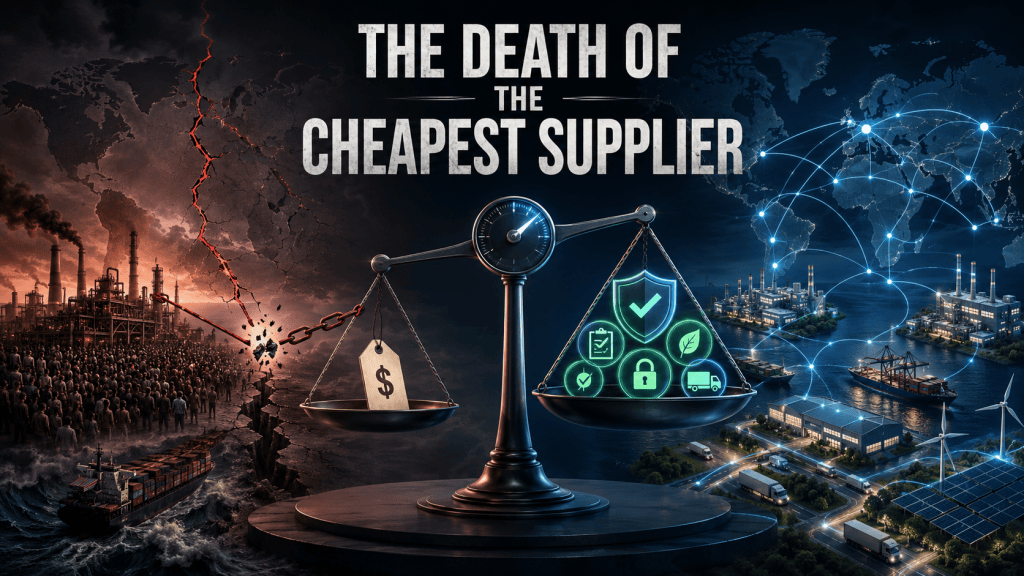
For nearly half a century, modern procurement was built around a deceptively simple question: who can supply this product at the lowest possible price? Corporations searched the world for cheaper labour, cheaper land, lighter regulation, lower taxes and larger production economies. Suppliers were compared through spreadsheets, purchase prices were negotiated to the last decimal point, and inventories were reduced because unsold material was treated as waste. The winning factory was often the one that could remove a few more cents from the unit cost. This system created extraordinary efficiency, but it also created an economy in which the cheapest supplier could become the most expensive source of failure.
From Just-in-Time to Just-in-Case
The dominance of price-first procurement emerged from a particular period of history. After the Cold War, international trade expanded under the assumption that economic interdependence would gradually reduce geopolitical conflict. Production could be concentrated wherever costs were lowest because borders appeared increasingly open, shipping remained inexpensive, and major disruptions were considered exceptional. Companies replaced warehouses with tightly timed supply chains. Governments allowed domestic capabilities to disappear because essential goods could supposedly always be imported.
The model worked well when the world was relatively predictable. It became fragile when predictability disappeared.
The oil crises of the 1970s had already demonstrated how dependence on a concentrated resource could become a strategic weakness. The 2011 earthquake and tsunami in Japan exposed the global dependence of several industries on a small number of specialised component producers. The pandemic then revealed that even wealthy countries could struggle to obtain masks, medicines, diagnostic equipment and basic industrial inputs. Semiconductor shortages slowed automobile production across continents. The blockage of the Suez Canal by a single ship showed how one physical obstruction could disturb global logistics. War in Ukraine, sanctions, export controls and tariff conflicts further demonstrated that supply chains were not separate from geopolitics. They had become one of its principal instruments.
The cheapest supplier did not necessarily become technically incapable of producing. The problem was that the product could no longer move, the payment could not be processed, an export licence was denied, energy supplies were interrupted, a port was closed, or the supplier’s country became politically unacceptable. A low factory price offered little protection when the shipment never arrived.
The New Price of Reliability
Procurement is therefore moving from a narrow calculation of purchase price towards a broader calculation of assured availability. The emerging question is no longer simply who can make the product most cheaply, but who can continue supplying it when political relations deteriorate, transport routes close, regulations change or digital systems come under attack.
This does not mean that price will become irrelevant. Businesses will always face pressure to control costs. But price will increasingly be treated as one variable within a larger risk equation. A supplier offering a component at 5 per cent less may not be genuinely economical if its failure can close an entire production line. The real cost of supply must now include disruption probability, recovery time, inventory requirements, regulatory exposure, reputational risk and the absence of alternative sources.
Reliability itself will also acquire several meanings. Operational reliability will concern quality, delivery and production capacity. Geographic reliability will examine exposure to conflict, climate disasters, shipping chokepoints and excessive regional concentration. Political reliability will assess whether the supplier’s country is likely to face sanctions, tariffs or export restrictions. Financial reliability will consider currency instability, access to trade finance and the solvency of the supplier. Digital reliability will examine whether production systems and connected products are secure from cyber intrusion.
The supplier of the future will therefore be judged not only by the product leaving the factory, but by the resilience of the entire system behind it.
Geopolitics Enters the Purchase Order
Global trade is being reorganised around political trust. Friend-shoring, near-shoring and selective localisation are signs that governments and companies no longer view all suppliers as strategically interchangeable. Political alignment is becoming an invisible specification in international procurement.
This shift carries serious dangers. If every country attempts to produce everything domestically, costs will rise, innovation may slow and smaller economies could be excluded from important value chains. Political alignment can also become a convenient justification for protectionism. Powerful countries may describe subsidies for their own industries as resilience while describing similar measures elsewhere as unfair trade. The world could move from excessive dependence to excessive fragmentation.
Yet some degree of diversification is now unavoidable. Businesses have learned that concentration produces efficiency during normal periods but magnifies damage during crises. The future supply chain is therefore unlikely to be completely global or completely national. It will be a managed network combining domestic capacity, trusted international partners, regional suppliers and strategic inventories.
The most important change is not the movement of every factory. It is the end of blind dependence on a single low-cost geography.
Carbon, Cybersecurity and Traceability Become Commercial Conditions
The new supplier competition will extend far beyond production cost and traditional quality certification. Carbon intensity will increasingly affect market access as governments and large buyers demand information about the emissions embedded in products. A component produced with cheap but carbon-intensive energy may appear economical at the factory gate while becoming expensive after carbon reporting, adjustment charges or customer sustainability requirements are applied.
Traceability will also move from a premium feature to a basic commercial requirement. Buyers will want to know where raw materials originated, whether labour standards were respected, how environmental claims were verified and whether restricted inputs entered the supply chain. The anonymous subcontractor hidden several layers below the principal supplier will become a major source of risk.
Cybersecurity will be equally important. As factories, vehicles, medical devices, energy systems and consumer products become digitally connected, a supplier can become an entry point into the buyer’s wider network. Procurement departments will increasingly evaluate software integrity, data handling, access controls and vulnerability-management systems alongside price, quality and delivery.
This will transform the meaning of competitiveness. A factory may have excellent machinery and low wages but still lose orders because it cannot provide emissions data, demonstrate material origin, protect customer information or map its own sub-suppliers. Documentation will no longer merely support production. In many sectors, documentation will determine whether production can be sold at all.
The MSME Risk: Reliability Could Become a New Entry Barrier
For Indian MSMEs, this transition creates both a historic opportunity and a serious threat. Companies seeking alternatives to concentrated supply chains may offer India new openings in engineering goods, pharmaceuticals, textiles, electronics, chemicals, auto components and processed foods. India’s large industrial base, domestic market and geopolitical relationships provide a strong platform for supplier diversification.
But orders will not move automatically simply because buyers want an alternative. Global firms are not merely searching for another cheap location. They are searching for dependable production ecosystems. They will examine testing facilities, logistics performance, energy stability, regulatory enforcement, digital security, environmental compliance and the financial health of suppliers. An individual MSME cannot compensate for a weak ecosystem surrounding it.
This is where conventional industrial policy may fall short. Offering land or capital subsidies can attract factories, but it cannot by itself create supply-chain reliability. Reliability requires common testing laboratories, traceability platforms, cybersecurity support, cleaner energy, skilled workers, dependable logistics, emergency-response systems and financially stable networks of smaller vendors. Cluster development must consequently move beyond creating common facilities and begin building collective resilience.
Smaller firms face an additional disadvantage because large buyers may transfer the cost of resilience downward. They may demand detailed carbon accounting, multiple certifications, stronger inventories and tighter cybersecurity without offering longer contracts or better prices. If these requirements are imposed without technical and financial support, the reliability revolution could produce a new form of market exclusion. Large suppliers would become safer choices simply because they can afford the cost of proving that they are safe.
Public policy and industry associations must therefore help MSMEs convert compliance into collective infrastructure. Shared carbon-measurement systems, common traceability tools, pooled cybersecurity services, supplier-development programmes and cluster-level contingency plans could prevent each small enterprise from having to construct an expensive reliability system alone.
The End of Efficiency Without Insurance
The death of the cheapest supplier does not mean the death of efficiency. It means the end of an artificially narrow definition of efficiency. A supply chain is not efficient if a minor disruption can stop it completely. A low-cost component is not cheap if its absence shuts down a much larger factory. Minimal inventory is not productive if it leaves hospitals, energy systems or strategic industries exposed. Concentrated sourcing is not rational when there is no credible alternative during a crisis.
Future procurement will increasingly resemble portfolio management. Buyers will distribute orders across suppliers, regions and political jurisdictions. They may deliberately retain some higher-cost domestic capacity as insurance. They will maintain strategic stocks for critical inputs, design products that can accept substitute components and demand visibility beyond first-tier suppliers. Artificial intelligence may help identify disruptions earlier, but algorithms cannot manufacture an alternative supplier after a crisis has already begun. Redundancy must be created before it is needed.
This will raise visible costs. Duplicate suppliers, additional inventories, cleaner energy and deeper verification are not free. But the old system concealed its costs until disruption occurred. The future economy will pay more regularly in order to lose less catastrophically.
The Supplier of the Future
The strongest supplier of the next decade may not be the one offering the lowest quotation. It will be the one that can demonstrate continuity under pressure. It will know where its inputs come from, how quickly it can shift logistics routes, how securely it manages data, how steadily it can access energy and how transparently it measures environmental performance. It will maintain alternative vendors, credible records and the capacity to recover from disruption.
Trust will become an economic asset, but trust will have to be supported by evidence. Political promises will not substitute for delivery performance. Sustainability claims will not substitute for verifiable data. A long commercial relationship will not substitute for cybersecurity. Reliability will have to be designed, measured and continuously tested.
The great procurement revolution ahead is therefore not simply a movement from one country to another. It is a movement from price to preparedness, from anonymous efficiency to visible responsibility, and from supply chains built for ordinary conditions to supply networks designed for an age of permanent uncertainty.
The cheapest supplier is not disappearing because the world has suddenly stopped caring about cost. It is disappearing because governments and businesses are finally recognising that failure has a price—and that price is often far higher than anything written on the purchase order.
#SupplyChains #Procurement #MSME #Manufacturing #Geopolitics #Resilience #IndianIndustry #GlobalTrade #ClusterDevelopment


Leave a Reply