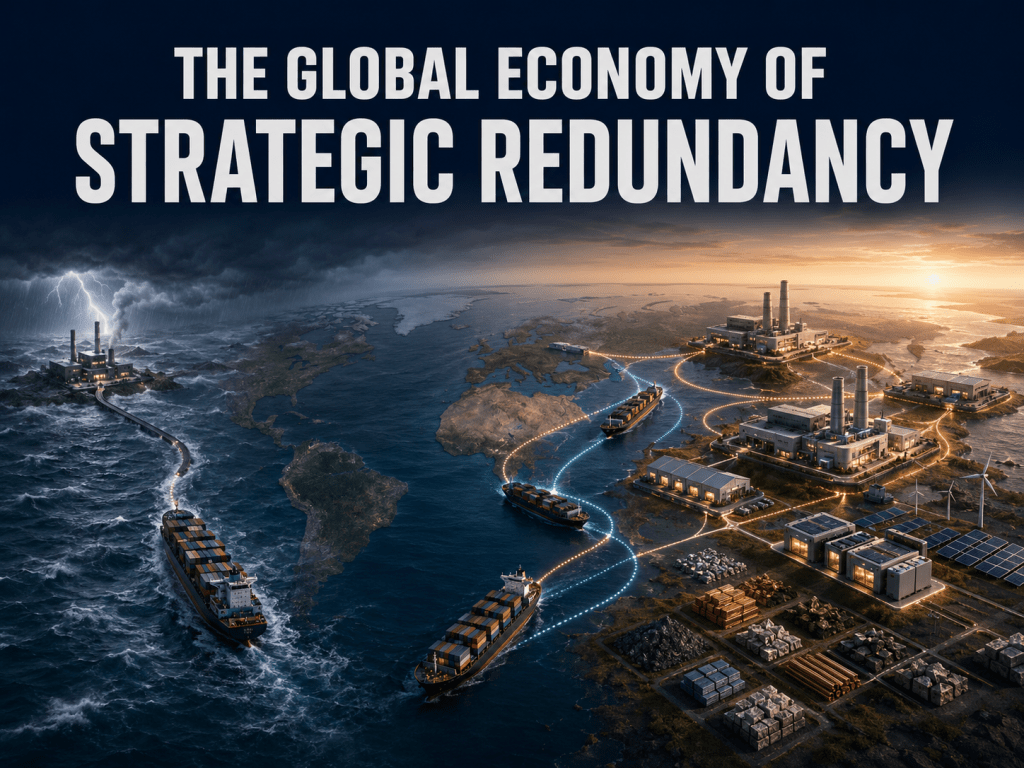
When Inefficiency Becomes a Form of Insurance
For nearly four decades, the global economy was organised around a powerful idea: remove every spare cost. Companies reduced inventories, concentrated production in the cheapest locations, relied on a small number of highly efficient suppliers and moved goods through tightly timed logistics networks. A factory was considered competitive when it held little stock, used its machines continuously and received components almost exactly when required. Spare capacity was treated as waste. A second supplier was often considered unnecessary. A domestic factory producing at a higher cost was allowed to disappear because the same product could be imported more cheaply.
This system created extraordinary efficiency. It also created extraordinary dependence.
The economic contradiction of the coming decade is therefore becoming clear: the world will deliberately accept higher costs in order to reduce the risk of catastrophic interruption. Factories will be duplicated. Inventories will become larger. Energy systems will retain backup capacity. Governments will stockpile minerals, medicines and critical components. Companies will maintain alternative suppliers even when those suppliers are more expensive. The new economy will not always reward the lowest-cost producer. It will increasingly reward the producer who can continue supplying when the lowest-cost system stops working.
Strategic redundancy is no longer simply an operational expense. It is becoming a form of national and corporate insurance.
From the Age of Efficiency to the Age of Exposure
The old model emerged from a particular historical period. After the Cold War, political relations appeared sufficiently stable to permit deep economic integration. Trade barriers declined, container shipping expanded, multinational production networks spread and digital technology made it possible to coordinate factories across continents. Production could be divided into hundreds of specialised stages and placed wherever each stage was cheapest.
This model assumed that geopolitical stability, open shipping routes, predictable tariffs and continuous access to energy would remain normal conditions. Risk was measured mainly through prices, interest rates and demand. Political disruption was treated as an exceptional event outside the normal economic calculation.
That assumption has broken down.
Pandemics closed factories and exposed the danger of depending on a few locations for medicines, medical equipment and electronic components. Wars disrupted food, fertilizer and energy markets. Sanctions turned banking systems, payment networks and technologies into instruments of geopolitical pressure. Shipping disturbances showed how a blockage or security crisis along a distant route could affect factories thousands of kilometres away. Tariff shocks demonstrated that a profitable supply chain could become commercially unviable through one policy announcement.
The lesson was not that globalisation had ended. The deeper lesson was that efficiency without alternatives creates hidden fragility. The cheapest supply chain may be the most expensive one when it fails.
The Return of the Duplicate Factory
In the emerging system, companies will increasingly ask a different question. Instead of asking only where production is cheapest, they will ask where production can survive political, climatic, logistical and regulatory shocks.
This will encourage the duplication of capacity. A company may retain its established factory in one country while building a second production base elsewhere. It may divide orders among suppliers in different regions, even when concentrating orders with one supplier would reduce unit costs. Governments may subsidise domestic production of semiconductors, batteries, pharmaceuticals, defence equipment, telecom systems and renewable-energy components, although imported alternatives may initially remain cheaper.
To the conventional economist, such duplication appears inefficient. Two factories may operate below full capacity. Multiple suppliers may require separate quality systems, audits and contracts. Domestic production may need incentives. But the apparent inefficiency contains an economic function: if one location becomes unavailable, the entire system does not stop.
The spare factory of the future will resemble the fire extinguisher in a building. It may remain unused for long periods, but its value cannot be judged only by how frequently it operates.
Inventory Will Return from Exile
Inventory was once condemned as capital sitting idle. The just-in-time revolution transformed warehouses into symbols of managerial failure. Firms were encouraged to minimise stocks and rely on continuous replenishment.
That principle worked when transport, borders and suppliers behaved predictably. In a more unstable world, extremely lean inventories can convert a small disruption into a complete production shutdown. The absence of a component costing a few rupees can immobilise machinery worth crores and delay an export order worth much more.
Companies will therefore hold larger stocks of selected inputs—not everything, but items that are difficult to replace, politically sensitive or capable of stopping the entire production process. Governments will similarly expand strategic reserves beyond food and petroleum. Critical minerals, pharmaceutical ingredients, fertilizers, batteries, electronic components and specialised industrial materials may gradually enter national security planning.
Warehouses will no longer be viewed only as storage spaces. They will become shock absorbers in the economic system.
But stockpiling also contains dangers. Governments may accumulate the wrong materials, firms may exaggerate shortages, and politically connected businesses may secure expensive storage contracts. Materials can become obsolete, degrade or lose strategic relevance as technologies change. Strategic reserves must therefore be governed by transparent criteria, rotation systems and regular assessment. Otherwise resilience becomes another name for waste.
Energy Security Will Require Capacity That Appears Uneconomic
The energy transition will make redundancy even more complicated. An economy based increasingly on solar and wind power will need storage, stronger grids, flexible generation, diversified fuel sources and backup capacity. Some assets may remain idle during normal periods but become essential during seasonal shortages, extreme weather or geopolitical disruption.
The future energy system cannot be designed only around the cheapest average unit of electricity. It must also be judged by whether power is available during the most difficult hour of the year.
This changes investment logic. Battery storage, transmission links, reserve generation, distributed energy and domestic manufacturing capacity may look expensive when examined separately. Their value becomes visible only when the complete system is under stress. The challenge is that governments may use resilience as an excuse to protect inefficient fossil-fuel assets indefinitely. Genuine backup must support transition, not become a permanent shelter for outdated technologies.
Strategic redundancy must be technologically flexible. A backup system that obstructs the future is not resilience; it is delayed adjustment.
The New Protectionism Will Speak the Language of Security
Industrial policy is returning across advanced and developing economies. Subsidies, local-content requirements, public procurement preferences, investment screening and export controls are expanding. Governments increasingly describe semiconductors, data infrastructure, energy technology, minerals, medicines and even food systems as strategic sectors.
Some of this intervention is economically defensible. Markets frequently underinvest in resilience because an individual company bears the cost of maintaining backup capacity while the wider economy gains from uninterrupted supply. Public policy may therefore be necessary to support capabilities whose social value is greater than their immediate commercial return.
But strategic redundancy can easily become a respectable disguise for protectionism. Almost every industry will attempt to present itself as nationally essential. Large corporations may seek subsidies for investments they would have made anyway. Domestic-content rules may create permanently high-cost industries without generating technological capability. Countries may duplicate entire supply chains when cooperation with trusted partners would be less expensive and more secure.
The critical distinction will be between strategic capacity and political shelter. A protected industry that never improves productivity, quality or innovation does not strengthen national resilience. It merely transfers its inefficiency to consumers and taxpayers.
The Price of Resilience Will Not Be Shared Equally
The move towards redundancy will raise costs, but its burden will be uneven. Large multinational companies can finance additional inventories, multiple factories and diversified supplier networks. Small enterprises cannot easily hold six months of inputs, certify alternative suppliers or absorb sudden changes in tariffs and logistics.
This creates a serious danger for MSMEs. The new resilience requirements may appear to diversify global supply chains while actually concentrating business among large firms capable of meeting complex compliance and continuity standards. Buyers may demand backup production, digital traceability, cybersecurity, environmental reporting and guaranteed inventory. These requirements can become invisible barriers excluding smaller suppliers.
Yet the same transition can also create opportunity. Companies looking for alternatives to concentrated sourcing will need new suppliers, locations and clusters. Indian MSMEs can benefit, but only if redundancy is organised collectively. Common warehouses, testing facilities, shared renewable-energy systems, joint compliance services, supplier databases and cluster-level contingency plans can provide resilience that individual firms cannot afford.
The future competitor may not be the isolated factory. It may be the organised industrial ecosystem capable of responding collectively to disruption.
India Must Avoid Confusing Self-Reliance with Isolation
India has strong reasons to build greater domestic capacity in electronics, defence, clean energy, pharmaceuticals, machinery and critical materials. However, complete self-sufficiency across every strategic industry would be economically impossible and technologically counterproductive.
The practical objective should be controlled interdependence. India should retain domestic capability in areas where interruption would create severe national harm, diversify external suppliers where domestic production is uneconomic and build trusted partnerships for technologies that no country can develop entirely alone.
This requires much more than announcing production incentives. A factory assembled through imported machinery, imported intellectual property, imported components and imported minerals may increase domestic output without reducing strategic dependence. True resilience lies deeper—in engineering capability, toolmaking, materials science, standards, repair systems, skilled workers, research institutions and adaptable supplier networks.
The test of self-reliance is not whether everything carries a domestic label. It is whether the economy can understand, maintain, modify and, when necessary, reproduce the technologies on which it depends.
Resilience Could Become the Next Source of Global Inequality
Rich countries can spend heavily to duplicate factories, subsidise technologies and secure long-term mineral supplies. Poorer countries cannot compete easily in a subsidy race. If every major economy reserves strategic industries for domestic firms, developing countries may lose the opportunity to industrialise through exports.
There is also a risk that powerful countries will secure multiple sources for themselves while leaving weaker economies exposed to higher prices and reduced availability. Strategic stockpiling by one nation can create scarcity for another. Resilience at the national level may therefore produce fragility at the global level.
A world in which every country attempts to become secure independently could become collectively less secure. The answer cannot be a return to blind dependence, but neither can it be complete economic fragmentation. Regional reserves, mutual-recognition systems, shared emergency protocols and trusted supply arrangements will be necessary to prevent strategic redundancy from becoming strategic hoarding.
The Economy Will Need a New Definition of Productivity
Traditional productivity measures reward systems that produce more output with fewer visible inputs. They often fail to value spare capacity, diversified suppliers, stored materials or infrastructure maintained for emergencies. A hospital with no empty beds may appear efficient until a pandemic arrives. An electricity system without reserve capacity may look economical until demand peaks. A factory dependent on one supplier may report excellent margins until that supplier disappears.
The coming decade will require a broader definition of productivity—one that includes continuity, adaptability and recovery time. Economic systems must be evaluated not only by how efficiently they operate during normal conditions, but also by how effectively they absorb shocks.
This does not mean that every inefficiency should be celebrated. Waste remains waste. Poor management cannot be renamed resilience. The difficult task is to identify which redundancies provide genuine protection and which merely preserve outdated industries or reward political influence.
The Future Will Be More Expensive—But Failure Is More Expensive Still
Strategic redundancy represents a major reversal in economic thinking. For years, the world removed buffers because stability was assumed. It is now rebuilding buffers because instability has become part of the calculation.
Consumers may pay higher prices. Governments may carry larger fiscal burdens. Companies may accept lower short-term returns. Some factories will operate below full capacity, and some inventories will sit unused. Judged through the narrow lens of immediate cost, this will look like economic retreat.
But resilience should not be understood as the abandonment of efficiency. It is the recognition that efficiency has a time horizon. A system that saves money for ten years and then collapses during one major shock may never have been truly efficient.
The central contest of the future will therefore not be between globalisation and self-reliance. It will be between fragile efficiency and intelligent redundancy. The successful economies will not attempt to manufacture everything at home or stockpile everything indefinitely. They will identify their critical dependencies, build alternatives where failure would be intolerable and continue trading where interdependence remains manageable.
The strongest economy of the next decade may not be the one that produces at the lowest possible cost. It may be the one that can continue producing when the assumptions behind low cost suddenly disappear.
GlobalEconomy #SupplyChains #EconomicResilience #MSME #IndustrialPolicy #India #Manufacturing


Leave a Reply