The Parcel Revolution Is Reaching Its Limits
For nearly two decades, cross-border e-commerce was built around a powerful assumption: a small parcel was too insignificant to deserve the full attention of the customs system. Governments created de minimis or low-value exemptions because collecting a few dollars of duty often cost more than the revenue generated. This administrative convenience unintentionally became the commercial foundation of global online retail.
It allowed a small enterprise in Jaipur, Moradabad, Kanpur, Tiruppur or Sivakasi to sell directly to a customer thousands of kilometres away. The exporter did not need a foreign warehouse, importing company, distributor or conventional retail network. A website, an online marketplace and an international courier could convert a workshop into a global seller.
That period is now ending.
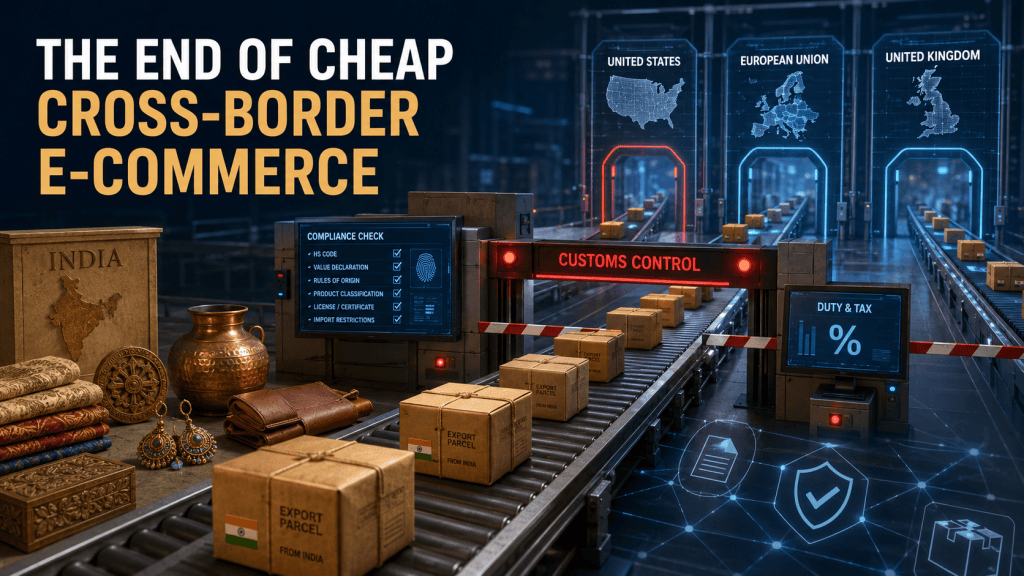
The United States has suspended duty-free de minimis treatment for commercial shipments from all countries. The European Union has removed its €150 customs-duty exemption and introduced a temporary €3 duty per item for qualifying low-value consignments. The United Kingdom has also decided to remove its £135 low-value import relief and create a new customs system, although its implementation will take place by October 2028 at the latest. These are not three unrelated policy adjustments. Together, they signal the dismantling of the economic architecture that made cheap cross-border parcel trade possible.
The United States: When Every Parcel Becomes an Import
The American market was particularly attractive because commercial shipments valued at up to $800 could previously enter under the de minimis provision. For Indian artisans, lifestyle brands, speciality food businesses, apparel manufacturers, leather-goods producers and online sellers, this made direct-to-consumer exports commercially viable even at a small scale.
That advantage disappeared when the United States suspended duty-free treatment for low-value commercial shipments from all countries. Goods that previously entered with limited customs friction can now attract tariffs, processing requirements and carrier charges. US Customs and Border Protection subsequently introduced a modernised informal-entry process for low-value shipments, effective from 24 July 2026. The policy direction is unmistakable: low value no longer means low regulatory attention. US Customs and Border Protection
The visible cost is the tariff, but the deeper cost lies in the machinery surrounding it. Product classification must be correct. Country of origin must be defensible. Product descriptions, values and consignee information must match across commercial invoices, marketplace records and carrier systems. Mistakes that were once absorbed within a simplified parcel channel can now cause additional charges, delays, customer refusals or returns.
For low-priced products, even a modest fixed clearance cost can be more damaging than a high percentage tariff. A duty of 10 per cent may be manageable on a $500 product. A combination of duty, brokerage, data-processing and return costs can destroy the margin on a $20 or $30 item. The economics of cross-border trade are therefore shifting against inexpensive individual shipments.
Europe: A Small Charge with a Large Strategic Meaning
The European Union’s reform is even more revealing. From 1 July 2026, it removed the customs-duty exemption for consignments valued at €150 or below. A temporary customs duty of €3 per item applies to qualifying distance sales, initially until July 2028. This is a duty on each item, not necessarily on each parcel. A package containing several separately classified items can therefore carry multiple charges. European Commission guidance
This distinction matters enormously for Indian MSMEs selling jewellery, handicrafts, fashion accessories, stationery, home décor or small gift collections. A parcel containing five low-priced items can face a higher relative burden than one containing a single premium product. The rule quietly changes the logic of assortment, packaging and minimum order value.
Europe is also moving towards a more data-intensive customs system. Product identifiers, electronic declarations, marketplace responsibility and the future EU Customs Data Hub will make it easier to connect the sale, seller, product, platform, payment and import declaration. The old gap between digital selling and physical customs enforcement is gradually closing.
This is happening alongside a broader European movement towards stricter product safety, environmental traceability, packaging responsibility and online-marketplace accountability. A product may be commercially attractive and well made, yet still fail because the seller cannot produce the required technical documentation, warnings, labelling, responsible-person details or evidence supporting a sustainability claim. The future border will increasingly inspect information before it inspects the product.
The United Kingdom: A Warning Arriving in Advance
The United Kingdom still provides Indian exporters with a transition period, but the direction has already been decided. The government will remove the £135 low-value import relief and introduce new requirements for customs data, payments and compliance by October 2028 at the latest.
The proposed model goes beyond collecting duty. It creates the possibility of requiring a UK-based fiscal representative who could share responsibility for customs debts incurred by an overseas seller. Businesses may face one-time expenditure on systems and continuing costs for additional data entry and local representation. UK Government policy paper
The UK should therefore not be treated as a market where the old model remains permanently available. It is a planning window. Indian exporters that use this period to develop compliant product records, consolidated fulfilment and reliable importer arrangements will be better prepared when the relief finally disappears.
The Hidden Shift from Tariff-Free to Friction-Full Trade
The most important change is not simply that tariffs are returning. Cross-border commerce is becoming friction-full.
The landed cost of a product now includes more than manufacturing, packaging and freight. It may include customs duty, import tax, brokerage, advance electronic data, marketplace fees, product testing, authorised representation, extended producer responsibility, returns management and the financial cost of goods delayed at the border.
These costs do not affect all firms equally. Large platforms can spread compliance technology across millions of shipments. Global brands can maintain warehouses, legal teams and importing entities in multiple markets. A small Indian exporter may have to recover the same type of compliance cost from a few hundred orders.
This creates a new scale barrier. Digital platforms lowered the cost of finding a foreign customer, but customs and product regulation are now raising the cost of serving that customer. Market access is no longer determined only by visibility on Amazon, Etsy or an independent website. It increasingly depends on whether the firm can build a legally complete path from the factory to the consumer.
The End of Cheap Does Not Mean the End of Opportunity
Indian MSMEs should not respond by abandoning cross-border e-commerce. They must abandon the belief that international parcel delivery is merely domestic e-commerce with a longer journey.
The first strategic response is to move from low-price selling to sufficient-value selling. Products must carry enough margin to absorb border costs. This favours design-led handicrafts, premium leather products, specialised textiles, authenticated heritage goods, customised products and well-differentiated wellness or lifestyle offerings. Competing internationally through low prices alone will become progressively more difficult.
The second response is shipment consolidation. Instead of dispatching every order independently from India, exporters can send inventory in bulk to a foreign fulfilment centre and deliver domestically from there. This does not eliminate tariffs or compliance, but it converts thousands of unpredictable parcel clearances into a smaller number of planned commercial imports. It can also improve delivery times and simplify customer returns. However, local warehousing brings new obligations involving inventory, taxation, product liability and working capital. It is therefore viable only when sales volumes justify the fixed cost.
The third response is collective infrastructure. Most individual MSMEs cannot independently maintain warehouses, customs expertise, product-testing systems and regulatory representatives in three major markets. Export associations, clusters and digital platforms can create shared fulfilment centres, compliance desks, testing arrangements, tariff databases and return-handling facilities. The next generation of cluster development must extend beyond the production location into the destination market.
The fourth response is market separation. A product should not automatically be offered in identical form, at the same price and through the same fulfilment route in the US, EU and UK. Each market has different tariff classifications, taxes, safety requirements, packaging rules and customer expectations. Export strategy must increasingly be designed at the level of the product–market–channel combination.
From Export Promotion to Export-System Building
India’s export-support system was largely designed for containers, trade fairs and wholesale buyers. The digital exporter requires a different public infrastructure: real-time landed-cost tools, product-specific compliance guidance, affordable testing, standard digital product passports, overseas return facilities and shared destination-market warehouses.
Traditional export statistics also provide an incomplete picture. A cluster may report growing online orders while its sellers quietly lose margin through customs fees, rejected parcels and expensive returns. Policymakers must begin measuring not only export value but also fulfilment cost, compliance failure, customer refusal and net realisation after all border charges.
Export promotion schemes should similarly move beyond subsidising participation in exhibitions. For many small firms, the critical need is no longer assistance in finding a customer. It is assistance in completing the transaction legally and profitably.
The Future Belongs to the Compliant Network
The first phase of cross-border e-commerce rewarded visibility. The second rewarded speed and marketplace expertise. The emerging phase will reward compliance, data quality, supply-chain design and collective scale.
The romantic image of a small producer directly reaching the world will not disappear, but the infrastructure behind that connection will become far more sophisticated. The winning Indian MSME may still look small at the factory gate, yet it will operate through a network of laboratories, customs specialists, fulfilment providers, digital platforms, local representatives and shared overseas facilities.
The age of cheap cross-border e-commerce is ending because governments no longer see a parcel as too small to regulate. Every parcel is becoming a taxable transaction, a product-safety event and a data record. Indian MSMEs that continue to treat these developments as courier problems will lose competitiveness one shipment at a time. Those that rebuild their export model around value, compliance and shared infrastructure can turn the end of an exemption into the beginning of a more mature global presence.


Leave a Reply