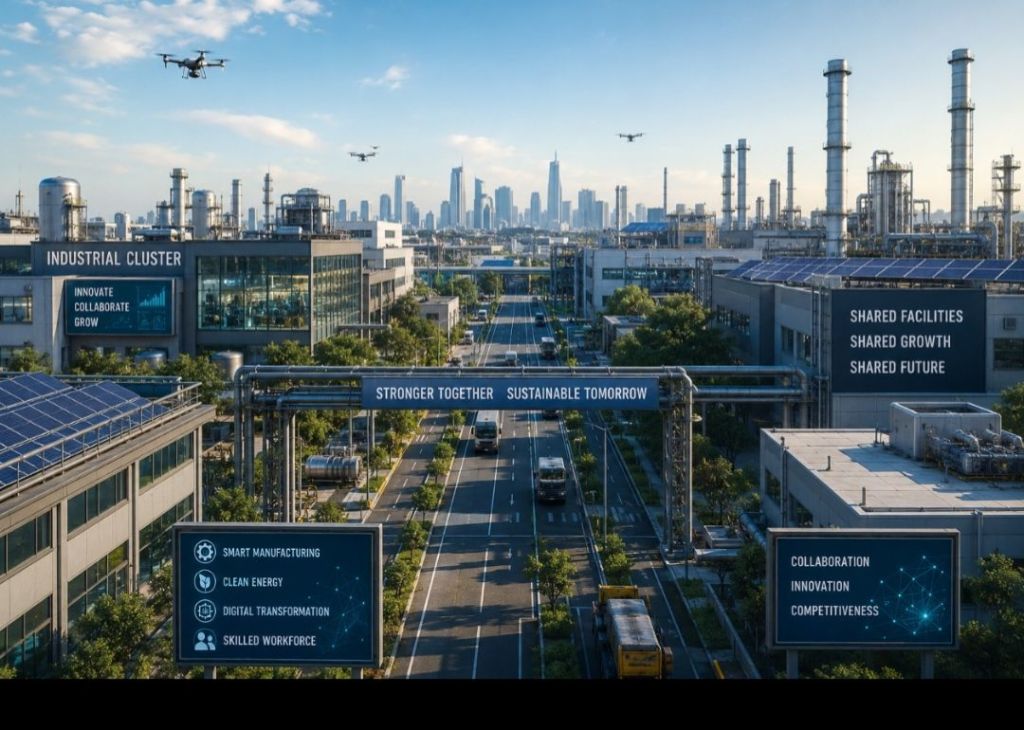
India’s industrial development story has long been built around clusters. From the textile hubs of Tirupur and Surat to the engineering clusters of Rajkot and Ludhiana, the idea was simple. When firms producing similar products operate close to each other, they can share knowledge, develop specialized skills, reduce costs, and become globally competitive. For decades, this geographical concentration helped many regions create jobs, support entrepreneurship, and spread industrial growth beyond large metropolitan cities.
Yet one of the most overlooked weaknesses in India’s cluster landscape is not infrastructure, finance, or technology. It is the absence of strong institutions that can bring enterprises together around common goals. Many industrial clusters today have hundreds or even thousands of enterprises, but surprisingly few have effective mechanisms for collective decision-making, collaboration, or long-term strategic planning. The cluster exists physically, but the ecosystem often remains fragmented.
From Collective Strength to Individual Survival
Historically, many Indian entrepreneurs developed a culture of self-reliance because they operated in an environment where government support was limited and markets were uncertain. This mindset helped build resilience, but it also created a tendency for firms to solve common problems individually rather than collectively. As a result, issues such as skill shortages, technology upgrades, quality certification, export promotion, branding, waste management, and market intelligence are often addressed separately by each enterprise.
The consequence is a massive duplication of effort and resources. Hundreds of firms may spend money solving the same problem while the cluster as a whole remains weak. What appears to be entrepreneurship at the firm level often becomes inefficiency at the ecosystem level.
Weak Associations, Weak Competitiveness
A large number of cluster associations struggle with limited resources, weak participation, and short-term agendas. Many function primarily as event organizers or grievance platforms rather than institutions driving competitiveness and innovation. Leadership frequently changes, long-term planning remains absent, and collective projects fail to gain momentum.
This institutional weakness creates a serious disadvantage when competing with industrial ecosystems in countries such as Germany, South Korea, China, and parts of Southeast Asia. There, firms often cooperate on research, training, technology development, export promotion, and workforce development while still competing in the marketplace. The result is faster innovation, stronger supply chains, and greater global market penetration.
The Underutilized Asset Problem
Over the years, significant investments have been made in common facility centres, testing laboratories, training institutes, design centres, and industrial infrastructure. However, many of these facilities remain underutilized. Buildings exist, machines exist, and equipment exists, but sustained collective ownership is often missing.
The problem is rarely the absence of physical assets. The real challenge is the absence of institutional structures capable of ensuring that these assets remain relevant, updated, and actively used. Without strong governance, even well-funded facilities gradually become symbolic investments rather than productive assets.
The Innovation Gap Is Widening
The world is entering an era where competitiveness is increasingly determined by knowledge sharing, digital technologies, artificial intelligence, sustainability compliance, advanced manufacturing, and rapid product development. These transitions require collective learning and continuous interaction among firms, research institutions, service providers, and governments.
Clusters lacking collaboration mechanisms may find themselves trapped in a low-productivity cycle. New technologies will spread slowly, best practices will remain confined to a few firms, and smaller enterprises will struggle to keep pace. The gap between leading firms and the rest of the cluster could widen significantly, creating a divided industrial ecosystem.
The Future May Belong to Ecosystems, Not Individual Firms
One of the biggest misconceptions in industrial policy is the belief that competitiveness is created only at the enterprise level. Increasingly, global competition is taking place between ecosystems rather than individual firms. Buyers evaluate supplier networks, logistics systems, innovation capacity, sustainability standards, workforce quality, and institutional reliability before making sourcing decisions.
A cluster where firms do not cooperate may struggle to attract global opportunities regardless of how efficient individual enterprises become. In the coming decades, buyers are likely to prefer locations where entire ecosystems can respond quickly to changing market demands.
The Real Challenge Ahead
India does not face a shortage of entrepreneurs. It does not face a shortage of industrial clusters. What it increasingly faces is a shortage of institutions capable of transforming individual business success into collective economic strength.
The future of many industrial clusters may depend less on building new factories and more on building trust, collaboration, and effective governance. Without stronger institutions, clusters risk remaining collections of isolated enterprises. With stronger institutions, they can evolve into globally competitive ecosystems capable of driving innovation, productivity, exports, and sustainable growth for decades to come. #IndustrialClusters #MSMEDevelopment #ClusterCompetitiveness #CollectiveAction #IndustryAssociations #InnovationEcosystem #ManufacturingGrowth #IndustrialPolicy #Productivity #GlobalCompetitiveness


Leave a Reply