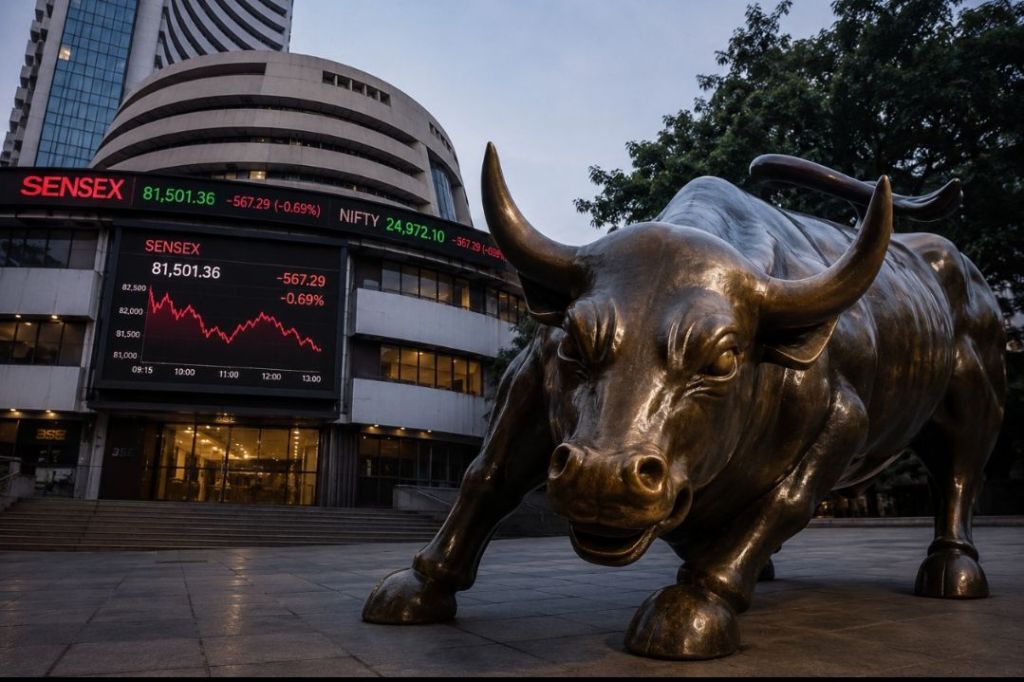
For many Indians watching television or checking stock apps every evening, the current situation feels confusing. American markets are touching new highs, some European and Asian indices are recovering, technology stocks globally are attracting fresh investment, and optimism around artificial intelligence and energy transition is pushing capital into many economies. Yet India, which was recently projected as one of the fastest-growing major economies, is witnessing weakness in its capital markets. This contradiction is not accidental. It reflects a deeper shift in the way global finance now views risk, growth, valuation, and economic confidence.
Global Optimism Does Not Mean Equal Optimism for Every Country
One of the biggest misconceptions in modern finance is the belief that all stock markets move together. Historically this was never fully true. During different economic cycles, capital has always behaved selectively. In the 1990s, global investors chased Southeast Asia. After the 2008 financial crisis, money moved aggressively toward emerging economies. During the pandemic, technology-heavy markets outperformed almost every traditional economy. Today, markets are increasingly driven by strategic themes rather than broad optimism.
The global rally is currently concentrated around areas such as artificial intelligence, semiconductor manufacturing, defense technology, energy infrastructure, and large technology companies. Much of this capital is moving toward markets where investors believe future technological dominance will emerge. The United States benefits heavily from this perception because companies linked with AI, cloud computing, chips, and digital platforms dominate global indices. Japan is benefiting from manufacturing restructuring and supply-chain diversification. Some European markets are recovering because energy prices stabilized compared to earlier fears.
India, however, is facing a different internal reality. The market had already risen sharply over the past few years based on expectations of strong growth, manufacturing expansion, infrastructure spending, and demographic advantages. When expectations rise faster than actual earnings, markets become vulnerable to disappointment.
Foreign Investors Are Becoming More Selective
The Indian stock market remains deeply influenced by foreign institutional investors even though domestic participation has increased dramatically through SIPs and retail investing. Global funds constantly compare returns across countries. If US bond yields rise or American technology stocks offer stronger returns with lower perceived risk, money naturally shifts away from emerging markets like India.
This is one of the hidden truths of globalization. Capital today has very little emotional attachment to growth stories. It moves where returns look safer and faster.
India is also facing a valuation problem. Many global investors feel Indian markets became expensive relative to earnings growth. When stock prices rise much faster than corporate profits, investors eventually begin questioning sustainability. Even a small reduction in foreign flows can trigger sharp corrections because markets are highly sentiment-driven.
This becomes especially visible in India because benchmark indices depend heavily on a few sectors and companies. If banking, IT, or energy companies weaken together, the entire index appears weak even if many smaller sectors remain stable.
The Burden of High Expectations
India is no longer judged as a poor developing economy. It is now judged as a future global power. Ironically, this creates pressure.
When expectations become extremely high, markets stop rewarding normal growth. They demand exceptional growth. A company growing at 10 percent may look healthy in another economy, but investors in India may punish it if they expected 20 percent.
The same logic applies to the broader economy. Investors expected manufacturing transformation through Production Linked Incentive schemes, rapid export growth, strong private investment cycles, and large employment generation. While progress exists, the pace remains uneven. Consumption growth in several sectors has slowed. Rural demand remains fragile in many areas. Private capital expenditure has not accelerated uniformly. Export sectors continue facing global demand weakness.
As a result, markets are entering a phase of recalibration where narrative is being replaced by scrutiny.
Bond Yields and Interest Rates Are Quietly Hurting Equities
Another major factor often ignored by ordinary investors is the bond market. Rising government bond yields reduce the attractiveness of equities. If investors can earn relatively safer returns through bonds, they become less willing to pay very high prices for stocks.
India is also managing multiple balancing acts simultaneously. The government continues large infrastructure spending while trying to maintain fiscal discipline. Liquidity conditions are tighter than during the easy-money pandemic years. Borrowing costs remain elevated for many businesses. Interest-sensitive sectors like real estate, automobiles, and consumer durables feel pressure when financing costs remain high.
The stock market is not just reacting to current growth. It is reacting to the future cost of money.
Oil Prices and the Currency Remain Structural Weaknesses
India’s economy still carries one major long-term vulnerability: dependence on imported energy. Whenever crude oil prices rise or geopolitical tensions intensify in regions like West Asia or the Red Sea, investors become cautious about India because higher oil imports pressure inflation, fiscal balances, and the rupee.
The Indian rupee itself plays an important psychological role in capital markets. If foreign investors fear currency depreciation, they may exit even profitable investments because exchange-rate losses can wipe out gains.
This is where India’s rise remains incomplete. Despite becoming a major economic power, the economy still depends heavily on imported energy, imported technology components, and global capital flows. These structural realities make markets sensitive to external shocks.
Retail Investors Are Changing the Nature of the Market
One of the most important changes in India over the last decade is the explosion of retail participation. Millions of new investors entered the market through apps, SIPs, influencers, and social-media-driven financial optimism.
This democratization of investing is historically significant, but it also creates instability. Many new investors entered during a prolonged bull market and experienced only rising prices. Corrections therefore create panic, profit booking, and emotional reactions.
Modern markets are increasingly psychological systems rather than purely economic systems. Fear spreads faster because of digital communication. Rumours, social media narratives, and instant commentary amplify volatility.
This creates an unusual paradox. India’s retail participation is strengthening long-term financial inclusion, but short-term emotional investing is also increasing market instability.
The Deeper Structural Question
The more important issue is not why markets are temporarily falling. The real question is whether India’s capital markets are fully aligned with India’s real economy.
There is growing concern that financial markets globally are becoming disconnected from employment generation, small businesses, agriculture, and ordinary citizens. Wealth creation increasingly concentrates around a narrow corporate and financial ecosystem. If capital markets rise but jobs remain uncertain, inequality expands. If markets fall while the real economy remains stable, panic still spreads because public perception now treats stock indices as indicators of national success.
India may therefore be entering a phase where investors begin differentiating between headline growth and quality of growth.
The Future Will Depend on Confidence, Not Only Growth
In the coming decade, capital markets across the world may become less dependent on traditional economic indicators and more dependent on strategic confidence. Investors will increasingly ask deeper questions.
Can India create globally dominant technology companies beyond services?
Can manufacturing become globally competitive rather than subsidy-dependent?
Can energy dependence reduce meaningfully?
Can household income growth sustain domestic demand?
Can institutions maintain policy stability and investor trust?
Can employment growth match demographic expansion?
These questions matter more than temporary daily market movements.
A Transition Rather Than a Collapse
India’s market weakness should not automatically be seen as economic failure. Corrections are normal in evolving economies. In many ways, they reflect maturity. Markets periodically force economies to confront uncomfortable realities that optimism temporarily hides.
The bigger risk is not short-term decline. The bigger risk is believing that demographic advantage alone guarantees economic dominance. History shows that many countries had large populations and strong growth phases but failed to convert them into sustainable prosperity because institutions, productivity, innovation, and strategic planning remained weak.
India still possesses enormous long-term strengths including entrepreneurship, digital infrastructure, manufacturing potential, domestic consumption, and geopolitical positioning. But the next phase of growth will require deeper structural transformation rather than narrative-driven optimism.
The world is entering an era where capital will increasingly reward resilience, technological capability, institutional trust, and strategic clarity. Countries that depend only on market sentiment may experience repeated cycles of excitement and disappointment.
India’s current market correction may therefore be less about temporary fear and more about the beginning of a tougher and more realistic economic evaluation.
#India #StockMarket #IndianEconomy #CapitalMarkets #GlobalEconomy #FII #EconomicGrowth #Investment #FinancialMarkets #EconomicPolicy


Leave a comment