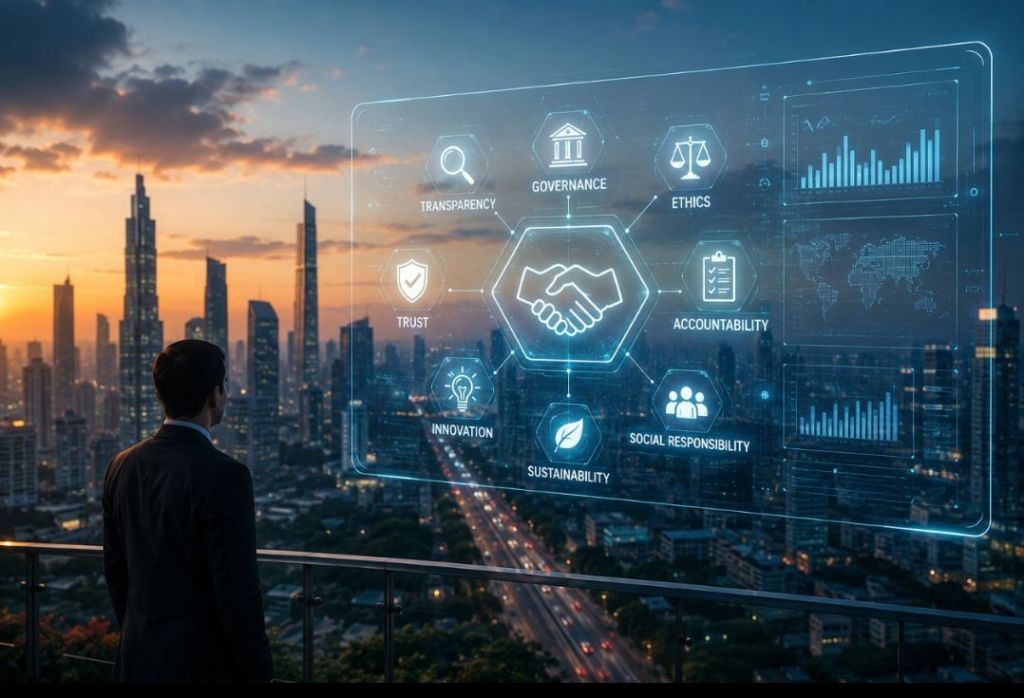
Trust is slowly becoming one of the most valuable invisible assets in the global economy. In earlier decades, countries competed mainly through natural resources, military power, industrial capacity, and low-cost labour. Today, trust itself is emerging as a major economic force influencing investment decisions, innovation ecosystems, financial stability, governance quality, and even social peace. The countries, corporations, and institutions that can maintain public credibility are likely to attract capital, talent, and technology, while those losing public confidence may face economic fragmentation, political instability, and declining competitiveness.
From Industrial Capital to Trust Capital
Historically, economic systems depended heavily on physical assets such as factories, ports, railways, and machinery. During the industrial revolution, investors looked mainly at production capacity and market size. In the digital economy, however, intangible assets have started dominating value creation. Brand reputation, governance credibility, ethical conduct, institutional transparency, and digital reliability now influence economic outcomes as strongly as physical infrastructure.
This shift is visible across the world. Technology companies with strong public trust command extraordinary market valuations despite limited physical assets. Financial systems survive primarily because people trust currencies, banks, and institutions. Democracies remain stable because citizens trust electoral systems and governance structures. Once trust begins to weaken, even strong economies can experience volatility.
The 2008 global financial crisis was not only a banking collapse but also a collapse of trust in financial institutions. Similarly, during the pandemic, countries with higher public trust often managed compliance, healthcare coordination, and economic recovery more effectively than those facing deep institutional skepticism.
India and the Emerging Trust Challenge
India is entering a phase where economic growth increasingly depends on institutional trust. As the country digitizes governance, expands financial inclusion, and builds global manufacturing ambitions, the quality of governance credibility will become critical.
There is growing public demand for transparency in governance systems, procurement processes, public spending, regulatory decisions, and corporate behaviour. Citizens today are far more informed and connected than previous generations. Social media, digital journalism, online activism, and real-time communication have transformed public expectations.
At the same time, trust has become more fragile because narratives spread rapidly through digital platforms. A single viral incident can damage the credibility of an institution or company within hours. Information ecosystems are now shaped not only by facts but also by perception battles, emotional narratives, and algorithm-driven amplification.
India’s rapid digital transformation has created both opportunities and risks. Platforms such as digital payments, Aadhaar-linked systems, online governance services, and e-commerce ecosystems have increased efficiency and accessibility. Yet they have also raised serious questions around data privacy, surveillance, cybersecurity, algorithmic bias, and misuse of personal information.
The future challenge for India will not simply be technological adoption but ethical technological governance. A digitally powerful state without sufficient accountability mechanisms may generate fear rather than trust. Similarly, corporations collecting massive amounts of consumer data may face resistance if citizens feel exploited rather than protected.
Trust and Investment Flows
Global investors are increasingly evaluating governance quality before allocating capital. Earlier, low labour costs and tax incentives were sufficient to attract investments. Today, investors also examine regulatory consistency, judicial efficiency, political stability, ESG compliance, and corporate ethics.
Environmental, Social, and Governance standards are no longer only moral debates. They are becoming financial filters. Pension funds, sovereign wealth funds, and institutional investors increasingly avoid companies or regions associated with governance failures, corruption scandals, labour exploitation, environmental negligence, or data misuse.
This trend may become even stronger in the future. Countries unable to maintain transparent regulatory systems may struggle to attract long-term investments despite market potential. Trust is therefore becoming directly linked to capital formation.
India has a major opportunity here. If the country strengthens institutional accountability, improves dispute-resolution systems, enhances data protection frameworks, and builds predictable regulatory systems, it can become a highly trusted global investment destination. However, if policy uncertainty, inconsistent enforcement, or excessive surveillance concerns increase, trust deficits could reduce investor confidence.
The Dangerous Rise of Digital Misinformation
One of the greatest threats to trust globally is the rapid expansion of misinformation ecosystems. Digital manipulation, fake news, deepfakes, AI-generated narratives, and coordinated propaganda campaigns are reshaping public discourse.
The problem is not merely political. Misinformation increasingly affects financial markets, public health, business reputations, elections, and social harmony. Rumours can trigger bank runs, damage stock valuations, create communal tensions, or destabilize democratic systems.
Artificial intelligence is likely to intensify this challenge. AI-generated content is becoming increasingly difficult to distinguish from reality. In the future, trust itself may become algorithmically manipulated.
This creates a paradox. The same technologies that improve efficiency and connectivity may also weaken social cohesion if ethical safeguards remain weak.
The future economy may therefore require a new institutional architecture focused on digital trust verification, AI accountability, cyber ethics, and data governance. Countries that fail to build these systems may face rising polarization and declining institutional legitimacy.
Human Psychology and Economic Stability
Trust is deeply connected with human psychology. People invest, consume, save, innovate, and cooperate when they feel secure about systems around them. Fear and uncertainty weaken economic behaviour.
A farmer trusts the market before investing in crops. A startup founder trusts policy stability before building a company. Consumers trust brands before spending money. Citizens trust governments before accepting reforms.
When trust declines, societies become defensive. Consumption slows, investments become cautious, political anger rises, and social fragmentation deepens. Economies cannot sustain long-term growth under widespread distrust.
This is visible globally today. Many developed economies are facing rising political polarization because large sections of society feel disconnected from institutions. Trust gaps between governments, corporations, media, and citizens are widening. Social media has amplified outrage faster than consensus.
The Future of Trust Economies
The next phase of economic competition may increasingly revolve around trusted ecosystems rather than merely productive ecosystems. Countries that successfully combine technology with ethics, innovation with accountability, and growth with institutional legitimacy may dominate the future global order.
Trust may become measurable economic infrastructure just like roads, ports, electricity, or digital connectivity. Nations with stronger trust ecosystems may attract more startups, more innovation, better talent retention, and higher-quality investments.
India stands at an important crossroads. Its demographic advantage, digital scale, and economic ambitions provide enormous opportunities. But sustaining growth in the coming decades will depend not only on GDP expansion but also on the ability to maintain public confidence in institutions, governance systems, corporations, and technology platforms.
The real battle of the future may not only be over artificial intelligence, semiconductors, or strategic minerals. It may also be over who can build societies where citizens still believe that institutions are fair, ethical, transparent, and accountable.
Without trust, even the most advanced economies may become unstable. With trust, even developing economies can build resilient and inclusive growth systems.
#TrustEconomy #DigitalGovernance #InstitutionalTrust #AIethics #ESG #EconomicStability #DataPrivacy #Governance #InnovationEconomy #FutureOfEconomics


Leave a comment