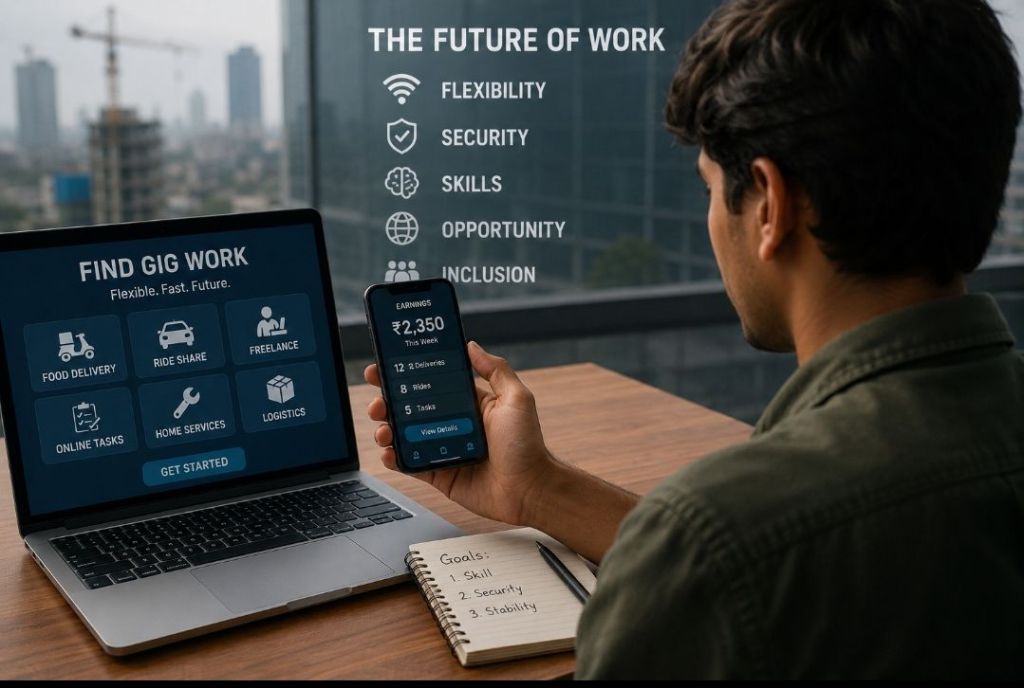
The meaning of employment is undergoing one of the biggest transformations in modern economic history. For decades, stable long-term employment was considered the foundation of economic security, social mobility, and industrial growth. A permanent job with predictable wages, social security, pensions, and institutional protection defined the aspirations of millions of families across the world. Today that model is slowly fragmenting. The rise of platform economies, digital technologies, artificial intelligence, remote work, and flexible contracts is creating a labour market where certainty is reducing and adaptability is becoming the new survival skill. What was once called employment is increasingly turning into task-based participation in economic systems. This transition is not only changing labour markets but also reshaping social structures, urbanisation patterns, productivity models, and even human psychology.
From Lifetime Employment to Platform Survival
Historically, industrial economies were built around long-term employer-worker relationships. Factories, banks, railways, public institutions, and manufacturing enterprises created stable employment ecosystems. Workers invested years in building careers within a single organisation. Employers, in return, invested in training, pensions, healthcare, and long-term workforce development. This model created a sense of belonging and social identity linked with work. However, globalisation, automation, cost pressures, and technological disruption slowly weakened this arrangement. Corporations began focusing on flexibility rather than permanence. Outsourcing, contract labour, freelancing, and temporary staffing expanded rapidly across industries.
The digital revolution accelerated this transition dramatically. Platform-based companies transformed work into digitally managed service delivery systems. Workers are now connected through apps rather than traditional offices. Algorithms increasingly allocate tasks, monitor productivity, evaluate ratings, and determine earnings. In many cases, technology has become the new supervisor. The growth of ride-sharing, food delivery, e-commerce logistics, home services, and digital freelancing platforms reflects this changing architecture of employment. Convenience for consumers and scalability for companies have come at the cost of growing uncertainty for workers.
India and the Expansion of the Gig Workforce
India has emerged as one of the largest laboratories of the platform economy. Rapid smartphone penetration, cheap internet, urban consumption growth, and youth unemployment created fertile ground for gig and platform work. Millions of workers are now employed in logistics, food delivery, mobility services, warehouse operations, beauty services, digital content creation, and online freelancing. For many young people migrating from rural or semi-urban areas, platform work provides immediate income opportunities without requiring high formal qualifications.
At one level, this transformation appears positive. It has created livelihoods at a scale that traditional industries were unable to absorb quickly. Platform work has also increased labour force participation among sections previously excluded from formal employment systems. Women, students, retirees, and part-time workers are increasingly participating in flexible work models. However, beneath this apparent flexibility lies a deeper structural concern. Most gig workers remain outside stable social protection systems. Earnings fluctuate unpredictably, incentives change frequently, and work hours often become excessively long to maintain income levels. Many workers carry operational risks such as fuel costs, vehicle maintenance, health risks, and insurance burdens themselves.
India’s attempt to address these issues through social security codes reflects recognition of the problem, but implementation remains extremely complex. The challenge is not only legal but structural. Traditional labour laws were designed for factories and offices where employer-employee relationships were clearly defined. Platform economies deliberately operate in grey zones where companies often classify workers as independent partners instead of employees. This reduces legal obligations related to provident funds, insurance, paid leave, minimum wages, and retirement benefits. As a result, a large workforce powering the digital economy continues to function without predictable long-term protection.
The Illusion of Flexibility and the Reality of Insecurity
Flexible work is often presented as empowerment, but the reality is more complicated. Flexibility benefits highly skilled professionals who can negotiate global opportunities, remote work arrangements, and independent consulting assignments. For low-income workers, however, flexibility frequently translates into income volatility and economic vulnerability. A delivery worker may technically choose work hours, but algorithmic incentives often force workers to stay online for longer durations to achieve reasonable earnings. This creates a hidden form of digital labour control.
The productivity debate around gig work is equally important. Platform economies increase efficiency in service delivery, but they do not always create deep economic productivity. A nation cannot sustain long-term growth only through low-value service aggregation. Countries require strong manufacturing ecosystems, innovation-led industries, research capabilities, and advanced technological sectors to generate sustainable employment quality. If economies increasingly depend on fragmented informal digital work, they may witness rising consumption without corresponding increases in long-term productivity or wealth creation.
Skill Mismatch in the Age of Artificial Intelligence
One of the most dangerous contradictions in modern labour markets is the coexistence of unemployment and labour shortages. India possesses one of the world’s largest working-age populations, yet industries repeatedly report shortages of skilled workers. This mismatch is becoming more severe with the rise of automation, robotics, artificial intelligence, and advanced manufacturing systems.
Educational systems continue producing degree holders, while industries increasingly demand adaptable problem-solving skills, digital literacy, machine interaction capabilities, communication abilities, and specialised technical competencies. The gap between education and employability is widening rapidly. Millions of young people may remain employable only for low-productivity tasks unless large-scale reskilling ecosystems emerge urgently.
Artificial intelligence is intensifying this disruption further. Routine white-collar jobs once considered secure are now vulnerable. Data entry, basic accounting, customer support, repetitive legal drafting, routine programming, and administrative functions are increasingly being automated. The coming decade may witness job destruction not only in blue-collar sectors but also across middle-income professional categories. This could fundamentally alter income distribution patterns globally.
Global Debate on Worker Classification
Across the world, governments, courts, labour unions, and platform companies are engaged in intense debates regarding worker classification. Should gig workers be treated as employees or independent contractors. This question has become central to the future of labour regulation. Companies argue that flexibility and innovation may suffer if strict employment laws are imposed. Workers and labour groups argue that without protections, digital capitalism may create a permanently insecure workforce.
Different countries are experimenting with hybrid regulatory frameworks. Some are introducing portable benefits systems where workers carry social security across platforms. Others are exploring minimum earnings guarantees, accident insurance, and algorithm transparency rules. Yet the global regulatory system remains fragmented because technology evolves faster than labour policy frameworks.
Climate Change, Migration, and Future Labour Markets
The future of employment will not be shaped only by technology. Climate change is emerging as a major driver of labour transformation. Heat stress, water scarcity, agricultural instability, and climate disasters may force millions to migrate from vulnerable rural regions toward urban economies. This could intensify pressure on already fragile labour markets.
Migration patterns are also changing globally. Developed economies facing ageing populations require labour, while developing economies continue producing young workforces searching for opportunities. However, rising nationalism, tighter immigration controls, and economic uncertainty are reshaping migration policies worldwide. Future labour mobility may increasingly depend on skills rather than sheer workforce availability.
The Human Side of the New Labour Economy
The most critical issue in this transition is not only economic but human. Work is more than income. It shapes dignity, identity, relationships, aspirations, and social stability. An economy dominated by insecure work can create psychological stress, declining social trust, and growing inequality. The next generation may no longer measure success through career stability but through continuous survival in changing labour markets.
The challenge before policymakers is therefore much larger than creating jobs numerically. The real challenge is creating meaningful, productive, secure, and future-ready livelihoods. Countries that successfully combine technological progress with social protection, skill transformation, and institutional adaptability will shape the next phase of economic leadership.
India stands at a decisive moment in this transformation. Its demographic strength can either become a historic advantage or a structural burden. If India manages to build strong manufacturing ecosystems, digital capability, skill alignment, worker protections, and innovation-led industries simultaneously, it can emerge as one of the defining labour economies of the twenty-first century. But if employment increasingly shifts toward low-security platform dependency without productivity expansion, the country may face a future where economic growth rises statistically while social insecurity deepens silently.
The future of employment will ultimately depend on whether technology remains a tool for human advancement or becomes a mechanism that gradually disconnects economic growth from human stability.
#GigEconomy
#PlatformWorkers
#FutureOfWork
#ArtificialIntelligence
#EmploymentCrisis
#SocialSecurity
#LabourMarkets
#DigitalEconomy
#SkillMismatch
#EconomicTransformation


Leave a comment