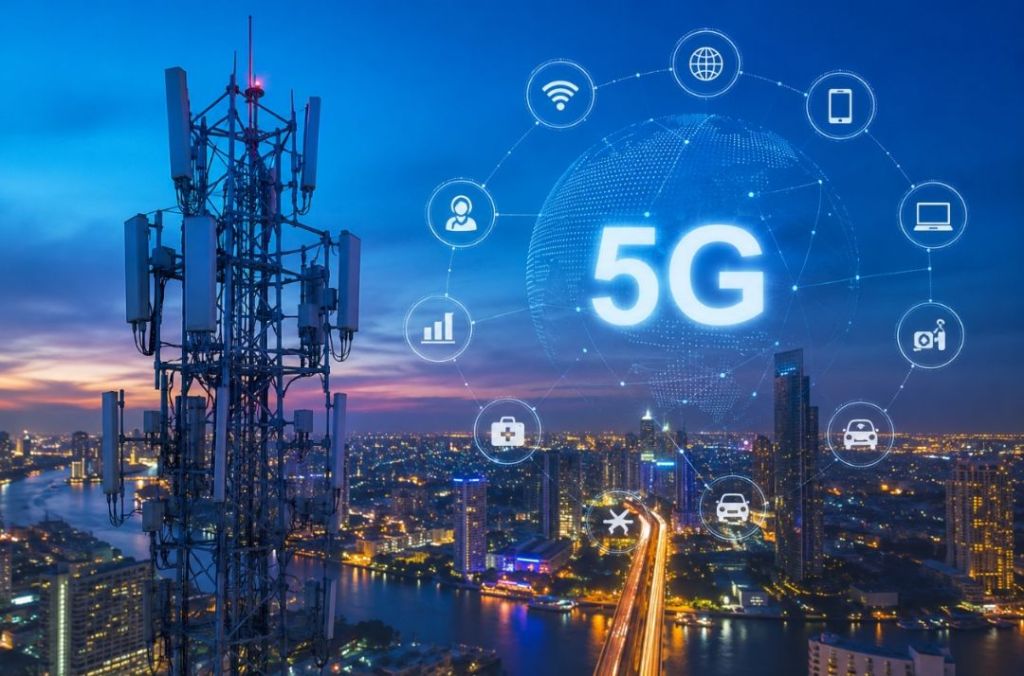
Telecom has quietly transformed from a communication service into the nervous system of the modern economy. In earlier decades, roads, railways, and ports defined national competitiveness. Today, fiber networks, mobile towers, cloud connectivity, and data ecosystems are becoming equally important because almost every sector now depends on digital connectivity for survival and growth. The rise of 5G is not merely about faster internet for consumers. It is about machine-to-machine communication, real-time industrial monitoring, smart logistics, telemedicine, digital payments, artificial intelligence, and the expansion of automated manufacturing ecosystems. Telecom is no longer a support industry. It is becoming a strategic national asset.
India’s telecom journey reflects one of the most dramatic transformations in modern economic history. From a time when waiting years for a landline connection was considered normal, the country has become one of the world’s largest mobile data consumers. Cheap data plans and aggressive competition expanded digital access to villages, small towns, street vendors, and low-income households. This digital democratization helped accelerate e-commerce, fintech, online education, and platform-based employment. India today is witnessing one of the fastest 5G rollouts globally, led by large telecom operators investing heavily in towers, fiberization, and spectrum acquisition. Yet beneath the celebration lies a more uncomfortable reality. Telecom companies are carrying enormous financial burdens due to expensive spectrum auctions, debt-heavy infrastructure investments, and intense pricing competition that has kept consumer tariffs unusually low compared to global standards.
The telecom sector in India increasingly resembles a high-investment, low-return industry where survival depends on scale. While users enjoy affordable connectivity, operators struggle with profitability and long-term financial sustainability. This raises an important question about whether telecom should continue to be treated purely as a commercial sector or partially as strategic infrastructure similar to power, transport, or public utilities. The challenge becomes more critical as 5G deployment requires dense tower networks, fiber backhaul systems, data centers, and continuous upgrades. The cost of maintaining digital infrastructure is rising much faster than the revenue generated from consumers. Many global telecom companies are already facing slower returns on 5G investments because industries are adopting advanced applications more slowly than expected.
The industrial implications of telecom are now becoming visible across sectors. Manufacturing units are experimenting with smart factories where machines communicate in real time to reduce downtime and improve efficiency. Logistics firms are using connected systems for fleet management and predictive maintenance. Healthcare is gradually integrating remote diagnostics, telemedicine, and wearable monitoring systems. Agriculture may eventually witness precision farming driven by sensors and satellite-linked communication networks. However, India still faces a major digital imbalance. Urban centers are rapidly entering the 5G era while many rural regions continue struggling with inconsistent connectivity and poor fiber penetration. The risk is that digital inequality may become as dangerous as income inequality in the future economy.
Globally, telecom has become deeply entangled with geopolitics. Control over telecom equipment, semiconductor chips, undersea cables, satellites, and cloud systems is increasingly viewed through the lens of national security. The rivalry between major powers has transformed telecom supply chains into strategic battlegrounds. Countries are now questioning dependence on foreign equipment providers because telecom networks are no longer just communication channels; they are repositories of sensitive economic and citizen data. Data sovereignty is emerging as a new form of economic sovereignty. Nations want their citizens’ data stored, processed, and protected within trusted systems because control over data increasingly means control over economic behavior, financial systems, and even political narratives.
Cybersecurity risks are simultaneously growing at an alarming pace. As economies become hyperconnected, vulnerabilities multiply. A telecom outage today can disrupt banking systems, transport operations, hospitals, factories, and governance platforms simultaneously. The future risk is not merely hacking but systemic digital paralysis. Artificial intelligence-driven cyberattacks, ransomware targeting infrastructure, and digital espionage are becoming strategic threats. This creates pressure on governments and companies to invest heavily in cyber resilience, encryption systems, and domestic technology capabilities. The irony is that while telecom enables digital growth, it also expands the surface area of vulnerability.
The global telecom industry is also entering a phase of consolidation and strategic restructuring. Building next-generation networks requires enormous capital expenditure, but returns remain uncertain because consumers expect low-cost services while investors expect profitability. Many telecom firms globally are reducing workforce intensity, sharing infrastructure, monetizing tower assets, and diversifying into cloud, fintech, cybersecurity, and digital services. The future telecom company may look less like a traditional operator and more like a digital ecosystem platform controlling connectivity, data flows, payments, entertainment, and enterprise solutions.
India stands at a decisive moment in this transformation. The country has scale, talent, a massive digital user base, and growing policy ambition. Yet the real challenge lies beyond network expansion. India must strengthen indigenous telecom manufacturing, semiconductor ecosystems, cybersecurity capabilities, and deep-tech innovation if it wants to avoid becoming permanently dependent on imported digital infrastructure. The coming decade may determine whether India emerges as a digital sovereign power or merely a large consumer market for global technology systems.
Historically, countries that controlled critical infrastructure dominated economic systems. In the industrial age it was coal, railways, steel, and oil. In the digital age it may be fiber networks, telecom ecosystems, cloud infrastructure, and data intelligence. Telecom is therefore no longer about calls or internet speed. It is about economic power, industrial competitiveness, strategic autonomy, and societal resilience. The future may belong not only to nations with the largest economies, but to those that control the strongest digital arteries connecting people, machines, industries, and intelligence.
#TelecomTransformation
#DigitalEconomy
#5GRevolution
#DataSovereignty
#CyberSecurity
#FiberNetworks
#IndustrialAutomation
#TelecomInfrastructure
#DigitalInequality
#GeopoliticalTechnology
 "Connecting communities, empowering nations: Unifying the Regional and Global Economy ."
Leave a comment