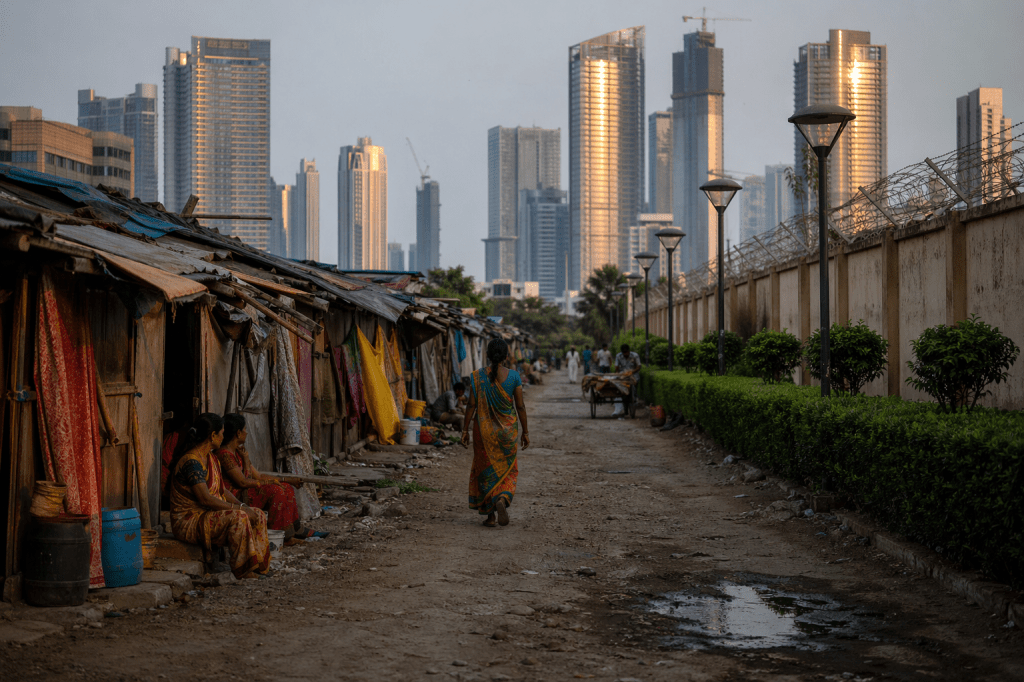
Historical roots of inequality and the unfinished promise of social justice
India’s economic journey since independence has always carried a dual narrative of growth and inequality, where the aspiration of a welfare state coexisted with deep structural hierarchies of caste, class, and access to opportunity. The constitutional vision led by B. R. Ambedkar placed social justice at the core of economic development, recognizing that markets alone cannot correct historical disadvantages. Early labour laws were therefore not merely regulatory tools but instruments to rebalance power between capital and labour, ensuring minimum wages, job security, and dignity at work. However, despite decades of policy evolution, inequality has persisted and in recent years intensified, suggesting that growth has not translated into equitable distribution.
Concentration of wealth and fragmentation of labour markets
Recent empirical evidence points toward a sharp concentration of wealth, where the top 1 percent controls a disproportionately large share of national assets and income. This is not just a statistical imbalance but reflects a structural shift in how value is created and distributed in the economy. On one side, capital accumulation is accelerating through financialisation, technology, and global integration, while on the other, labour markets are becoming increasingly informal, precarious, and fragmented. The rise of gig work, contract employment, and informalisation within formal enterprises has weakened job security and reduced the bargaining power of workers. This divergence creates a scenario where economic growth becomes decoupled from wage growth, leading to a widening gap between productivity and income.
Labour codes and the reconfiguration of state-market relations
The consolidation of 29 labour laws into four Labour Codes represents a major structural reform, but its deeper implications lie in the reorientation of the state’s role. Instead of acting as a neutral arbiter balancing labour and capital, the state increasingly appears to be facilitating capital efficiency and labour flexibility. This shift reflects a broader global trend where competitiveness is often pursued through deregulation and cost minimisation. However, in the Indian context, where labour markets are already vulnerable, such reforms risk amplifying existing inequalities. The dilution of inspection mechanisms, greater thresholds for applicability of labour protections, and flexibility in hiring and firing collectively signal a movement toward employer-centric regulation.
Centralisation, governance shifts and weakening of federal balance
A critical dimension of this transformation is the centralisation of labour governance. Labour, constitutionally a concurrent subject, historically allowed states to adapt policies based on regional industrial conditions. The increasing concentration of decision-making powers at the Union level reduces this flexibility, potentially leading to a one-size-fits-all framework that may not suit diverse economic realities. This centralisation also reflects a broader governance trend where economic policymaking is becoming more standardised, often prioritising national competitiveness over local labour conditions. In the long run, this may weaken the ability of states to innovate and respond to region-specific labour challenges.
Delegated legislation and the shift from democratic to executive control
Another significant structural change lies in the increasing reliance on delegated legislation, where broad legal frameworks are defined in statutes but detailed rules are left to executive authorities. While this allows flexibility and faster policy adaptation, it also reduces transparency and democratic accountability. Key aspects such as wage determination, social security eligibility, and compliance mechanisms are increasingly shaped by administrative decisions rather than parliamentary debate. This shift raises concerns about the erosion of institutional checks and balances, especially in areas that directly impact millions of workers.
Changing philosophy of work and the risk of regressive frameworks
Beyond legal and administrative changes, there is an emerging ideological shift in how work is conceptualised. The movement from a rights-based framework toward a duty-based narrative risks undermining the fundamental principle that labour is not just an economic input but a human activity tied to dignity and social justice. Historically, labour laws were designed to counter exploitation and ensure equitable participation in economic growth. Reframing work primarily as an obligation without corresponding rights can reinforce existing hierarchies, particularly in a society where social and economic inequalities are deeply intertwined.
Global commitments and divergence from international labour standards
India’s engagement with global institutions such as the International Labour Organization has historically aligned its labour policies with international norms on wages, equality, and worker protections. However, deviations from principles such as equal pay for work of equal value highlight a growing divergence between domestic reforms and global commitments. In a world where trade agreements and global supply chains increasingly incorporate labour standards, such divergence may also have economic consequences, affecting export competitiveness and international credibility.
Erosion of social justice and the future of labour dignity
The cumulative effect of these changes is a gradual erosion of the social justice framework that once defined India’s labour policy. Judicial interpretations over decades have reinforced the idea that economic development must be inclusive and that labour rights are integral to democratic stability. The shift away from this framework risks transforming labour law from a tool of empowerment into an instrument of exclusion. When workers lose access to fair wages, social security, and collective bargaining, the economy may achieve short-term efficiency but at the cost of long-term social cohesion.
Futuristic outlook: inequality as a macroeconomic risk
Looking ahead, inequality is not just a social concern but a macroeconomic risk. High concentration of wealth can suppress aggregate demand, limit human capital development, and create structural inefficiencies. For a country like India, aiming to become a global economic powerhouse, inclusive growth is not optional but essential. The challenge is to design a labour framework that balances flexibility with security, competitiveness with fairness, and growth with dignity. If current trends continue unchecked, the risk is the emergence of a dual economy where a small segment thrives in high-productivity sectors while the majority remains trapped in low-wage, insecure employment.
Reimagining the path forward: restoring balance between capital and labour
The future of India’s economic trajectory will depend on its ability to recalibrate this imbalance. Strengthening social security systems, ensuring fair wage mechanisms, empowering collective bargaining, and restoring federal flexibility in labour governance are critical steps. Equally important is reasserting the principle that economic policy must serve society as a whole, not just capital accumulation. The real test of India’s development model will not be the pace of growth alone but the extent to which it upholds dignity, equity, and justice for its workforce.
Keywords
#Inequality #LabourCodes #WealthConcentration #Informalisation #SocialJustice #Federalism #WorkerRights #EconomicPolicy #InclusiveGrowth #LabourReforms


Leave a Reply