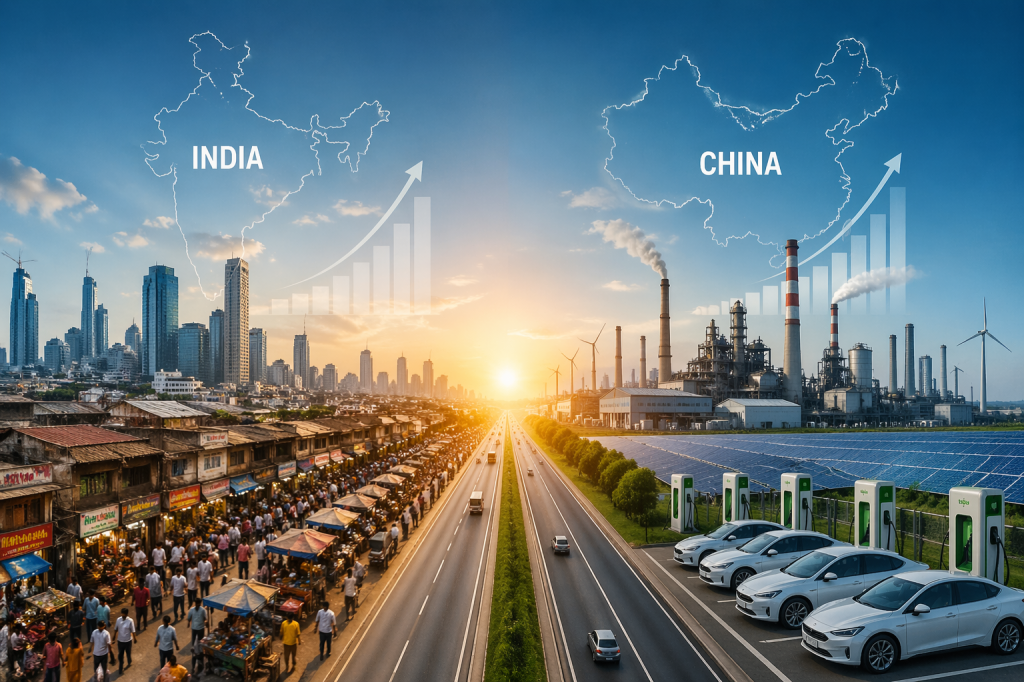
India and China began their modern economic journeys under similar conditions of poverty, large agrarian populations, and state-led developmental ambitions, yet their trajectories diverged sharply over the past four decades, creating a visible gap in income levels, industrial depth, and human capital outcomes. China’s growth model evolved through a tightly sequenced transition where agriculture released labour into manufacturing, manufacturing scaled into exports, and exports financed technological upgrading, whereas India’s path has been far more discontinuous, with services leapfrogging manufacturing and growth being driven by enclaves of high productivity rather than broad-based structural transformation. This divergence is not merely statistical; it reflects deeper institutional choices, policy priorities, and the capacity to align labour, capital, and knowledge systems toward a coherent national economic objective.
Labour Force Transition and the Missing Middle
China’s transformation is fundamentally a story of labour reallocation at scale, where hundreds of millions moved from low-productivity agriculture into factory-based employment, creating not only jobs but also a disciplined industrial workforce embedded in global value chains. This transition generated rising wages, urban consumption, and a virtuous cycle of productivity growth. India, in contrast, exhibits a structural anomaly where labour has shifted from agriculture largely into informal services rather than organised manufacturing, creating a fragmented labour market with limited productivity gains. The absence of a strong manufacturing base means that India has struggled to absorb its demographic expansion into stable, wage-generating employment, resulting in a paradox of growth without sufficient job creation. Historically, economies such as Japan and South Korea demonstrated that manufacturing acts as the bridge between agrarian surplus labour and high-income status, and India’s deviation from this pathway raises critical concerns about long-term income convergence.
Industrial Strategy and the New Technological Frontier
China’s rise in sectors such as batteries and electric vehicles reflects not just industrial capacity but strategic foresight, where the state anticipated future technological shifts and aligned finance, policy incentives, supply chains, and human capital accordingly. By securing access to critical minerals, investing heavily in research and development, and nurturing domestic champions, China positioned itself at the core of the global green technology ecosystem. India’s progress in these sectors, while notable, remains constrained by fragmented supply chains, dependence on imports for key inputs, and relatively lower investment in deep technology innovation. The emerging global competition is no longer about low-cost manufacturing alone but about control over technology ecosystems, standards, and intellectual property, and here the gap between the two economies becomes even more pronounced.
Education Systems and the Quality Paradox
At the heart of this divergence lies the question of human capital, where India faces a structural contradiction between access and quality. While enrolment levels have improved significantly, learning outcomes remain uneven, and the system continues to rely heavily on rote-based pedagogy that does not align with the demands of a knowledge-driven economy. The growing preference for private schooling reflects a lack of confidence in public education, yet private institutions themselves often replicate similar deficiencies in curriculum design and teaching quality. China, despite its own challenges, has invested more consistently in foundational education, technical training, and STEM capabilities, enabling a stronger linkage between education and industrial needs. The real issue for India is not merely expanding education but transforming it into a system that builds analytical ability, problem-solving capacity, and adaptability in a rapidly changing economic environment.
Entrepreneurship, Institutions, and the Innovation Ecosystem
Both India and China have demonstrated entrepreneurial dynamism, but the ecosystems supporting entrepreneurship differ significantly in depth and coherence. China’s model combines state support with market competition, enabling rapid scaling of enterprises and integration into global supply chains, while India’s entrepreneurial landscape, though vibrant, often operates within a context of regulatory complexity, uneven infrastructure, and constrained access to long-term finance. The result is a concentration of successful start-ups in select sectors and regions rather than a widespread entrepreneurial base. The challenge for India is not the absence of entrepreneurial talent but the lack of an enabling ecosystem that allows ideas to translate into scalable enterprises across sectors and geographies.
The Demographic Window and the Risk of Delay
India’s demographic advantage is frequently highlighted as a key strength, yet it is also a time-bound opportunity that requires rapid conversion into productive capacity. Without sufficient job creation, skill development, and industrial expansion, this demographic dividend risks turning into a demographic burden. China, having already passed its demographic peak, is now focusing on productivity and technological upgrading, while India is still grappling with the foundational challenge of employment generation. The contrast underscores a critical point: demographics alone do not guarantee growth; they must be complemented by structural transformation and institutional effectiveness.
Strategic Realignment: Education, Manufacturing, and Entrepreneurial Depth
For India, the path forward requires a rebalancing of priorities where education reform, industrial policy, and entrepreneurial support are not treated as isolated domains but as interconnected pillars of economic transformation. Strengthening foundational learning, modernising curricula, and investing in teacher capacity must align with industry needs through vocational training and apprenticeships, creating a workforce that is both skilled and employable. Simultaneously, manufacturing must be repositioned as a central driver of growth, supported by infrastructure development, policy stability, and integration into global value chains. Entrepreneurship, in turn, must be broadened beyond technology start-ups to include manufacturing, rural enterprises, and innovation within traditional sectors, thereby creating a more inclusive and resilient economic base.
A Futuristic Lens: Competing Models in a Fragmented Global Economy
Looking ahead, the global economic environment is becoming more fragmented, with geopolitics, technology control, and sustainability shaping the contours of growth. China’s model of state-coordinated capitalism is likely to continue evolving with a focus on technological self-reliance, while India’s challenge is to craft a hybrid model that leverages market dynamism without losing strategic direction. The competition between the two economies will increasingly be defined not by size alone but by the ability to innovate, adapt, and build resilient systems that can withstand global shocks. In this context, India’s openness, democratic institutions, and entrepreneurial culture offer unique strengths, but these must be matched by execution capability and long-term policy coherence.
Bridging the Gap Through Structural Clarity
The comparison between India and China is not about replication but about understanding the importance of sequencing, scale, and strategic intent in economic transformation. India’s journey ahead depends on its ability to correct structural imbalances, particularly in manufacturing and education, while unleashing its entrepreneurial potential in a more systematic manner. The future will not be determined by isolated successes but by the creation of an integrated ecosystem where labour, industry, and knowledge reinforce each other. If India can align these elements effectively, it has the potential not only to bridge the existing gap but to define a distinct model of growth that is both inclusive and globally competitive.
#IndiaChinaComparison #ManufacturingVsServices #LabourTransition #HumanCapital #EducationReform #Entrepreneurship #IndustrialStrategy #EVandBatteries #DemographicDividend #GlobalValueChains


Leave a Reply