29 November 2026 | International Economics | Global Investment and Economic Transformation
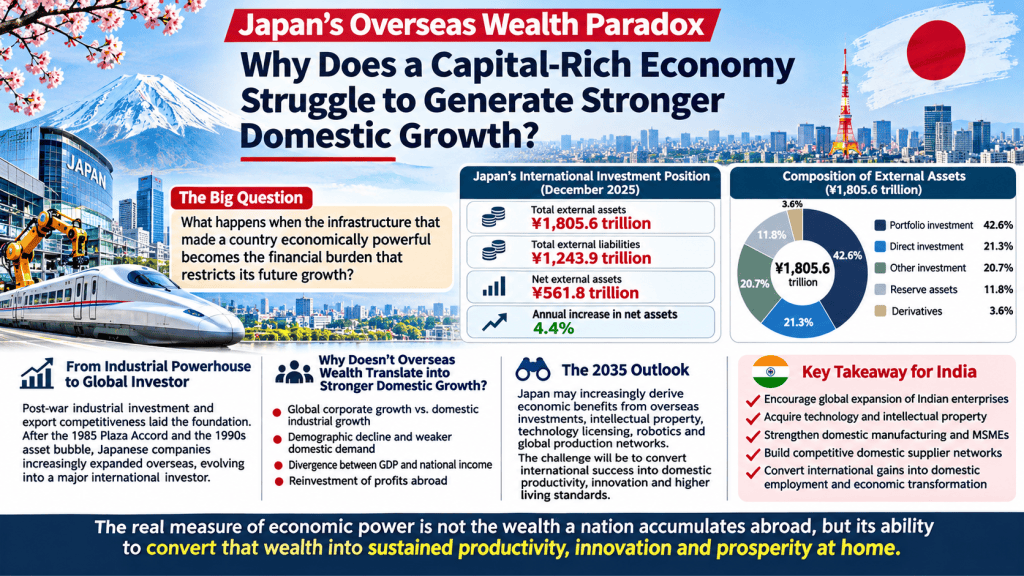
Japan presents one of the most interesting paradoxes in contemporary international economics. It possesses enormous overseas financial assets, advanced technological capabilities, globally competitive corporations and sophisticated manufacturing ecosystems. Yet its domestic economy continues to struggle with relatively weak growth, demographic decline and limited investment dynamism.
Japanese corporations and financial institutions have invested extensively in overseas manufacturing, infrastructure, technology and financial markets. These investments generate substantial income for Japan, but international financial success does not automatically translate into stronger domestic economic development.
The fundamental question is whether the globalisation of Japanese capital has become more successful than the revitalisation of the Japanese economy itself.
From manufacturing powerhouse to global investor
Japan’s post-war economic miracle was driven by domestic industrial investment, technological innovation, productivity improvements and export competitiveness. Its automobile, electronics, machinery and precision engineering industries established global leadership.
However, the Plaza Accord of 1985 and the subsequent appreciation of the yen encouraged Japanese corporations to establish manufacturing facilities overseas. The collapse of the domestic asset-price bubble in the early 1990s further increased the importance of international markets as sources of growth and commercial opportunity.
Over subsequent decades, Japan gradually transformed itself from primarily an export-oriented manufacturing economy into a major international investor.
Japanese enterprises increasingly became global production organisations rather than manufacturers operating exclusively within Japan.
This transformation strengthened corporate competitiveness but also changed the relationship between corporate prosperity and domestic economic growth.
Japan’s international investment position: December 2025
Total external assets
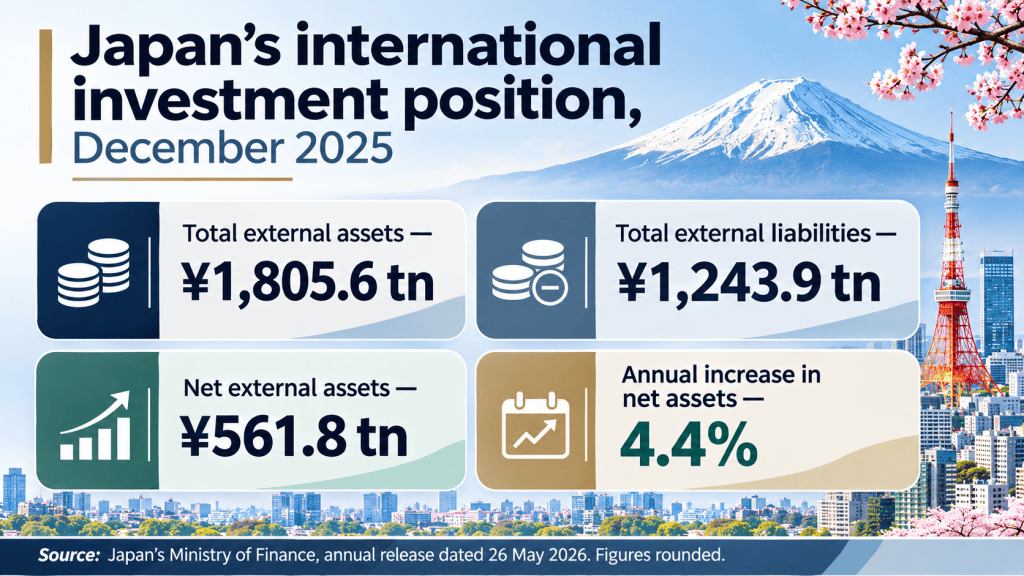
Investment category ¥ trillion Overseas direct investment 384.5 Portfolio investment 768.7 Financial derivatives 65.5 Other investment 373.3 Reserve assets 213.7 Total external assets 1,805.6 Net international investment position 561.8
Source: Japan’s Ministry of Finance, annual release dated 26 May 2026. Figures rounded. 財務省 +1
Composition of Japan’s external assets
Japan’s external wealth provides considerable financial resilience. However, these assets belong to different institutions and enterprises and cannot automatically be mobilised for domestic development or government expenditure. Moreover, increases in external asset values can reflect exchange-rate movements and market valuations rather than entirely new investment.
Why does overseas wealth not automatically generate domestic growth?
1. Global corporate growth versus domestic industrial growth
When Japanese companies establish factories overseas, they gain access to expanding markets, lower production costs and international supply chains.
However, much of the associated direct employment, infrastructure development and supplier demand may arise in host countries rather than Japan.
Japanese enterprises can therefore become more globally competitive without generating proportionate increases in domestic industrial activity.
2. Demographic decline and weakening domestic demand
Japan’s ageing and declining population restricts the expansion of domestic consumer markets while creating labour shortages.
For enterprises evaluating future investment opportunities, expanding economies in India, Southeast Asia and other emerging markets may offer greater commercial potential than mature domestic markets.
The problem is not necessarily a shortage of capital but a shortage of sufficiently attractive domestic investment opportunities.
3. The divergence between GDP and national income
Japan’s experience highlights an important distinction between Gross Domestic Product (GDP) and Gross National Income (GNI).
GDP measures economic production within national boundaries, whereas GNI incorporates net primary income earned from abroad.
Overseas investment income can strengthen Japan’s national income without generating an equivalent increase in domestic production. Global financial strength Domestic economic challenge Large overseas assets Weak domestic growth Internationally competitive enterprises Limited expansion of domestic markets Overseas investment income Insufficient new domestic employment opportunities Advanced manufacturing capabilities Ageing and shrinking workforce Substantial capital resources Limited attractive investment opportunities
4. The reinvestment dilemma
Profits generated by Japanese enterprises abroad may be reinvested in overseas operations rather than transferred back to Japan.
This is often a rational corporate strategy. However, from a national development perspective, it raises questions about the transmission of international corporate earnings into domestic wages, consumption, innovation and productive investment.
The challenge is not to discourage overseas investment but to strengthen its connections with the domestic economy.
Future outlook: Japan in 2035
Japan may increasingly evolve towards an economy that derives income from ownership of international assets, intellectual property, advanced technology, financial investment and global production networks.
Its future economic strength could increasingly depend on robotics, industrial automation, precision engineering, advanced materials, intellectual property and international financial returns.
Nevertheless, Japan must simultaneously revitalise domestic entrepreneurship, improve service-sector productivity, accelerate digital transformation and create new investment opportunities.
A successful transition would involve converting international wealth into domestic technological capabilities, higher real wages and improved living standards.
This is a possible structural trajectory, not a prediction of inevitable domestic stagnation.
Implications for India
Japan’s experience offers an important long-term lesson for India’s industrial and economic development strategy.
India must encourage its enterprises to internationalise, acquire foreign technologies, establish overseas distribution networks and participate in global value chains. However, international expansion should simultaneously deepen domestic manufacturing capabilities. Conventional objective Strategic objective Increasing exports Building ownership of global value chains Encouraging overseas investment Acquiring technology and intellectual property Expanding corporate profitability Strengthening domestic productive capabilities Attracting multinational companies Developing competitive domestic supplier networks Accumulating financial wealth Converting wealth into productive investment Global corporate expansion Domestic employment and economic transformation
Indian MSMEs and industrial clusters should particularly focus on developing technology ownership, international customer relationships, specialised manufacturing capabilities and domestic value addition.
India should pursue global integration without weakening its domestic industrial foundations.
Conclusion: Financial power versus economic dynamism
Japan demonstrates that a country can accumulate extraordinary international financial wealth while experiencing relatively modest domestic economic growth.
Overseas investment is not inherently responsible for domestic stagnation. Rather, Japan’s experience reveals how demographic conditions, domestic demand, investment incentives and the distribution of corporate income determine whether international financial success translates into broader economic prosperity.
The true measure of economic power is not simply the volume of assets a country owns across the world, but its ability to convert those assets into sustained productivity, innovation and prosperity at home.
The provocative question:
What happens when a country’s capital becomes increasingly successful abroad, while its domestic economy struggles to discover new sources of growth?
Keywords: Japan Economy, International Investment, Global Value Chains, Domestic Growth, Industrial Competitiveness, Capital Accumulation, MSMEs, Economic Transformation.
Reference: Ministry of Finance, Japan – International Investment Position, End of 2025


Leave a Reply