The real challenge is not eliminating middlemen but transforming their economic role
For decades, agricultural and MSME development policies have been influenced by a relatively simple assumption: eliminating intermediaries will increase producer incomes, reduce consumer prices and improve market efficiency. Governments have promoted direct marketing, producer organisations, digital marketplaces and direct export linkages to reduce dependence on middlemen.
However, this approach often overlooks a fundamental economic question: if intermediaries are merely exploitative, why have they remained an integral part of production and distribution systems despite technological progress and market liberalisation?
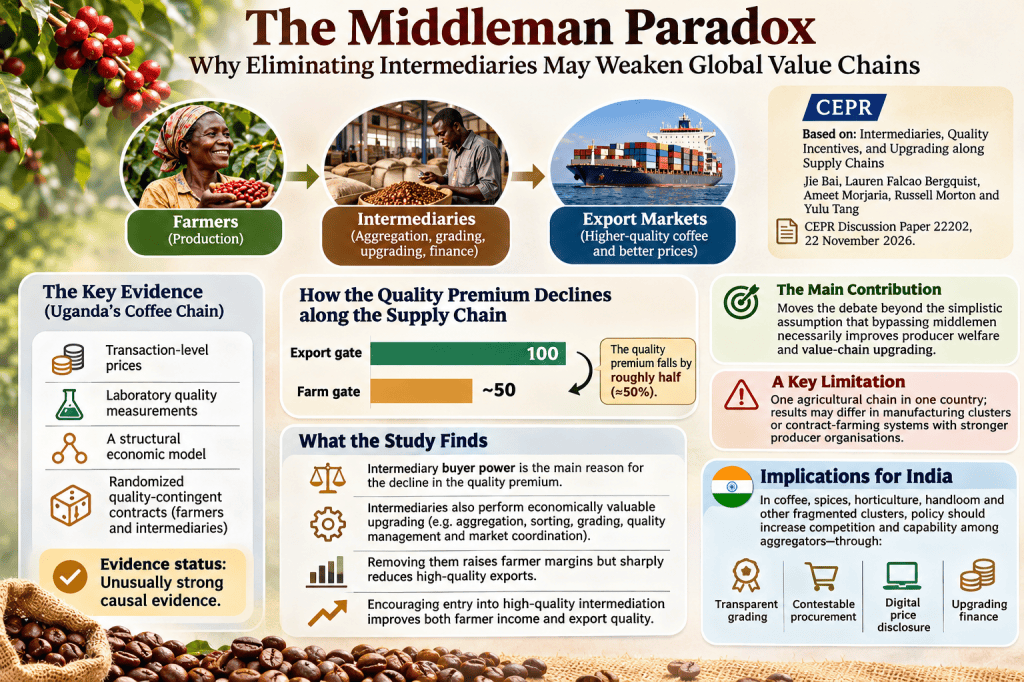
A recent CEPR discussion paper, Intermediaries, Quality Incentives, and Upgrading along Supply Chains, challenges this conventional understanding through an examination of Uganda’s coffee value chain. Its findings have significant implications for agricultural markets, industrial clusters, MSMEs and export competitiveness in developing economies, particularly India.
The hidden economics of intermediation
The research, undertaken by Jie Bai, Lauren Falcao Bergquist, Ameet Morjaria, Russell Morton and Yulu Tang, combines transaction-level price data, laboratory-based quality measurements, structural economic modelling and randomised experiments involving farmers and intermediaries.
One of its most significant findings is that the quality premium declines by approximately 50% between the export gate and the farm gate. In other words, a substantial portion of the financial incentive associated with producing higher-quality coffee does not reach the original producer.
The research identifies the bargaining power of intermediaries as a major reason for this decline. However, it also reveals that intermediaries undertake economically valuable activities that contribute to quality improvement and export competitiveness.
These include aggregation, sorting, grading, quality management, financing and coordination between fragmented producers and international markets.
The study’s model suggests that eliminating intermediaries could increase farmer margins while simultaneously reducing high-quality exports. Encouraging competition and entry into high-quality intermediation, however, could improve both producer incomes and export quality.
This challenges the assumption that a shorter supply chain is necessarily a more efficient supply chain.
Exploitation and value creation can coexist
The fundamental problem with traditional development thinking is that it often treats intermediaries either as exploiters or as facilitators. In reality, they can perform both roles simultaneously.
An intermediary may provide working capital, absorb commercial risks, aggregate small production volumes and connect producers with sophisticated markets while also exercising excessive bargaining power.
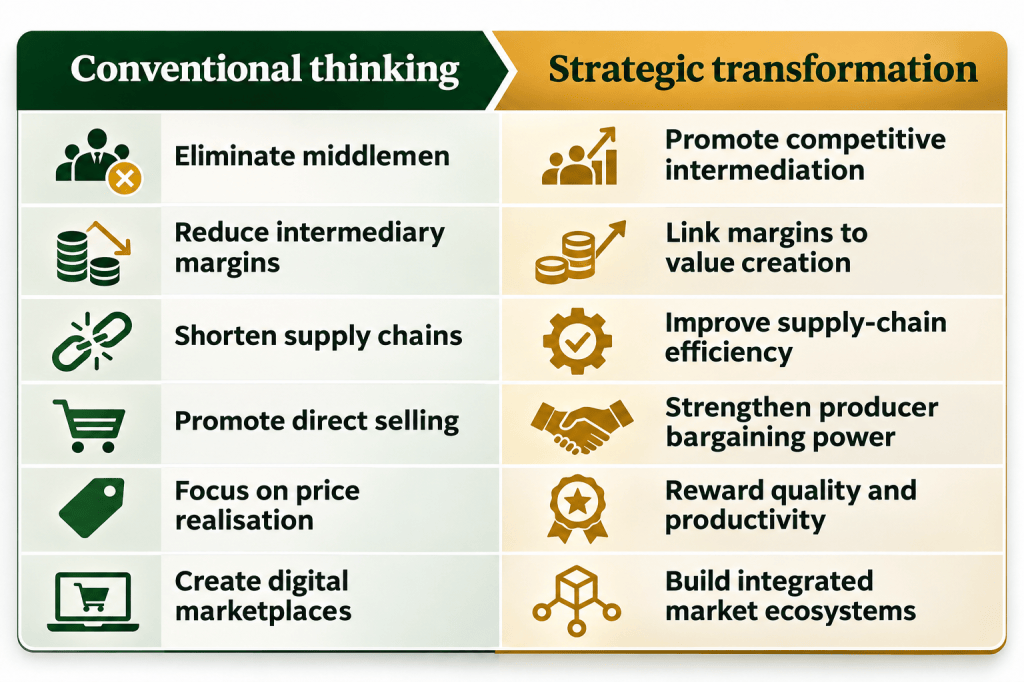
Eliminating such an intermediary without creating an institutional alternative may remove exploitation but also destroy essential economic functions. Conventional thinking Strategic transformation Eliminate middlemen Promote competitive intermediation Reduce intermediary margins Link margins to value creation Shorten supply chains Improve supply-chain efficiency Promote direct selling Strengthen producer bargaining power Focus on price realisation Reward quality and productivity Create digital marketplaces Build integrated market ecosystems
The objective of development policy should therefore be to separate genuine value creation from excessive extraction of economic rents.
India’s fragmented production paradox
India’s agricultural and industrial landscape is characterised by millions of small and geographically dispersed producers. Whether in coffee, spices, horticulture, handloom, handicrafts or engineering clusters, individual enterprises frequently lack the scale, financial resources and market intelligence necessary to access sophisticated markets independently.
A small coffee grower cannot easily establish direct relationships with international roasters. A rural artisan may not understand changing consumer preferences in Europe or North America. A small engineering enterprise may possess manufacturing capabilities but lack international certification, marketing networks and customer acquisition capabilities.
Intermediaries bridge these gaps.
However, when producers have limited alternative buyers, intermediaries can capture a disproportionate share of the value generated. This weakens incentives to invest in technology, quality improvement and product differentiation.
India’s challenge is therefore not simply fragmented production but fragmented production combined with concentrated market access.
The missing transmission of quality incentives
How quality incentives weaken along a supply chain
Illustrative index based on the study’s reported finding
The quality premium is approximately halved. This does not imply that half of the total product price is retained by intermediaries.
When international buyers pay higher prices for superior quality but producers receive only a fraction of that premium, the economic incentive for upgrading becomes weaker.
A farmer may have little motivation to adopt better harvesting practices. An artisan may hesitate to invest in improved designs. An MSME may avoid investing in precision machinery if the additional value generated is largely captured by buyers.
Over time, this creates a structural low-quality equilibrium in which producers compete on cost rather than quality, innovation and differentiation.
India cannot become a high-value manufacturing and agricultural exporting economy unless quality incentives travel backwards through the entire value chain.
Digitalisation alone cannot solve the problem
Digital marketplaces are frequently presented as instruments for eliminating intermediaries. However, digital platforms themselves are a new form of intermediation.
While technology can improve price transparency and reduce transaction costs, it cannot automatically replace physical aggregation, quality assurance, inventory management, logistics, working capital and commercial risk management.
Moreover, a dominant digital platform may simply replace traditional intermediary power with algorithmic and platform-based market power.
The future lies not in disintermediation but in intelligent, transparent and competitive reintermediation.
From traditional middlemen to professional value-chain enterprises
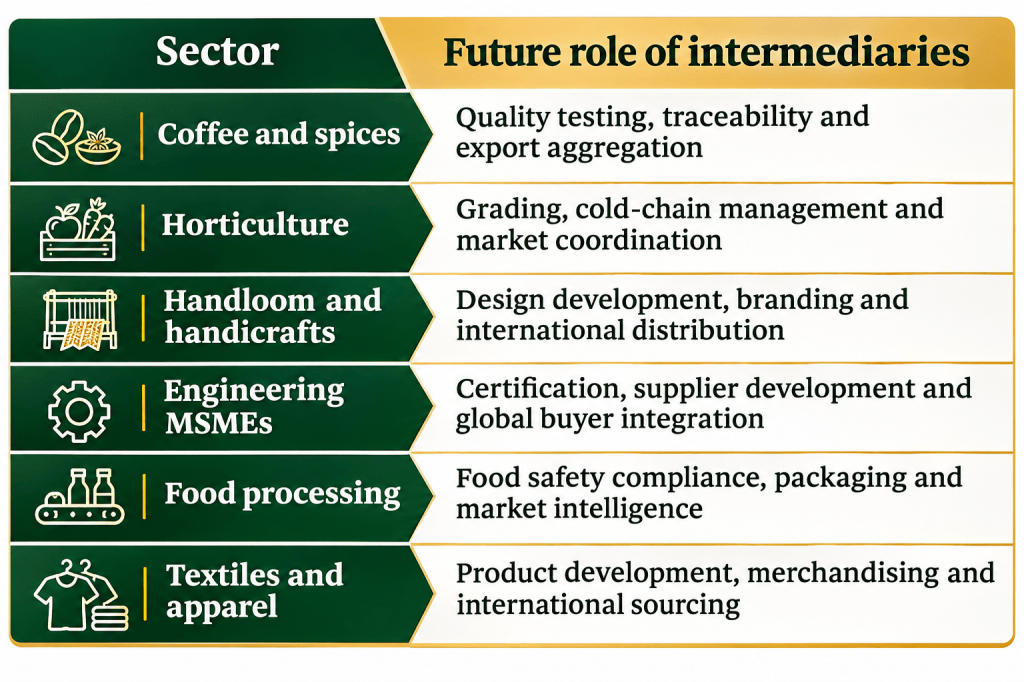
India’s cluster development strategy needs to recognise aggregation and intermediation as specialised economic capabilities. Sector Future role of intermediaries Coffee and spices Quality testing, traceability and export aggregation Horticulture Grading, cold-chain management and market coordination Handloom and handicrafts Design development, branding and international distribution Engineering MSMEs Certification, supplier development and global buyer integration Food processing Food safety compliance, packaging and market intelligence Textiles and apparel Product development, merchandising and international sourcing
Policy interventions should encourage multiple competing aggregators, independent quality certification, transparent procurement, digital price disclosure and access to upgrading finance.
Farmer Producer Organisations, MSME consortia, cluster-level export houses and specialised marketing enterprises can become alternative intermediaries. However, their success should be measured by commercial sustainability, producer income, quality improvement and market diversification rather than merely by the number of organisations established.
Competition between value chains
By 2035, international competitiveness will increasingly depend not merely on the efficiency of individual enterprises but on the efficiency of entire value chains.
Countries that successfully integrate small producers with sophisticated systems of finance, technology, logistics, quality assurance and market intelligence will be better positioned to capture higher-value segments of global markets.
India must therefore move beyond its traditional focus on production subsidies and market-linkage programmes towards building professional value-chain institutions.
The next generation of intermediaries should function as technology facilitators, quality managers, market intelligence providers, financial coordinators and export development partners.
Their profitability should increasingly depend on the additional value they create rather than on the bargaining weakness of producers.
Transform the middleman, not merely remove him
The Ugandan coffee study offers an important lesson for developing economies. Intermediaries are not necessarily the fundamental problem. Uncompetitive, opaque and extractive intermediation is.
India’s long-term development strategy must create an environment in which intermediaries compete for producers, reward quality, facilitate technological upgrading and expand access to international markets.
The ultimate objective should not be to create a middleman-free economy but to create an economy in which every participant in the value chain is rewarded in proportion to the value created.
The future of inclusive competitiveness lies not in eliminating economic linkages but in making them more productive, transparent and equitable.
Research reference: Jie Bai, Lauren Falcao Bergquist, Ameet Morjaria, Russell Morton and Yulu Tang, Intermediaries, Quality Incentives, and Upgrading along Supply Chains, CEPR Discussion Paper 22202, 22 November 2026.
The research findings and bibliographic details are based on the supplied research summary and have not been independently verified. The implications for India and the 2035 outlook are original analytical extensions; findings from Uganda’s coffee sector should not be automatically generalised to all industrial value chains.
Keywords: MSMEs, industrial clusters, global value chains, intermediaries, agricultural markets, quality upgrading, export competitiveness, producer welfare, market integration.


Leave a Reply