The real challenge for Indian MSMEs is not merely building production capacity but creating an integrated ecosystem that enables enterprises to compete, innovate and capture greater value in global markets.
India has made considerable progress in infrastructure development over the past decade. Expressways, dedicated freight corridors, modern ports, digital infrastructure and industrial corridors are gradually transforming the country’s economic landscape. However, the existence of modern infrastructure does not automatically translate into industrial competitiveness.
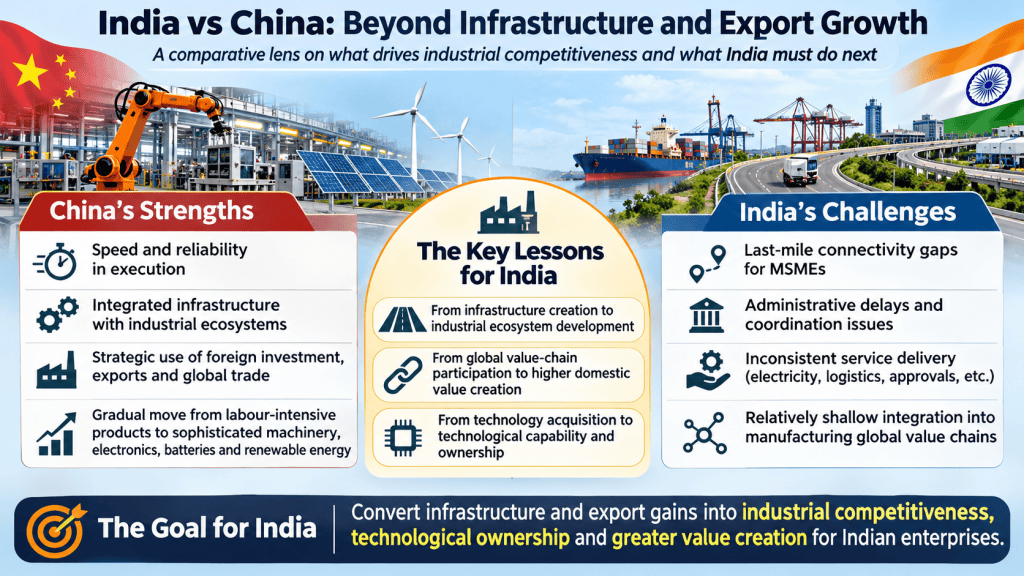
China’s manufacturing success offers two important lessons for India: the integration of infrastructure with industrial ecosystems and the strategic utilisation of global value chains to build domestic technological capabilities.
Infrastructure Development versus Industrial Competitiveness
China recognised relatively early that infrastructure should not be developed in isolation from industrial activity. Industrial parks, ports, highways, railways, power networks, logistics facilities and supplier clusters were progressively integrated into a broader manufacturing ecosystem.
The competitive advantage that emerged was not simply lower transportation costs but greater speed, reliability, predictability and coordination across the entire production system.
For a manufacturing enterprise, uncertainty can be more damaging than high costs. Unpredictable electricity supply, delayed administrative approvals, inconsistent logistics services and unreliable delivery schedules compel enterprises to maintain additional inventories and working capital. These hidden costs disproportionately affect MSMEs.
India’s infrastructure development has been impressive, but significant gaps remain between national infrastructure networks and local industrial ecosystems. A modern expressway may pass close to an industrial cluster, yet enterprises within that cluster may continue to struggle with internal roads, drainage, electricity quality, waste management and last-mile logistics.
The problem is increasingly one of institutional coordination rather than physical infrastructure alone.
India must therefore move beyond measuring infrastructure achievements in kilometres of highways, railway tracks and investment expenditure. The more meaningful indicators are reductions in delivery time, inventory requirements, production interruptions, transaction costs and improvements in enterprise productivity.
China’s strength: Speed, reliability and infrastructure integration.
India’s challenge: Converting physical infrastructure into industrial competitiveness.
Strategic Integration into Global Value Chains
China’s integration into the global economy was not merely an export promotion exercise. It was also a long-term process of industrial learning, technological acquisition and domestic capability development.
Beginning with labour-intensive manufacturing, China progressively utilised foreign investment, international buyer relationships, export markets and domestic supplier development to acquire manufacturing knowledge. Its accession to the World Trade Organization in 2001 accelerated this process.
Over time, Chinese enterprises moved from producing garments, toys and simple consumer goods towards sophisticated machinery, electronics, electric vehicles, batteries and renewable energy equipment.
The transformation was supported by domestic supplier networks, engineering capabilities, research institutions, economies of scale and sustained industrial investment. It was not without costs, including environmental degradation, industrial overcapacity and trade tensions.
Nevertheless, the fundamental achievement was the gradual movement from manufacturing products designed elsewhere towards developing domestic technological capabilities and intellectual property.
India, in contrast, has achieved remarkable success in information technology, business services, pharmaceuticals and selected manufacturing industries. However, its integration into several sophisticated manufacturing value chains remains relatively shallow.
An enterprise may participate in a global value chain through assembly or fabrication without acquiring meaningful control over product design, critical components, technology, branding or distribution.
Consequently, manufacturing output and exports can increase without a proportionate increase in domestic value creation.
The Difference Between Participation and Transformation
Dimension China’s industrial approach India’s strategic challenge Infrastructure Integrated industrial ecosystems Last-mile connectivity and coordination Foreign investment Domestic capability development Technology absorption and supplier integration Export promotion Industrial learning and upgrading Moving beyond low-value activities Industrial clusters Dense supplier networks Fragmented production ecosystems Technology Progressive domestic ownership Dependence on imported critical technologies Global value chains Movement towards higher-value activities Deeper integration and value capture MSME development Supplier upgrading and enterprise scaling Enterprise transformation and graduation
Rethinking India’s MSME Development Strategy
India needs to reposition industrial clusters as instruments of global competitiveness rather than merely geographical concentrations of small enterprises.
Future cluster development programmes must integrate physical infrastructure with technology centres, product development facilities, testing laboratories, logistics networks, market intelligence, research institutions and international buyer relationships.
Foreign investment incentives should increasingly encourage domestic supplier development, engineering collaboration, technology absorption and workforce upgrading, rather than focusing exclusively on investment commitments and employment generation.
Similarly, export promotion must move beyond trade fairs, subsidies and buyer-seller meetings towards helping enterprises develop independent product capabilities, international certifications, intellectual property and direct market relationships.
The objective should not simply be to increase the number of exporting MSMEs but to increase the value that each enterprise captures from international markets.
The Road to 2047: From Manufacturing Destination to Industrial Power
The next phase of global manufacturing will increasingly be shaped by artificial intelligence, robotics, advanced materials, energy efficiency, carbon compliance and digitally integrated supply chains.
Low-cost labour alone will become a progressively weaker source of competitive advantage. Countries that combine reliable infrastructure with technological capabilities, skilled human resources and integrated supplier ecosystems will be better positioned to dominate emerging industries.
India cannot mechanically replicate China’s development model. Its democratic institutions, federal structure, entrepreneurial diversity and economic conditions require a distinct approach. However, it can learn from China’s ability to connect infrastructure, investment, trade, technology and enterprise development within a coherent industrial strategy.
India’s ambition of becoming a developed economy by 2047 will depend not merely on how much infrastructure it builds or how much it exports, but on how effectively these achievements transform domestic enterprises.
The fundamental challenge is to move from infrastructure creation to ecosystem creation, from export participation to value-chain leadership, and from manufacturing capacity to technological ownership.
India must not simply become an alternative manufacturing destination to China. It must become an independent centre of industrial innovation, productivity and value creation.
Keywords: Indian MSMEs, China manufacturing, industrial competitiveness, infrastructure integration, global value chains, cluster development, technology ownership, export competitiveness, Viksit Bharat 2047.
This article presents a structural and strategic comparison rather than a statistical benchmarking exercise; no unverified numerical claims have been introduced.


Leave a Reply