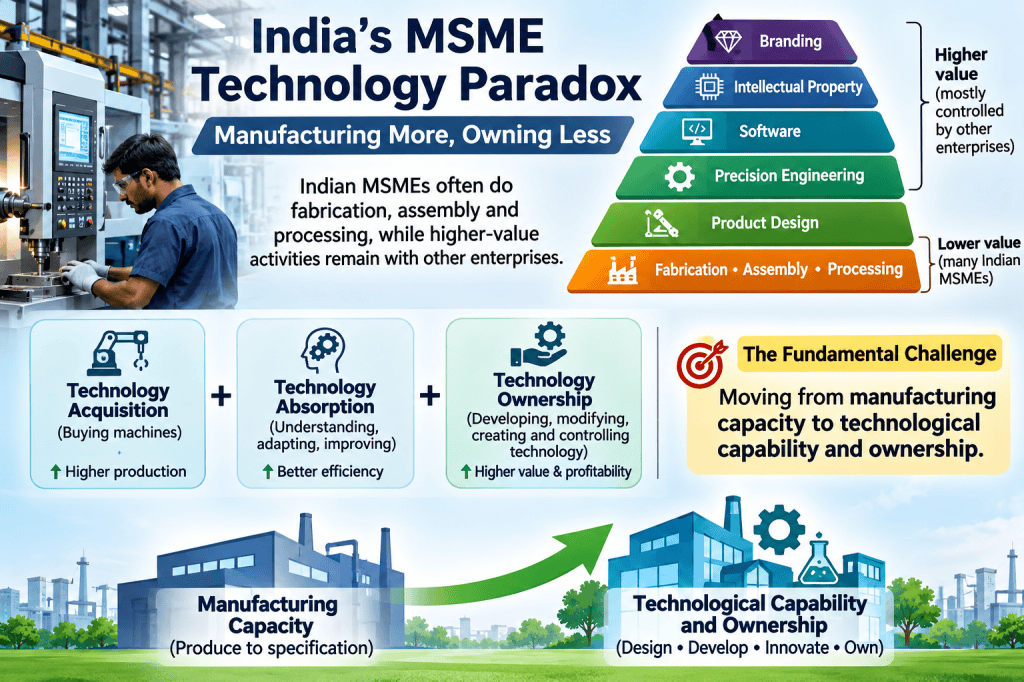
Moving from manufacturing capacity to technological capability and ownership
26 November 2026
India’s MSME sector has expanded its manufacturing capabilities considerably over the past three decades. From automotive components and engineering products to textiles, pharmaceuticals and electronics, Indian enterprises have become important participants in domestic and global production networks. However, participation in manufacturing does not necessarily translate into technological leadership or higher value creation.
A significant proportion of Indian MSMEs remain engaged in fabrication, assembly, machining and processing, while higher-value activities such as product development, precision engineering, industrial software, intellectual property and branding are frequently controlled by larger domestic or foreign enterprises.
India’s fundamental challenge is no longer simply how to manufacture more, but how to capture a greater share of the value generated through manufacturing.
The historical roots of technological dependence
India’s industrial development historically emphasised production capacity, employment generation, import substitution and regional industrialisation. The protection provided to small-scale industries helped create a broad entrepreneurial base but did not sufficiently encourage technological innovation, product differentiation or economies of scale.
Economic liberalisation after 1991 opened new opportunities for Indian MSMEs to participate in international production networks. However, many enterprises entered these networks as subcontractors rather than independent product developers.
They acquired machinery, improved production processes and adopted international quality standards, but their technological capabilities often remained dependent on buyer specifications and external technology providers.
Consequently, industrial modernisation has not always resulted in technological independence.
The difference between buying technology and owning technology
Purchasing a sophisticated machine does not automatically make an enterprise technologically advanced. A manufacturing unit may operate imported CNC machines, automated production systems and advanced software without possessing the capability to modify, redesign or independently develop the underlying technology.
Technology acquisition improves production capacity. Technology absorption enables enterprises to understand, adapt and improve production processes. Technology ownership gives enterprises greater control over product development, differentiation and commercialisation.
These are three fundamentally different stages of industrial development.
An enterprise that imports advanced machinery but remains dependent on external suppliers for software, maintenance, critical components and product designs may achieve higher productivity without significantly improving its strategic position.
The ability to use technology is not the same as the ability to create technology.
The unequal distribution of value
Where value is captured in a manufacturing value chain
Illustrative smile curve of value creation. Actual value distribution varies across industries and enterprises.
Modern global value chains increasingly reward enterprises that control knowledge, technology, customer relationships and intellectual property.
In the automotive industry, fabrication and conventional component manufacturing may generate employment, but advanced sensors, electronic control systems and embedded software offer opportunities for greater value capture. In textiles, weaving and garment manufacturing face intense price competition, while specialised materials, functional fabrics, design and branding offer differentiation. Similarly, in capital goods, the intelligence inside machinery—industrial software, precision controls and automation systems—can be more strategically valuable than its physical structure.
Indian MSMEs risk remaining concentrated in activities where competition is intense, entry barriers are relatively low and bargaining power is weak.
Why technology subsidies alone cannot solve the problem
India’s MSME development policies have traditionally supported machinery acquisition, credit availability, technology modernisation and common infrastructure. These interventions remain necessary, but they are insufficient to build technological leadership.
A machinery subsidy can help an enterprise purchase equipment, but it cannot automatically create an engineering team, develop a proprietary product or establish an innovation culture.
The real weakness lies in the limited institutional ecosystem connecting MSMEs with universities, research laboratories, technology developers, design institutions and specialised financial organisations.
Moreover, conventional bank financing is generally better suited to purchasing physical assets than supporting uncertain investments in research, experimentation, software development and intellectual property.
India needs to move from financing machines towards financing technological capabilities.
Industrial clusters as centres of technological innovation
Individual MSMEs often lack the financial and human resources required to undertake independent research and development. Industrial clusters can help overcome this limitation through collective investment and institutional collaboration.
However, cluster development must move beyond conventional common facility centres focused primarily on machinery, testing and processing.
Future industrial clusters should develop shared product development laboratories, precision engineering centres, industrial design facilities, digital manufacturing platforms, technology extension services and collaborative research mechanisms.
For example, engineering clusters in Rajkot, Ludhiana, Pune and Coimbatore could progressively move from conventional component manufacturing towards proprietary machinery, specialised equipment, automation solutions and advanced engineering services.
The objective should not merely be to reduce the cost of production but to collectively increase the technological sophistication of enterprises.
The transition India needs
Manufacturing capacity-oriented enterprise Technological capability-oriented enterprise Purchases machinery Develops and adapts technology Manufactures according to buyer specifications Develops proprietary products and designs Depends on external technical expertise Builds internal engineering capabilities Competes primarily on production costs Competes on innovation and differentiation Focuses on production volumes Focuses on value addition and profitability Invests primarily in physical assets Invests in knowledge, software and intellectual property Remains dependent on technology suppliers Develops greater technological autonomy Participates in value chains Progressively moves into higher-value activities
Looking towards 2040: The emerging technological divide
Artificial intelligence, robotics, advanced materials, digital twins and intelligent manufacturing systems will fundamentally reshape industrial competitiveness over the next two decades.
The traditional advantage of inexpensive labour may gradually weaken as automation becomes more accessible. Enterprises that merely provide manufacturing capacity could face increasing pressure from technologically sophisticated competitors.
The next industrial divide may not be between large and small enterprises, but between enterprises that control technology and those that remain dependent on it.
India must therefore redefine the indicators of MSME development. The number of enterprises registered, machinery installed, loans disbursed and employment generated should be complemented by indicators of indigenous product development, technology absorption, intellectual property creation, domestic value addition and productivity improvement.
Technological ownership does not mean that every MSME must invent its own machinery or eliminate imported technology. It means developing sufficient knowledge and capabilities to adapt technology, negotiate better commercial arrangements and progressively control strategically important activities.
From the factory floor to the knowledge economy
India cannot become a leading industrial economy merely by becoming a preferred manufacturing location for global enterprises. It must also become a centre of product development, engineering, industrial innovation and technology creation.
The success of Make in India must increasingly be complemented by Design in India, Engineer in India, Innovate in India and Own in India.
For Indian MSMEs, the next stage of development must be defined not simply by how much they manufacture, but by how much knowledge, technology and economic value they control.
Manufacturing capacity creates industrial activity. Technological capability creates competitiveness. Technological ownership creates long-term economic power.


Leave a Reply