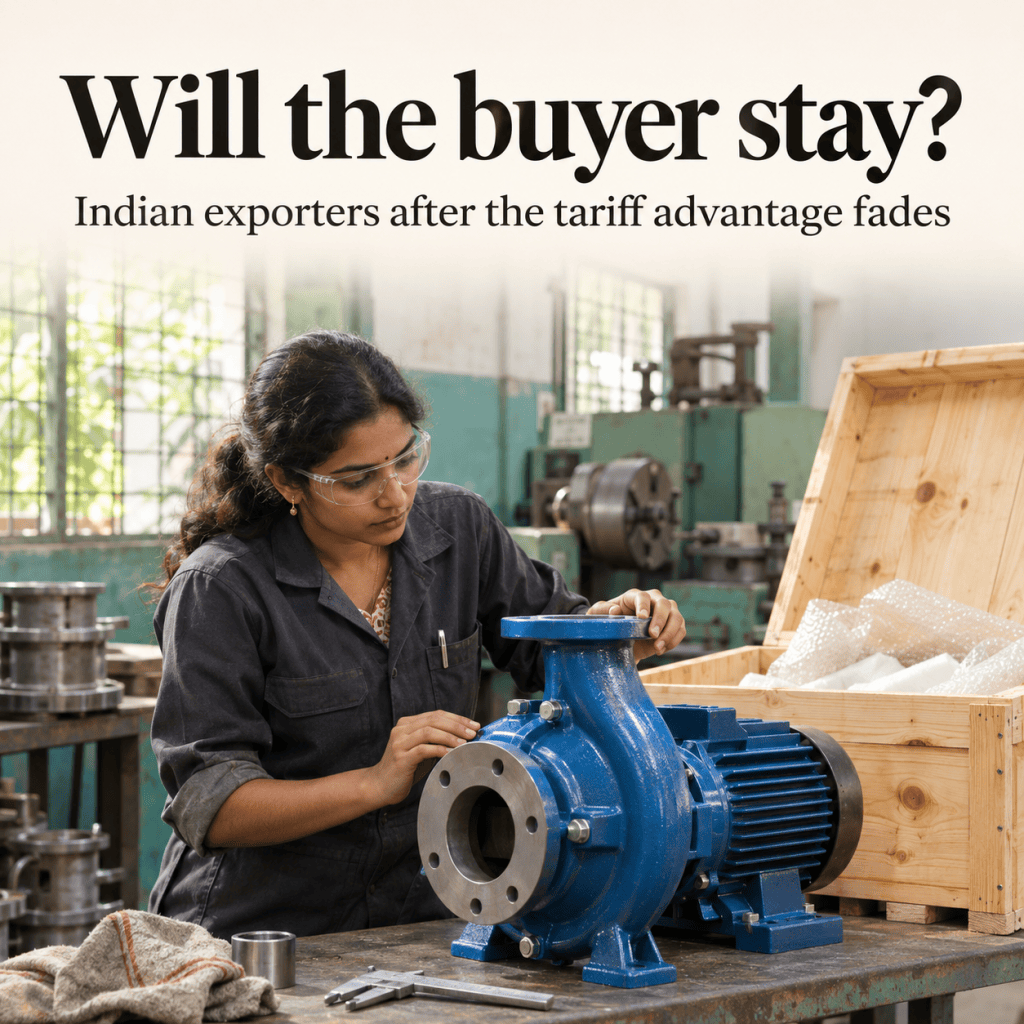
Imagine a pump manufacturer in Coimbatore receiving an enquiry from an American distributor. A tariff has made the distributor’s usual supplier more expensive. The Indian firm can fill the first order on its existing machines. To supply the annual volume mentioned in the enquiry, however, it would need new tooling, another shift and a larger working-capital limit. The owner faces two decisions with different time horizons. Taking the order may make sense today. Buying the machine depends on where the distributor will source its pumps after the next tariff settlement.
That distinction matters for India’s industrial clusters. An export order diverted by a tariff can open a relationship that would otherwise have taken years to establish. It can also leave a small manufacturer repaying a loan long after the buyer has returned to its original supplier.
How retaliation changes the arithmetic
A study by Xinxin Wei, Kausik Chaudhuri and Muhammad Ali Nasir, published in Oxford Economic Papers on 13 November 2026, shows how much depends on the response to the first tariff. In their simulation of unilateral US tariff escalation, US long-run welfare rises by 0.53%, while Mexico and Canada suffer the largest losses. With comprehensive retaliation, the simulated US gain becomes a 0.40% loss. Both figures are modelled changes in economic welfare. Their size depends on the tariffs assumed and on how readily producers and buyers can switch suppliers.
Countries can also respond by lowering barriers for selected partners. In the authors’ simulations, selective tariff easing among China, the European Union and ASEAN shifts sourcing and produces uneven gains. For an Indian exporter, this creates a second layer of competition. A tariff may improve its price position in one destination while a preferential agreement gives a rival access to cheaper components elsewhere. An assessment based solely on the duty charged on India’s finished product will miss that change in the rival’s costs.
The paper’s contribution is to let production networks change after a tariff shock. Industries can switch the sources of their inputs, the foreign share of value added can change, and investment adjusts over time. The resulting effects look modest in the global aggregate, yet individual economies can become substantially more reliant on a different set of suppliers. A pump assembled in a new country may still contain a motor or controller from the original source. The customs record will show where the finished pump came from. A buyer concerned about the next disruption will also want to know who can replace the controller.
What makes an order worth investing in?
Return to the Coimbatore manufacturer. The most revealing question it can ask the distributor is simple: What would earn us a repeat order if the tariff advantage disappeared? The answer might be a shorter delivery time for replacement pumps, lower energy consumption at the customer’s operating conditions, or the ability to repair equipment locally. Each answer points to a different investment. A vague assurance of future volume gives the manufacturer little basis for choosing among them.
Buyer qualification provides stronger evidence. A distributor that shares its testing requirements, pays for a pilot batch and assigns an engineer to review failures has begun committing resources to the relationship. Even then, qualification can take months. Wages, materials and testing bills fall due before the first commercial invoice is paid. The study models how capital adjusts across an economy. It cannot tell us whether a particular MSME will run out of cash while its sample sits on a buyer’s test bench. A milestone payment for an approved prototype could matter more to that firm than a higher indicative order volume.
Cluster institutions can help at precisely this point. Suppose several pump makers face the same performance test. Their association could first establish which buyers accept the test results and how often local firms would use the facility. A shared test bench could then serve several suppliers and markets even if one distributor withdrew. Dedicated tooling for a single buyer calls for a different arrangement, such as a tooling contribution or a minimum purchase commitment. The difference is who can use the asset if the original order disappears.
India’s cluster programmes could learn more by following a tariff-driven order beyond its first shipment. Did the buyer qualify a second product? Could the firm meet the specification using technology it can continue to access? Did another customer accept the same test results? Above all, did the buyer reorder when the price advantage narrowed? Those answers reveal whether a temporary opening has given the cluster something it can keep. For the manufacturer in Coimbatore, that is the evidence that can justify buying the next machine.


Leave a Reply