23 November 2026 | Agriculture, Food Systems and Rural Economic Development
India is becoming increasingly successful at producing agricultural commodities, but its ability to preserve, process and profitably market that production is not advancing at the same pace. The next agricultural revolution may therefore depend less on how much India grows and more on how much economic value it can retain.
From Food Scarcity to the Crisis of Agricultural Value
For decades, India’s agricultural policy was driven by one overriding concern: producing enough food for a growing population. The Green Revolution of the 1960s and 1970s transformed foodgrain production through improved seeds, irrigation, fertilisers, mechanisation and public procurement. This production-oriented strategy helped India move from chronic food shortages towards greater food security.
However, the structure of agricultural demand has changed considerably. Rising incomes, urbanisation, changing diets and expanding food retail have increased demand for fruits, vegetables, dairy products, poultry and processed foods.
These products present a fundamentally different economic challenge. Unlike wheat and rice, many horticultural and livestock products are highly perishable. Their economic value depends not merely on production but also on harvesting practices, grading, storage, transportation, processing, disease management and timely access to markets.
India’s agricultural policy has not fully adjusted to this structural transformation.
The emerging contradiction is that the country can produce more agricultural output without necessarily generating proportionately higher agricultural incomes.
Record Horticultural Production, but an Unresolved Market Question
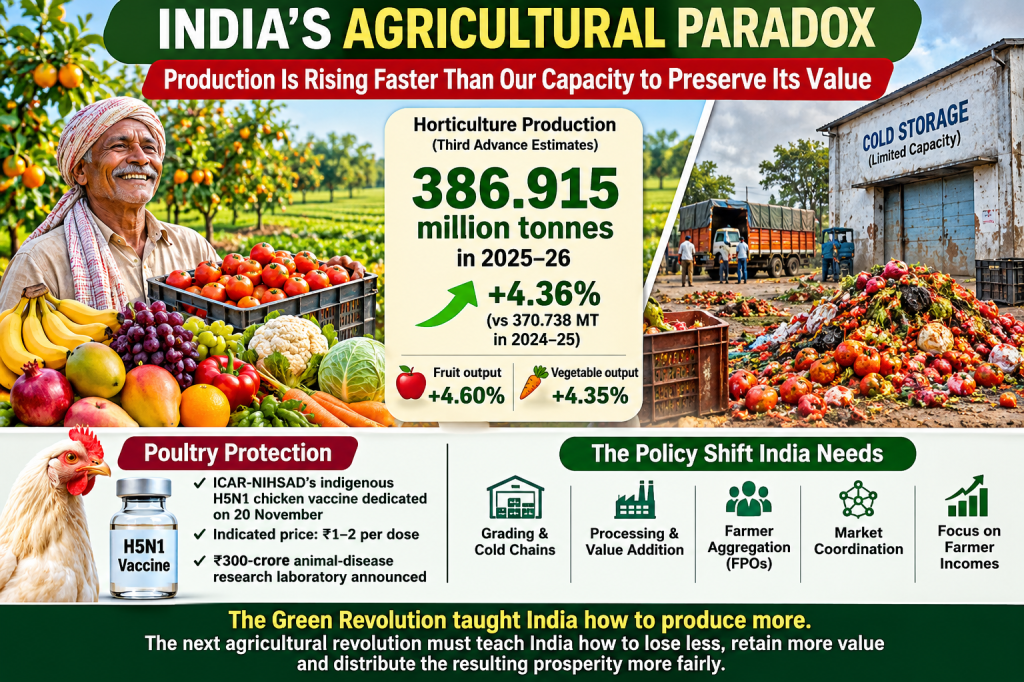
According to the Third Advance Estimates released by the Government of India on 17 November 2026, horticultural production during 2025–26 is estimated at 386.915 million tonnes, compared with 370.738 million tonnes in 2024–25.
2025–26 horticulture output
386.915 MT
+4.36% estimated growth
2024–25 production
370.738 MT
Comparison estimate
Fruit production is estimated to have increased by 4.60% and vegetable production by 4.35%. Figures are advance estimates, not final marketed quantities or realised farm incomes. Source: Ministry of Agriculture and Farmers Welfare, PIB, 17 November 2026.
At first glance, this is an encouraging achievement. It reflects improvements in productivity, crop diversification, cultivation practices and the expanding economic importance of horticulture.
Yet these figures raise a more important economic question: How much of this additional production will translate into higher net income for farmers?
Agricultural output and agricultural prosperity are not synonymous.
A farmer may harvest more tomatoes, onions, potatoes or fruits but receive a lower price if production arrives in the market during a concentrated harvesting period. Without adequate storage, processing or alternative marketing channels, increased supply can become an economic disadvantage.
This creates a situation in which higher production may coincide with lower farm-gate prices, while consumers continue paying relatively high retail prices.
The problem is not necessarily inadequate production. It is the inability of the agricultural marketing and distribution system to coordinate production, preserve quality and distribute value efficiently.
The Economics of Perishability: Why More Can Become Less
Agricultural perishability creates an economic vulnerability that is often underestimated in policy discussions.
When production rises, supply can increase rapidly during the harvesting season. However, demand does not necessarily expand at the same speed. If the commodity cannot be stored economically, farmers face pressure to sell immediately.
This weakens their bargaining position.
For example, when large quantities of vegetables arrive simultaneously in wholesale markets, prices may decline sharply. Farmers with access to cold storage, processing facilities or alternative buyers can postpone sales or redirect produce. Farmers without such facilities have little choice but to accept prevailing prices.
The economic consequences extend beyond physical wastage.
Value can be lost through poor grading, damage during transportation, deterioration in freshness, inadequate packaging, rejection by institutional buyers and distress sales.
Consequently, the true agricultural loss is broader than the quantity of produce physically wasted. It includes the difference between the economic value that could have been realised and the value actually received.
This suggests that India needs to measure agricultural performance through a broader framework:
Agricultural success = marketable production × quality retention × value realisation.
This is a conceptual framework rather than a statistical identity, but it highlights a fundamental weakness in conventional production-focused assessments.
Cold Chains Are Not Enough: India Needs Integrated Value-Preservation Systems
Cold storage and refrigerated transportation are frequently presented as solutions to post-harvest losses. They are important, but infrastructure alone cannot solve the problem.
A cold-storage facility without reliable electricity, adequate utilisation, suitable commodities, organised aggregation and paying customers may become an expensive underused asset.
Similarly, a food-processing plant cannot operate efficiently without consistent supplies of appropriately graded raw materials.
The missing element is coordination across the agricultural value chain.
Farmers, farmer producer organisations, traders, transport operators, processors, wholesalers, retailers and exporters must function as interconnected participants rather than isolated economic actors.
This requires investments in collection centres, scientific grading, packhouses, temperature-controlled logistics, quality testing, processing facilities and market information systems.
More importantly, these investments must be linked to identifiable market demand.
India’s next agricultural infrastructure strategy should therefore shift from constructing individual facilities towards developing economically viable regional production and marketing ecosystems.
The Cluster Approach: Turning Agricultural Surpluses into Regional Economic Strength
India’s agricultural geography offers considerable opportunities for cluster-based development.
Many districts have concentrations of particular fruits, vegetables, spices, dairy products or poultry enterprises. Such geographical specialisation creates opportunities for shared infrastructure and collective services.
A horticultural cluster could combine production planning, farmer aggregation, sorting, grading, packaging, pre-cooling, processing, logistics and institutional marketing.
Rather than requiring every small farmer to invest independently in expensive facilities, common infrastructure can reduce costs and improve market access.
However, successful cluster development requires more than creating a common facility centre.
It requires commercially sustainable business models, professional management, transparent service charges, dependable buyers and mechanisms for sharing benefits among participating producers.
Farmer producer organisations can play an important role, but their effectiveness should be assessed through actual sales, price realisation, reduced losses and financial sustainability rather than merely the number of organisations registered.
The central policy objective should be to transform geographically concentrated agricultural production into geographically concentrated economic competitiveness.
Poultry Vaccination: Protecting Agricultural Value Before It Is Lost
A related development on 20 November 2026 illustrates another dimension of value preservation.
The indigenous H5N1 chicken vaccine developed by ICAR’s National Institute of High Security Animal Diseases was dedicated in Bhopal, with an indicated price of ₹1–2 per dose.
A ₹300-crore animal-disease research laboratory was also announced.
These developments are important because poultry production faces risks that cannot be addressed merely by improving feed, breeding or farm productivity.
Disease outbreaks can destroy productive assets, interrupt supply chains, reduce market confidence and impose substantial economic losses on farmers and poultry enterprises.
An affordable domestically developed vaccine has the potential to strengthen disease prevention and reduce vulnerability.
However, the economic value of the vaccine will depend on effective deployment.
Research success is not equivalent to widespread field protection. Manufacturing capacity, regulatory implementation, strain surveillance, vaccination protocols, veterinary services and cold-chain distribution will determine the actual benefits.
Furthermore, the announced ₹300-crore laboratory represents a proposed investment in research capacity, not an already operational facility.
The broader lesson is that agricultural competitiveness increasingly depends on managing biological risks as well as production costs.
Disease prevention, quality assurance, food safety and traceability must become integral components of agricultural value-chain development.
Why Agricultural Policy Must Move Beyond Production Targets
India’s agricultural support architecture has historically emphasised inputs, irrigation, production incentives, subsidies and procurement.
These instruments remain important, particularly for food security and vulnerable farming households.
But the changing composition of agricultural production requires a parallel emphasis on market systems and value retention.
A more effective policy framework should address three interconnected gaps.
The first is the infrastructure gap: insufficient or poorly connected post-harvest facilities in particular commodities and locations.
The second is the institutional gap: weak coordination between producers, aggregators, processors and final markets.
The third is the information gap: limited access to reliable demand forecasts, quality requirements, market prices and production planning.
Public investment should increasingly support systems that address all three gaps together.
Subsidising isolated assets without ensuring market linkages risks repeating the familiar problem of infrastructure creation without sustained economic utilisation.
India also needs better measurement. Estimates of agricultural production should be complemented by credible data on post-harvest losses, processing volumes, farm-gate prices, producer margins and realised income.
Without these indicators, policy may celebrate increases in production even when farmers experience limited economic improvement.
The Future: Agriculture Will Compete on Value, Not Volume Alone
Over the next decade, agricultural competitiveness will increasingly be shaped by the capacity to deliver consistent quality, meet food safety standards, ensure traceability, reduce losses and respond rapidly to changing consumer preferences.
Climate variability will make this transition even more urgent.
Unpredictable rainfall, heat stress, disease outbreaks and extreme weather can simultaneously affect production, storage requirements, logistics and market stability.
Digital technologies, artificial intelligence, predictive demand systems and improved supply-chain monitoring may help, but technology should be judged by measurable economic results rather than adoption numbers.
For agricultural MSMEs, the opportunities are substantial.
Small enterprises can provide grading, packaging, dehydration, freezing, primary processing, quality testing, cold-chain services, logistics and specialised marketing.
This could generate rural non-farm employment while improving the economic returns from agricultural production.
But these opportunities will emerge only if investment decisions are driven by commercial demand and realistic operating economics.
The future agricultural economy will require stronger connections between farms, rural enterprises, food-processing clusters, modern retail and export markets.
India’s Next Agricultural Revolution Must Preserve Prosperity
India’s estimated horticultural production of nearly 387 million tonnes represents an important production achievement. The development of an indigenous poultry vaccine also demonstrates growing technological capability in agricultural risk management.
Yet both developments point towards the same structural challenge.
India is increasingly capable of producing agricultural value, but the institutions and infrastructure required to protect that value remain uneven.
The challenge is no longer simply to produce more. It is to ensure that higher production generates higher incomes, stronger rural enterprises, lower avoidable losses and more competitive food supply chains.
The Green Revolution taught India how to produce more. The next agricultural revolution must teach India how to lose less, retain more value and distribute the resulting prosperity more fairly.
Until this transition occurs, record production figures may continue to coexist with distressed farmers, inefficient markets and expensive food for consumers.
That is the central paradox of India’s emerging agricultural economy.
Source references
Ministry of Agriculture and Farmers Welfare, Third Advance Estimates of Horticultural Production, 17 November 2026; Press Information Bureau, ICAR-NIHSAD indigenous H5N1 chicken vaccine announcement, 20 November 2026. Official releases: Press Information Bureau.


Leave a Reply