INDUSTRIAL POLICY | ENERGY TRANSITION | INDIA | 17 NOVEMBER 2026
India’s battery manufacturing ambitions are attracting investors. But the real test is not how many companies compete for government incentives. It is whether India can build a technologically competitive, commercially viable and deeply integrated battery industry.
From Policy Announcements to Industrial Reality
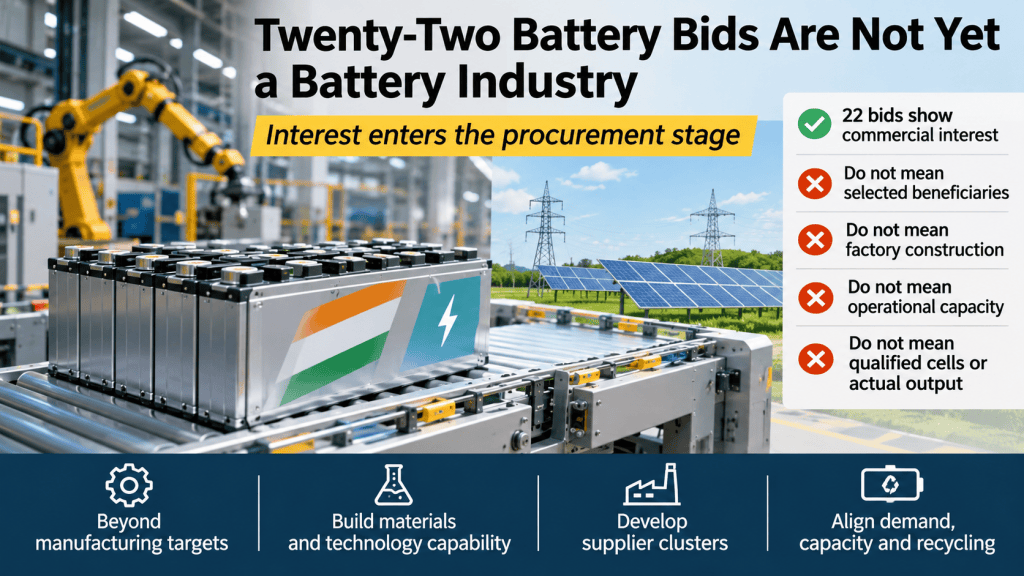
India’s ambition to become a major battery manufacturing economy has entered another important stage. On 12 November 2026, the Ministry of Heavy Industries announced that 22 companies had submitted technical bids for 10 GWh of advanced chemistry cell (ACC) manufacturing capacity dedicated to grid-scale stationary energy storage. The bids were opened on 11 November under a two-stage quality-and-cost selection process.
This capacity forms part of India’s larger 50 GWh Advanced Chemistry Cell Production Linked Incentive programme.
At first glance, 22 bidders competing for 10 GWh of manufacturing capacity appear to demonstrate strong investor confidence. However, there is a fundamental difference between interest in manufacturing batteries and the actual creation of a competitive battery industry.
India has witnessed similar transitions in several industries, where ambitious policy targets generated investment announcements, incentive applications and factory proposals, but the development of indigenous technological capabilities and domestic supply chains progressed much more slowly.
The critical question is whether India’s battery programme will create a genuinely integrated industrial ecosystem or merely encourage domestic assembly and cell production dependent on imported technologies, machinery and materials.
The Industrialisation Paradox: More Bidders Do Not Necessarily Mean More Capabilities
Competitive bidding is an important mechanism for allocating public incentives. A larger number of participants can improve competition, reduce subsidy requirements and help identify financially and technically capable manufacturers.
But competition among investors does not automatically translate into technological competition.
Twenty-two companies may submit separate bids while depending on a relatively narrow group of international technology providers, equipment manufacturers and raw-material suppliers.
A battery factory may be physically located in India while its most critical technological capabilities remain abroad.
Cathode and anode materials, separators, electrolytes, precision manufacturing equipment, cell-design expertise and sophisticated production processes can account for significant portions of the technological and economic value chain.
Consequently, domestic manufacturing capacity measured in gigawatt-hours can expand without a corresponding increase in domestic technological independence.
This creates an uncomfortable possibility: India could become a major battery manufacturing location without becoming a major battery technology economy.
The Historical Lesson: Manufacturing Capacity Is Not the Same as Industrial Competitiveness
India’s industrial history offers an important lesson.
In several sectors, government protection, fiscal incentives and investment promotion helped establish manufacturing facilities. Yet many industries continued to depend on imported components, capital equipment, advanced materials and proprietary technologies.
The electronics industry illustrates this challenge particularly clearly. Domestic assembly and final-product manufacturing expanded, but dependence on imported semiconductors, displays, precision components and specialised manufacturing equipment remained substantial.
Battery manufacturing could encounter a similar structural problem.
The international experience also demonstrates that competitive battery industries develop through coordinated investments in material processing, chemical engineering, manufacturing equipment, research, quality control, skilled labour and large-scale commercial demand.
China’s battery industry, for example, benefited not merely from constructing cell factories but from building extensive capabilities across materials, processing, equipment, manufacturing and downstream applications.
India cannot reproduce such an ecosystem simply by announcing capacity targets or distributing production incentives.
The central lesson is that industrial competitiveness emerges from the strength of the entire value chain, not from the number of factories at its final stage.
Grid Storage Introduces a Different Technological Challenge
The allocation of 10 GWh specifically for stationary energy storage is strategically important.
As India’s solar and wind generation expand, electricity systems will increasingly require storage to manage fluctuations in renewable generation, support grid stability and improve the availability of power outside peak generation hours.
However, batteries designed for stationary storage face different economic and technical requirements from batteries used in electric vehicles.
For grid applications, safety, operating life, degradation, thermal performance, efficiency and lifetime storage cost can be more important than energy density alone.
A battery that appears inexpensive at the procurement stage may become expensive if it deteriorates quickly, requires frequent replacement or performs poorly under demanding operating conditions.
Therefore, the cheapest manufacturing proposal is not necessarily the proposal that delivers the lowest long-term cost to India’s electricity system.
Industrial policy must distinguish between the cost of establishing manufacturing capacity and the lifetime economic value of the technology being manufactured.
The Demand–Capacity Mismatch: Two Risks Moving in Opposite Directions
India faces another potentially serious challenge: the timing of battery manufacturing investment and electricity-storage demand.
On one side, renewable-energy developers and electricity utilities may need storage systems before domestic cell factories become operational. To meet project deadlines, they may rely on imported cells.
On the other side, manufacturers receiving incentives may establish production facilities before reliable domestic demand becomes available at commercially sustainable prices.
This creates two opposite risks.
The first is excessive import dependence despite domestic manufacturing incentives.
The second is underutilised domestic manufacturing capacity despite growing national storage requirements.
Both outcomes could impose economic costs.
A factory operating substantially below its designed capacity may struggle to recover its investment, maintain technological competitiveness or achieve the economies of scale necessary to compete with established international manufacturers.
Similarly, storage developers forced to purchase uncompetitive domestic batteries could face higher project costs, ultimately affecting electricity tariffs or public finances.
The solution cannot be to protect manufacturers indefinitely from international competition. Nor can it be to expose emerging domestic manufacturers to unrestricted competition without helping them overcome initial technological and scale disadvantages.
India needs a coordinated approach connecting manufacturing investment, technology development, procurement schedules, grid-storage demand and competitive performance.
Beyond Gigawatt-Hours: What Should India Actually Measure?
The success of India’s battery programme should not be judged primarily by sanctioned capacity, approved investment or the number of successful bidders.
More meaningful indicators would include commissioned manufacturing capacity, actual annual cell output, plant utilisation, domestic value addition, cell performance, manufacturing yields, technological innovation and international competitiveness.
It is equally important to measure how much of the value chain is genuinely developing within India.
Are Indian enterprises producing advanced battery materials? Are domestic engineering companies developing specialised manufacturing equipment? Are research institutions contributing to cell chemistry and production technology? Are local suppliers meeting international quality requirements?
These questions are more important for long-term industrial development than the headline number of gigawatt-hours.
The Missing Opportunity: Building Battery Industrial Clusters
India’s battery strategy should also recognise that the industry cannot develop efficiently through isolated large factories.
Battery manufacturing requires networks of specialised suppliers, chemical-processing facilities, testing laboratories, equipment manufacturers, recycling enterprises, logistics providers and skilled technical personnel.
This creates a strong case for developing integrated battery industrial clusters.
Such clusters could provide common facilities for material testing, product certification, research, workforce development, environmental management and industrial waste treatment.
They could also create opportunities for Indian MSMEs in precision engineering, industrial automation, electrical systems, thermal management, testing equipment, specialised chemicals and recycling technologies.
However, these opportunities will not emerge automatically through incentives offered to large cell manufacturers.
They require deliberate supplier-development programmes, technology partnerships, common infrastructure and mechanisms connecting smaller enterprises with major manufacturers.
The strategic objective should be to transform battery investment into a broader industrial capability-building process.
The 2035 Outlook: From Manufacturing Incentives to Technological Independence
By 2035, global battery competition may be shaped increasingly by technological improvements, manufacturing efficiency, material security, recycling capabilities and the lifetime economics of energy storage.
Battery chemistry will continue to evolve. Manufacturing processes will become more automated. New technologies may challenge today’s dominant solutions, while international price competition could intensify.
This creates a significant risk for countries investing heavily in manufacturing facilities without developing the ability to adapt technologically.
A factory designed around today’s technology may become commercially vulnerable if competing chemistries or production methods improve rapidly.
India therefore needs an industrial strategy capable of supporting technological learning, not merely reimbursing manufacturing investment.
Public incentives should increasingly reward demonstrated production, quality, domestic capability development, operational efficiency and technological upgrading.
The objective should be to create enterprises that can eventually compete without permanent government support.
The Larger Economic Question
The participation of 22 companies in India’s latest battery manufacturing tender is an encouraging indication of commercial interest. But it remains an early stage in a much longer industrial transformation.
The real challenge begins after bidding: selecting capable manufacturers, mobilising investment, constructing factories, developing suppliers, qualifying products and achieving commercially sustainable production.
India must avoid confusing the announcement of industrial capacity with the creation of industrial competitiveness.
The provocative question is this: Could India achieve its battery manufacturing targets while remaining dependent on foreign countries for the technologies, materials and equipment that determine the industry’s real economic value?
If that happens, India may succeed in manufacturing batteries without fully capturing the industrial and technological benefits of the energy transition.
The success of India’s battery policy will ultimately depend not on how many companies bid for incentives, but on how many develop the capability to manufacture, innovate and compete when those incentives are no longer necessary.
Suggested blog subtitle: The real challenge is not building 50 GWh of factories, but creating the materials, technologies, suppliers and markets that make those factories globally competitive.
#BatteryManufacturing #IndiaEconomy #EnergyStorage #IndustrialPolicy #MakeInIndia #MSME #ClusterDevelopment #RenewableEnergy #Technology #SupplyChains
Editorial note: The tender figures and dates above follow the information supplied. They have not been independently verified in this response.


Leave a Reply