18 November 2026 | Global Economic Perspectives
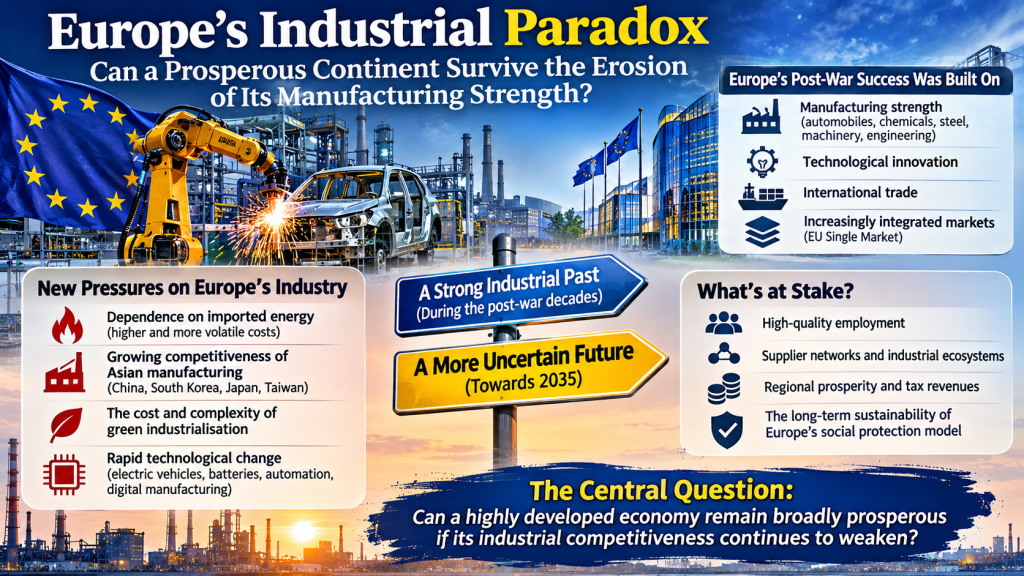
Europe became one of the world’s most prosperous regions through industrial excellence. Today, the very industrial structure that created its prosperity faces growing pressure from energy costs, global competition, technological disruption and changing international trade relationships.
The central economic question is no longer simply whether Europe can maintain its industrial leadership. It is whether a highly developed economy can sustain rising living standards, technological independence and social protection when the foundations of its manufacturing competitiveness are weakening.
From Industrial Destruction to Global Leadership
Europe’s post-war economic transformation remains one of the most remarkable achievements in modern economic history.
Following the devastation of the Second World War, European countries rebuilt their economies through industrial investment, technological innovation, skilled labour, infrastructure development and expanding international trade.
Germany emerged as a global centre for automobiles, machinery, chemicals and precision engineering. France developed capabilities in aerospace, transport equipment, energy and advanced manufacturing. Italy established internationally competitive industrial districts specialising in machinery, textiles, furniture and design-intensive products. Other European economies developed strong positions in pharmaceuticals, electronics, maritime equipment and specialised engineering.
The creation of the European Economic Community in 1957, followed by the development of the European Single Market, strengthened this industrial transformation.
European manufacturers gained access to larger markets, more integrated supply chains and greater opportunities for economies of scale.
Importantly, Europe’s industrial success was not based primarily on low wages. It was built on productivity, engineering quality, workforce skills, technological sophistication and reliable institutions.
Europe demonstrated that high wages and strong social protection could coexist with internationally competitive manufacturing.
That achievement became an important foundation of the European economic model.
The Industrial Structure That Created Prosperity Is Now Under Pressure
The global economic environment supporting Europe’s industrial success has changed fundamentally.
During the post-war decades, European industries benefited from relatively predictable energy supplies, expanding export markets, established technological leadership and growing global demand for sophisticated manufactured products.
Today, several of these advantages are under pressure.
Europe’s dependence on imported energy became particularly visible following the disruption of Russian gas supplies after 2022. Energy-intensive industries, including chemicals, fertilisers, metals, glass and certain engineering activities, faced sharply higher operating costs.
Although energy markets subsequently adjusted, the crisis exposed a deeper structural weakness: sophisticated manufacturing systems can become vulnerable when essential production inputs depend on external suppliers.
At the same time, Asian manufacturing economies have moved beyond competition based primarily on lower labour costs.
China has developed extensive capabilities in electric vehicles, batteries, solar equipment, electronics and industrial machinery. South Korea and Taiwan occupy important positions in semiconductors and advanced electronics. Japan remains highly competitive in robotics, industrial automation and precision manufacturing.
The challenge for Europe is therefore not simply that Asian products are cheaper.
The more serious challenge is that competing economies are increasingly combining scale, technology, integrated supply chains and rapid industrial innovation.
Europe must now compete with countries that have developed capabilities once considered distinctive European strengths.
The High-Cost, High-Productivity Paradox
Europe’s industrial model has historically depended on a relatively straightforward economic relationship: higher labour and regulatory costs can be sustained when productivity, product quality and technological sophistication are sufficiently strong.
However, this relationship becomes difficult to maintain when competitors achieve comparable technological capabilities at lower production costs or greater scale.
Consider the automobile industry.
For decades, European automobile manufacturers competed successfully through engineering quality, sophisticated engines, brand reputation and extensive supplier networks.
The transition towards electric vehicles is changing the competitive landscape.
Competitive advantage increasingly depends on batteries, power electronics, software, semiconductors, charging systems and digitally integrated production.
Traditional excellence in mechanical engineering remains valuable, but it no longer guarantees leadership.
An industrial system optimised for one technological generation may struggle when the next generation requires a different combination of capabilities.
This is not merely a problem of replacing conventional engines with electric motors. It involves reorganising entire value chains, retraining workers, changing supplier relationships and investing in technologies where other economies may already possess substantial advantages.
Europe’s industrial challenge is therefore partly a problem of technological transition within an established and highly specialised production system.
Can Green Industrialisation Weaken Traditional Industry?
Europe has positioned itself as an international leader in climate policy and industrial decarbonisation.
This creates substantial opportunities in renewable energy, clean technologies, energy-efficient machinery and low-carbon manufacturing.
However, the transition also presents an economic contradiction.
European industries are expected to reduce emissions, adopt cleaner technologies and comply with increasingly demanding environmental requirements while competing against producers operating under different energy costs, subsidy systems and regulatory conditions.
Environmental regulation can stimulate innovation and create new markets. Yet poorly coordinated transitions can increase production costs before the associated productivity benefits become available.
The danger is not that environmental sustainability and industrial competitiveness are inherently incompatible.
The danger is that Europe could accelerate demand for clean technologies while losing parts of the manufacturing capacity required to produce them.
For example, expanding renewable energy installations does not automatically create a competitive domestic solar manufacturing industry. Similarly, increasing electric vehicle adoption does not guarantee European leadership in battery cells or critical materials.
A continent can become a major consumer of green technologies without becoming their leading producer.
This distinction has important implications for employment, industrial investment, trade balances and technological independence.
The Hidden Vulnerability of Europe’s Industrial Ecosystems
Industrial competitiveness is frequently measured through exports, productivity, manufacturing output and investment.
However, these indicators do not fully capture the importance of industrial ecosystems.
A successful automobile or machinery industry depends on thousands of specialised suppliers, component manufacturers, engineering firms, testing facilities, research institutions and skilled workers.
Many of these enterprises are small and medium-sized businesses embedded in regional industrial clusters.
Their competitiveness depends not only on their individual capabilities but also on the strength of relationships across the production system.
When major manufacturers relocate production or reduce domestic sourcing, the consequences extend far beyond individual factories.
Specialised suppliers may lose orders. Skilled workers may move into other occupations. Training institutions may face declining demand. Regional innovation networks may weaken.
Over time, capabilities accumulated over several decades can disappear.
Rebuilding them may be considerably more difficult than preserving them.
This creates an important industrial policy challenge: protecting individual companies is not necessarily the same as preserving the productive capabilities of an entire industrial ecosystem.
Europe’s future competitiveness may depend as much on the adaptability of its industrial clusters and specialised SMEs as on the investment decisions of its largest corporations.
The Globalisation Paradox: Europe’s Success Created New Competitors
European companies were among the major beneficiaries of globalisation.
They expanded production networks, accessed lower-cost inputs, entered emerging markets and transferred technology across international borders.
Globalisation helped European firms improve profitability and extend their commercial reach.
However, it also accelerated the international diffusion of manufacturing knowledge and technological capabilities.
Countries that initially participated in global value chains through assembly and low-value production gradually developed capabilities in design, engineering, machinery, research and advanced manufacturing.
This development was economically beneficial for the global economy, but it also changed the competitive environment facing established industrial powers.
Europe’s industrial advantage increasingly depends on capabilities that competitors are learning to reproduce, improve or replace.
The historical irony is significant.
The international production system that helped European companies become globally successful also contributed to the emergence of powerful new industrial competitors.
The policy response cannot simply be to reverse globalisation. European industries remain dependent on international markets, imported raw materials, specialised components and global technological cooperation.
The challenge is to manage interdependence without allowing it to become excessive industrial vulnerability.
The Employment and Social Protection Dilemma
Manufacturing has played a role in European prosperity that extends beyond its direct contribution to GDP.
Industrial activity supports relatively productive employment, regional economic development, technical training, research and extensive supplier networks.
It also contributes to the tax base that supports public services and social protection.
A shift towards services does not automatically undermine prosperity. Europe has highly competitive service industries, including finance, software, professional services, logistics and research.
However, the transition becomes economically difficult when displaced industrial workers cannot easily move into equally productive and well-paid employment.
The consequences may include regional inequality, declining industrial towns, pressure on public finances and growing political dissatisfaction.
Europe therefore faces a challenge that goes beyond manufacturing statistics.
Can it preserve an inclusive economic model while the industries that historically supported high-productivity employment undergo structural transformation?
This is particularly important in ageing societies, where pension, healthcare and social expenditure requirements are likely to remain substantial.
Future Outlook: Europe’s Industrial Economy by 2035
By 2035, Europe’s industrial position could evolve in three different directions.
In the first scenario, Europe successfully modernises its industrial structure through affordable clean energy, digital technologies, automation, stronger capital markets and improved coordination between research and manufacturing. It retains leadership in selected high-value sectors while developing new capabilities in emerging technologies.
In the second scenario, Europe remains technologically sophisticated but experiences gradual industrial erosion. Major companies retain research, design and high-value services while increasing manufacturing activities outside the continent. Economic prosperity continues, but industrial employment and regional production networks weaken.
The third scenario is more concerning. Persistent energy disadvantages, fragmented investment, slow technological adaptation and international trade tensions could accelerate the loss of industrial capabilities, creating wider productivity and regional income gaps.
These are possible trajectories, not predetermined outcomes.
Europe possesses considerable strengths: advanced research institutions, highly skilled workers, sophisticated engineering companies, strong infrastructure and substantial consumer markets.
Its challenge is to translate these strengths into a new generation of competitive production systems.
The crucial policy question is whether Europe can move quickly enough from protecting established industrial structures towards creating new productive capabilities.
Implications for India: An Important Industrial Lesson
Europe’s experience offers several lessons for India’s manufacturing ambitions.
First, industrial competitiveness cannot depend indefinitely on low production costs, fiscal incentives or protected domestic markets. It requires continuous technological upgrading, productivity improvements and supplier development.
Second, industrial clusters must evolve with technological change. India’s automobile, textiles, engineering, chemicals and electronics clusters should not become locked into production systems that may lose competitiveness over the next decade.
Third, energy security is becoming an essential component of manufacturing competitiveness. Reliable and affordable electricity, energy efficiency and access to cleaner industrial technologies will increasingly influence export performance.
Fourth, India should avoid confusing final assembly with deep industrial capability. Sustainable competitiveness requires domestic strengths in components, machinery, materials, testing, design and industrial research.
Finally, the European experience demonstrates that industrial ecosystems are difficult to rebuild once specialised suppliers, technical skills and institutional relationships have disappeared.
India should therefore treat MSME upgrading and cluster development as central elements of industrial strategy rather than supplementary support programmes.
Conclusion: Can Europe Remain Rich While Becoming Less Industrial?
Europe is not experiencing a uniform collapse of manufacturing. Its industrial strengths remain substantial, and its economies possess important capabilities in advanced services, research and technology.
Nevertheless, the structural pressures facing parts of European manufacturing raise a fundamental question about the future of developed economies.
A country can maintain high living standards for some time through accumulated wealth, services, financial income and established institutions.
But sustaining prosperity across generations requires continued productivity growth, technological adaptation and the creation of internationally competitive economic activities.
The real issue is not whether manufacturing must retain exactly the same share of employment or GDP that it held in the past.
It is whether Europe can generate new sources of productivity and economic value fast enough to compensate for the erosion of established industrial advantages.
Europe’s greatest economic risk may not be the disappearance of its factories. It may be the gradual disappearance of the industrial capabilities, supplier networks and technological leadership that made those factories globally competitive.
And that leads to a provocative question:
Can an advanced economy continue to finance a high-cost social model if it increasingly consumes the technologies and industrial products developed and manufactured elsewhere?
The answer will shape not only Europe’s economic future but also the industrial strategies of emerging economies seeking to achieve lasting prosperity.
Global Economic Perspectives | Industrial Competitiveness, Structural Transformation and International Economics
This article presents a structural economic analysis. Its 2035 scenarios are illustrative rather than forecasts, and no specific November 2026 statistical developments are asserted without verification.


Leave a Reply