16 November 2026 | Global Economic Perspectives
The greatest contradiction in today’s global economy is that the United States and China increasingly regard each other as strategic competitors, yet neither can easily escape the economic consequences of their interdependence.
For decades, international economic thinking was influenced by a powerful assumption: countries that trade extensively with each other develop stronger incentives to cooperate. Economic interdependence was expected to discourage confrontation because conflict would impose costs on businesses, consumers, investors and governments.
The evolving US–China relationship challenges this assumption. The two economies remain connected through manufacturing, agricultural trade, technology, consumer markets, financial flows and global supply chains. Yet these connections coexist with disagreements over industrial subsidies, semiconductor technologies, market access, national security and geopolitical influence.
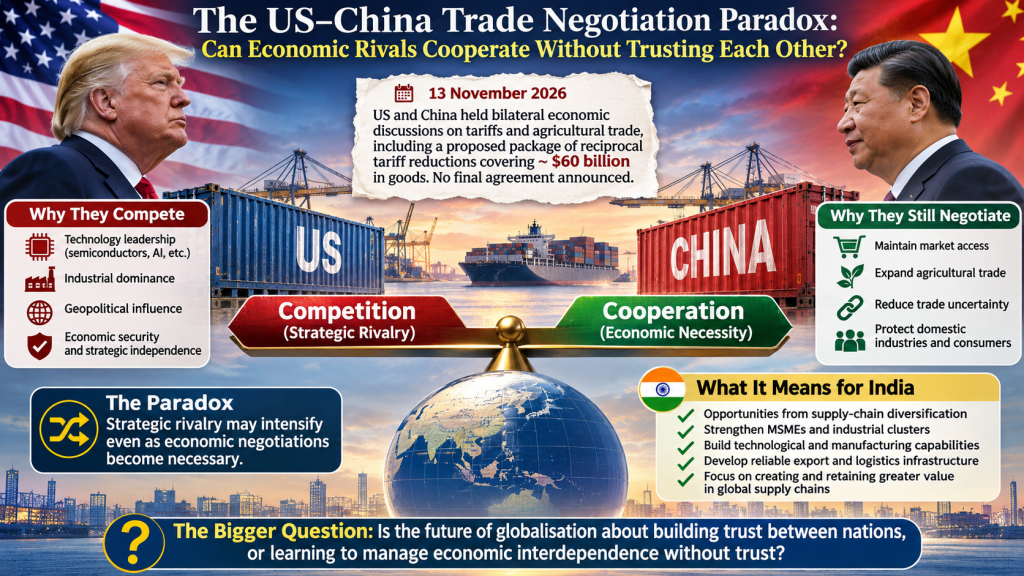
The emerging paradox is striking: economic negotiations may become more necessary precisely when political trust is declining.
Trade Negotiations in an Age of Strategic Rivalry
Reports concerning discussions on 13 November 2026 suggest renewed attention to tariffs and agricultural trade, including a proposed package of reciprocal tariff reductions reportedly valued at approximately $60 billion. The reported proposal should not be confused with a concluded agreement, and its precise valuation and scope require independent confirmation.
The economic significance of such discussions extends beyond the immediate tariff measures. They illustrate how commercial interests can encourage negotiations even when the underlying strategic disagreements remain unresolved.
For the United States, tariffs may protect selected domestic producers and provide negotiating leverage, but they can also raise costs for importing businesses, manufacturers dependent on intermediate inputs and consumers. Agricultural exporters may face additional uncertainty when foreign markets become entangled in diplomatic disputes.
For China, access to major export markets remains important for industrial production, employment and business confidence. At the same time, restrictions on advanced technologies and uncertainty over future market access encourage efforts to strengthen domestic capabilities and diversify commercial relationships.
Both economies therefore confront an uncomfortable reality. They may seek greater strategic independence while simultaneously requiring selective economic cooperation.
Historical Perspective: From Cold War Separation to Global Economic Integration
During the Cold War, the United States and the Soviet Union operated within largely separate economic systems. Their geopolitical rivalry was accompanied by relatively limited bilateral commercial integration.
The US–China relationship developed differently.
China’s economic reforms beginning in 1978, the expansion of international manufacturing networks and China’s accession to the World Trade Organization in 2001 created a level of economic integration that was difficult to imagine during the earlier Cold War.
American corporations gained access to manufacturing capabilities, suppliers and an expanding consumer market. China benefited from export demand, foreign investment, technological learning and participation in global production networks.
The expectation was that expanding economic relationships would gradually encourage cooperation and greater predictability.
However, the experience of the past decade suggests that economic integration does not necessarily eliminate strategic competition. Indeed, integration can create new vulnerabilities because countries become dependent on foreign technologies, critical components, raw materials and markets.
This marks an important change in the relationship between international economics and geopolitics.
Interdependence, once regarded primarily as a source of economic efficiency, is increasingly also viewed as a potential source of strategic vulnerability.
The Economic Contradiction: Protection Without Complete Separation
The United States and China face a difficult balancing problem. Both have incentives to protect strategically important industries, but complete economic separation could impose substantial costs.
Modern manufacturing is not organised entirely within national boundaries. A single electronic product may depend on design capabilities in one country, semiconductor production in another, specialised materials from several economies and final assembly elsewhere.
Tariffs and export restrictions can therefore affect firms far beyond their immediate targets.
A tariff designed to protect domestic manufacturing may raise the cost of imported components used by domestic producers. Restrictions intended to reduce technological dependence may encourage alternative supply chains but also increase investment costs and delay production.
Similarly, industrial subsidies can accelerate domestic capacity creation while contributing to excess production, international disputes and pressure on public finances.
The central issue is not whether economic security matters. It clearly does. The more difficult question is how governments can strengthen economic security without unnecessarily weakening the productivity and competitiveness they seek to protect.
This creates what may be called the protection–competitiveness paradox: measures intended to strengthen national industries can sometimes increase their costs and reduce their international competitiveness.
Why Trade Agreements May No Longer Produce Political Trust
Traditional trade negotiations often aimed to reduce barriers and establish stable rules for expanding commerce.
Increasingly, negotiations between strategic competitors may have a narrower objective: managing economic friction without resolving the underlying political disagreements.
An agreement on agricultural purchases does not necessarily resolve disputes over semiconductor restrictions. Reciprocal tariff reductions do not automatically eliminate disagreements over industrial subsidies, cybersecurity or military security.
Consequently, trade negotiations may produce limited commercial stability without creating broader political confidence.
This distinction is crucial.
Countries can cooperate transactionally while continuing to compete strategically. They may agree to reduce selected tariffs while simultaneously investing in alternative supply chains, domestic technologies and strategic industrial capacity.
The result could be a system of managed interdependence, in which economic relationships continue but are increasingly shaped by security considerations, negotiated exceptions and sector-specific restrictions.
The New Trade Architecture: Cooperation in Selected Sectors, Competition Everywhere Else
The November discussions provide an interesting example of this emerging arrangement. The proposed tariff reductions cover approximately $30 billion of goods imported by each country, based on earlier trade values, rather than representing $60 billion in direct financial savings. The September 2026 framework also requires domestic legal procedures before reductions can be implemented. The White House +2
This suggests that the future of US–China trade may not involve either unrestricted globalisation or complete economic separation.
Instead, the two economies could develop a selective trading relationship. Commercially important but less sensitive products may continue to move across borders, while advanced technologies, critical minerals, defence-related components and strategically important industries face tighter controls.
Such an arrangement would create a complicated international trading environment. Companies would need to distinguish between commercially accessible markets and strategically restricted sectors.
The resulting uncertainty could be particularly difficult for smaller firms that lack the financial resources, legal expertise and international networks needed to manage changing trade regulations.
The Global Consequences: Third Countries Cannot Remain Passive
US–China economic competition has consequences far beyond their bilateral relationship.
European manufacturers depend on international markets and specialised supply networks. Southeast Asian economies participate in production systems connecting Chinese inputs with Western consumers. Resource-exporting countries depend on demand from major industrial economies.
When the United States and China change tariffs, investment restrictions or technology regulations, the consequences spread through these interconnected networks.
Some developing economies may gain investment as multinational companies diversify production. Others may experience higher input costs, disrupted exports or pressure to comply with competing technological and regulatory systems.
There is also a less visible danger. When businesses reorganise supply chains primarily to manage geopolitical risks rather than improve productivity, the global economy may become more resilient in some respects but less efficient overall.
The cost of international trade may increasingly include not only transportation, tariffs and production expenses, but also the cost of managing geopolitical uncertainty.
India’s Opportunity and Its Strategic Challenge
For India, the US–China negotiation paradox presents both opportunities and risks.
The diversification of international supply chains could create opportunities in electronics, engineering components, pharmaceuticals, textiles, machinery and renewable-energy equipment.
However, India should avoid assuming that geopolitical competition will automatically translate into industrial competitiveness.
International manufacturers relocating production or diversifying suppliers will still evaluate costs, quality, delivery reliability, technological capabilities, infrastructure and regulatory predictability.
India must also recognise that Chinese intermediate goods and machinery remain important in several manufacturing value chains. Attempting to reduce such dependence without developing competitive alternatives could increase costs for domestic producers.
A more effective strategy would combine diversified sourcing with systematic domestic capability development.
For Indian MSME clusters, the priorities should include common testing and certification facilities, advanced production technologies, supplier development, product design, export intelligence and stronger relationships with international buyers.
The strategic objective should not simply be to replace Chinese imports or attract factories relocating from China. It should be to increase India’s ability to create, retain and capture value within international production networks.
Future Outlook: By 2035, Could the World Have Trade Without Trust?
By 2035, the international economy may operate through a combination of selective cooperation and persistent strategic rivalry.
The United States and China could continue negotiating over agricultural products, consumer goods and selected industrial inputs while competing intensely over semiconductors, artificial intelligence, advanced manufacturing and critical technologies.
Trade agreements might become narrower, more conditional and more frequently renegotiated.
For businesses, this would change the meaning of competitiveness. Low production costs and product quality would remain essential, but firms would also need supply-chain flexibility, regulatory intelligence, diversified customers and the capacity to respond quickly to policy changes.
For governments, the challenge would be to distinguish genuine economic-security requirements from protectionist measures that unnecessarily raise costs and weaken productivity.
For developing economies, the critical question would be whether they can use the restructuring of global trade to build lasting industrial capabilities rather than becoming temporary alternative production locations.
The world may therefore be moving towards an unusual economic arrangement: countries that distrust one another politically but remain sufficiently interdependent to negotiate continuously.
Conclusion: The Paradox of Necessary Cooperation
The US–China relationship reveals a fundamental limitation of conventional thinking about globalisation.
Economic integration does not guarantee political trust. Strategic competition does not necessarily eliminate commercial cooperation.
Both forces can operate simultaneously.
The real test of future international economic relations may not be whether rival countries can become friends. It may be whether they can establish sufficiently predictable rules to prevent their rivalry from imposing excessive costs on the wider global economy.
The provocative question is this: If two economic superpowers must continue trading despite deep strategic distrust, is the future of globalisation no longer about building trust, but about learning to manage distrust?
And for countries such as India, an equally important question follows: Can emerging economies turn geopolitical fragmentation into lasting industrial competitiveness, or will they merely inherit the higher costs of a divided world?
Source basis: Reuters reporting, 14 November 2026; US–China Board of Trade framework published by the White House, September 2026; and China’s Ministry of Commerce statement reported 14–15 November 2026. The analysis and future scenarios are interpretive, not established forecasts. Reuters +2


Leave a Reply