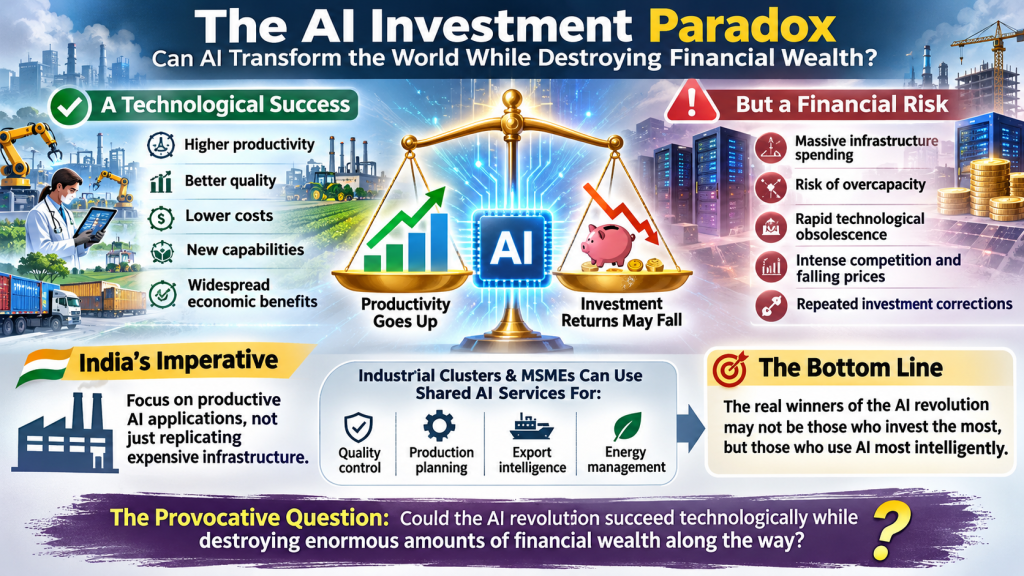
The next great technological revolution may create enormous economic value without rewarding everyone who finances it.
The Great Contradiction: Technological Success Does Not Guarantee Financial Success
Artificial intelligence is increasingly being presented as the foundation of the next great economic transformation. Governments are developing national AI strategies, technology companies are investing heavily in computing infrastructure, and financial markets are assigning enormous valuations to businesses associated with the AI revolution.
The underlying expectation is straightforward: artificial intelligence will improve productivity, reduce operating costs, accelerate innovation, and create entirely new industries.
But an uncomfortable economic question is emerging. What happens if artificial intelligence becomes extraordinarily successful as a technology while many of the investments made in its name fail to generate adequate financial returns?
This possibility challenges a widely held assumption that technological progress and investment profitability necessarily move together.
History suggests otherwise. Some of the most transformative technologies have produced spectacular economic benefits while simultaneously destroying enormous amounts of investors’ wealth.
The AI revolution may follow a similar path.
Historical Perspective: When Revolutionary Technologies Created Financial Crises
The nineteenth-century railway revolution fundamentally changed the geography of economic activity. Railways connected markets, reduced transportation costs, expanded industrial production, and accelerated urbanisation. Yet railway investment also experienced speculative booms, financial failures, and widespread losses.
The infrastructure remained economically valuable even when the companies financing it collapsed.
A similar contradiction appeared during the telecommunications expansion of the late twentieth century. Companies invested heavily in fibre-optic networks in anticipation of rapidly expanding internet traffic. Much of this capacity initially remained underutilised, contributing to financial distress and bankruptcies.
Nevertheless, the infrastructure eventually supported the expansion of the digital economy.
The dot-com bubble provides another important example. During the late 1990s, investors correctly anticipated that the internet would transform commerce, communication, banking, and information services. However, they frequently overestimated how quickly individual companies could generate sustainable profits.
When the bubble collapsed in 2000–2002, enormous financial wealth disappeared, but the internet revolution continued.
These episodes reveal a fundamental economic distinction: investors can correctly predict the future importance of a technology while incorrectly predicting who will earn money from it, how much they will earn, and when those earnings will materialise.
Artificial intelligence may be entering a similar period of uncertainty.
The AI Infrastructure Race: Investment Is Expanding Faster Than Proven Returns
Artificial intelligence requires substantial investment in advanced semiconductors, data centres, electricity generation, cooling systems, telecommunications networks, specialised software, and skilled workers.
Unlike many earlier digital applications, advanced AI systems can involve substantial recurring costs for computing and energy.
This creates an important economic challenge. Companies must generate sufficient revenue not merely to recover their initial investments but also to finance continuing operating expenditure, equipment replacement, and technological upgrading.
The speed of technological change makes this challenge particularly difficult.
A data centre built today may remain physically useful for many years, but some of its computing equipment could become economically less competitive much sooner. New chips, more efficient AI models, and alternative computing architectures may change the economics of existing infrastructure.
Consequently, companies could face a situation in which their technological capabilities improve continuously while the financial value of earlier investments declines.
This is not necessarily evidence of technological failure. It may simply reflect the rapid depreciation of economic advantage in a highly competitive industry.
The deeper concern is that investment decisions may increasingly depend on expectations of future demand rather than demonstrated profitability.
The Productivity–Profitability Paradox
Artificial intelligence could deliver substantial productivity improvements without producing equally substantial profits for AI infrastructure providers.
Consider a manufacturing enterprise using AI to reduce material wastage, improve product quality, and optimise production schedules.
The enterprise may achieve higher productivity and lower operating costs. Consumers may benefit from more competitive prices, and the wider economy may gain from more efficient resource utilisation.
However, the company providing the AI service may face intense competition, falling service prices, and high infrastructure costs.
In such a situation, the economic benefits of AI could be distributed across thousands of businesses and millions of consumers rather than concentrated among the companies financing the underlying technology.
This distinction between social returns and private financial returns is central to understanding the future of AI investment.
A technology can generate enormous benefits for society without providing extraordinary profits to its investors.
Indeed, greater competition and technological efficiency could eventually make AI services cheaper and more widely available, simultaneously increasing their economic usefulness and reducing the profitability of some providers.
The greatest beneficiaries of AI may ultimately be its users rather than its producers.
Could AI Create a New Form of Industrial Overcapacity?
Traditional industries experience overcapacity when production facilities expand faster than market demand.
Steel, automobiles, chemicals, and real estate have repeatedly demonstrated how excessive investment can create falling prices, declining profitability, financial stress, and stranded assets.
Artificial intelligence may experience a technologically different but economically comparable problem.
If multiple companies simultaneously construct enormous computing facilities based on optimistic demand projections, aggregate capacity could exceed the level that customers are willing to purchase at commercially sustainable prices.
The problem becomes more complicated because AI demand itself is changing.
More efficient algorithms may reduce the computing resources required for certain tasks. Smaller specialised models may replace expensive general-purpose systems in some applications. Improvements in hardware utilisation could also increase effective computing supply without proportionate increases in physical infrastructure.
At the same time, new applications and more intensive AI use could expand total demand substantially.
The outcome is therefore uncertain.
Nevertheless, the possibility of overinvestment deserves serious attention because the existence of rapidly growing demand does not automatically guarantee profitable utilisation of every new facility.
The Hidden Macroeconomic Risks of an AI Investment Correction
An AI investment correction would not necessarily remain confined to technology companies.
Large-scale AI investment connects semiconductor manufacturers, electricity suppliers, construction companies, financial institutions, equipment producers, and commercial property markets.
If expected returns disappoint, reductions in investment could affect these interconnected industries.
Financial markets could also experience substantial valuation adjustments if investors revise assumptions about future earnings.
There is another important dimension. AI-related investment may contribute to measured economic growth during the construction phase, even before the resulting infrastructure generates adequate commercial returns.
This creates a possible disconnect between short-term GDP expansion and long-term investment efficiency.
An economy could initially experience higher growth because of large infrastructure expenditure, only to face weaker investment, financial losses, and lower asset valuations when expectations are corrected.
However, such a correction would not necessarily eliminate the underlying productivity benefits of artificial intelligence. Lower computing costs could even accelerate adoption among businesses that previously found AI services too expensive.
This is the central paradox: a financial correction could damage investors while improving the affordability and diffusion of the technology.
Future Outlook: By 2035, AI May Be More Productive but Less Profitable for Some Investors
By 2035, artificial intelligence could become deeply embedded in manufacturing, logistics, healthcare, agriculture, education, financial services, and public administration.
Its economic importance may increasingly resemble electricity or telecommunications: a general-purpose capability supporting productivity across numerous industries.
Yet the financial structure supporting AI could undergo repeated adjustments.
Some infrastructure investments may become highly profitable because of strong utilisation, technological leadership, and economies of scale. Others may struggle because of excessive capacity, rapid obsolescence, competitive pricing, or weaker-than-expected commercial demand.
The crucial distinction will be between three fundamentally different economic realities: genuine demand for AI services, profitable utilisation of AI infrastructure, and speculative expectations about future growth.
These should not be treated as interchangeable.
An important possibility is that the AI industry eventually becomes more competitive and less financially exceptional even as artificial intelligence becomes more essential to everyday economic activity.
The technology may become increasingly successful precisely because its services become cheaper.
This would represent a victory for productivity but not necessarily for every investor.
India Implications: Become an Intelligent User of AI, Not Merely a Builder of Expensive Infrastructure
India faces an important strategic choice.
One approach is to compete primarily through large investments in computing infrastructure, data centres, and advanced AI systems. Such investments can be valuable where demand, technical capabilities, financing, energy availability, and commercial viability justify them.
However, replicating expensive infrastructure without a clearly established economic rationale could create substantial financial risks.
A more balanced strategy would combine essential domestic AI capabilities with widespread adoption of productive applications.
India’s greatest opportunity may lie in applying artificial intelligence to the practical problems of its economy.
Manufacturing enterprises need better production planning, quality assurance, inventory management, and energy efficiency. Agricultural systems require improved information, forecasting, and resource management. Exporters need reliable market intelligence, documentation support, and assistance in understanding international standards.
These applications may generate significant economic value without requiring every enterprise to develop or own expensive AI infrastructure.
For Indian MSMEs, the central challenge is not necessarily access to the most sophisticated AI models. It is access to affordable, reliable, industry-specific solutions that improve business performance.
Industrial Clusters Could Become India’s Most Effective AI Adoption Platforms
India’s industrial clusters provide a particularly promising institutional framework for spreading AI capabilities.
Individual MSMEs often lack the financial resources, technical expertise, and data systems needed to adopt advanced technologies independently.
However, enterprises operating within the same industrial cluster frequently share similar production processes, quality requirements, supply-chain challenges, and export-market needs.
This creates opportunities for collective AI services.
Cluster institutions, industry associations, common facility centres, and technology service providers could establish shared platforms for production scheduling, predictive maintenance, defect detection, energy management, export intelligence, and regulatory compliance.
Such arrangements could reduce adoption costs and allow smaller enterprises to benefit from capabilities that would otherwise remain concentrated among large corporations.
For example, a textile cluster could develop shared AI-assisted fabric inspection services. An engineering cluster could introduce collective predictive-maintenance and process-optimisation facilities. A food-processing cluster could use AI-supported demand forecasting and quality monitoring.
The economic value would come not from possessing expensive technology but from improving measurable enterprise performance.
However, these initiatives must also address data confidentiality, technical reliability, interoperability, and the availability of skilled personnel.
Public support should therefore focus on demonstrable productivity improvements rather than technology acquisition alone.
The relevant policy indicators should include reductions in defects, energy consumption, production delays, inventory costs, and export rejection rates.
India should measure AI success by improvements in industrial competitiveness, not simply by the number of data centres constructed or the amount of investment announced.
A New Economic Question: Who Captures the Value Created by Artificial Intelligence?
The AI revolution raises a broader question about the distribution of economic gains.
If AI improves productivity across the economy, who will capture the resulting value?
Will it be semiconductor producers, cloud infrastructure companies, AI software developers, businesses adopting AI, consumers benefiting from lower prices, or workers acquiring complementary skills?
The answer will depend on competition, market structure, intellectual property, access to computing resources, workforce capabilities, and the bargaining power of different economic actors.
There is no economic law guaranteeing that the companies investing the most will capture the greatest share of the benefits.
Indeed, technological history repeatedly demonstrates that the organisations creating infrastructure and the organisations ultimately capturing economic value may be very different.
For developing economies, this distinction is especially important.
They should avoid confusing participation in a global investment race with the creation of lasting domestic economic capabilities.
Conclusion: The AI Revolution May Succeed Even if the AI Investment Boom Does Not
The economic history of transformative technologies suggests that technological progress and financial success frequently follow different paths.
Railways transformed transportation despite speculative investment failures. Telecommunications infrastructure supported the digital economy despite periods of excessive investment. The internet transformed global commerce even after the dot-com collapse.
Artificial intelligence may produce a comparable contradiction.
By 2035, AI could be indispensable to global economic activity while some of today’s most celebrated investments have delivered disappointing returns.
For policymakers, the challenge is to distinguish technological ambition from economically productive investment.
For businesses, the priority should be measurable efficiency gains rather than participation in technological enthusiasm.
For India, the greatest opportunity may be to build an economy in which millions of enterprises use AI productively, rather than concentrating primarily on the financial scale of AI infrastructure.
Ultimately, the success of artificial intelligence should be judged not only by computing power, corporate valuations, or investment commitments, but by its contribution to productivity, competitiveness, employment quality, and broad-based economic welfare.
The provocative question is therefore unavoidable: Could artificial intelligence become one of the greatest technological successes in economic history while simultaneously destroying enormous amounts of financial wealth?
And perhaps an even more important question follows:
Could the countries and businesses that spend less on building AI infrastructure, but use AI more intelligently, emerge as the real economic winners of the revolution?


Leave a Reply