INTERNATIONAL ECONOMICS | TRADE POLICY | NOVEMBER 2026
The hidden economics of trade protection, supply-chain dependence and corporate profitability
The invisible cost of trade protection
Trade wars are generally discussed in terms of tariffs, imports, exports, trade deficits and national economic interests. Governments impose tariffs to protect domestic industries, encourage local production and reduce dependence on foreign suppliers. However, a fundamental economic question often receives insufficient attention: What happens to the financial performance of businesses when tariffs spread through interconnected supply chains?
A recent Federal Reserve Bank of Boston working paper, Trade Wars on the Income Statement: The Effects of Tariffs on Firms, by Omar Barbiero, Viacheslav Sheremirov, Alvaro Silva and Hillary Stein (November 2026), offers an important perspective.
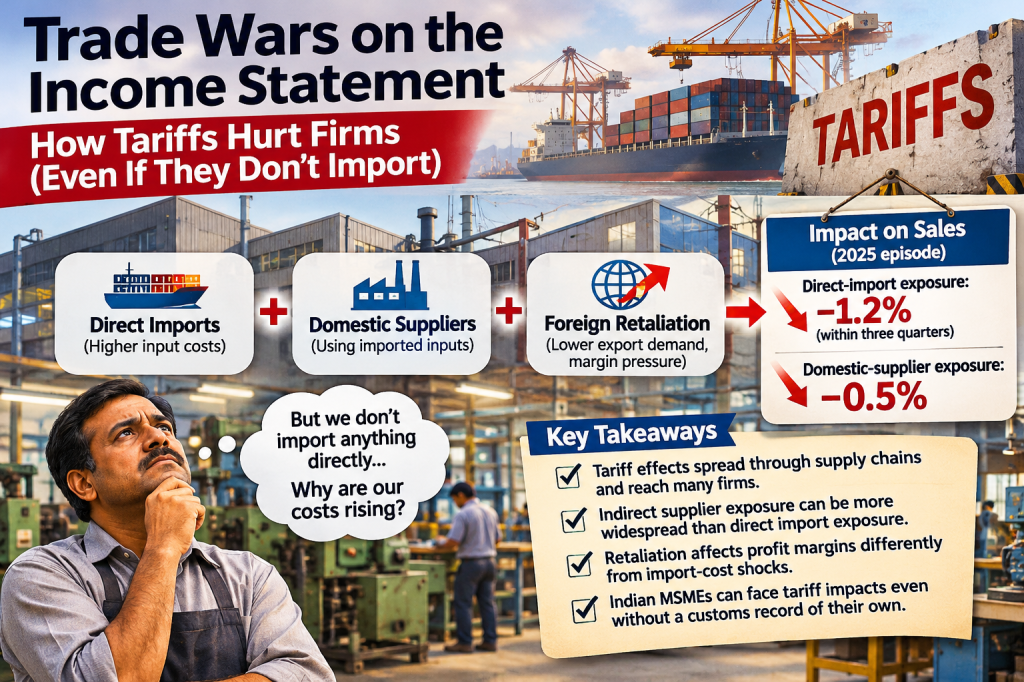
The study examines how the US tariff episodes of 2018 and 2025 affected listed companies through three interconnected channels: direct imports, purchases from domestic suppliers dependent on imports, and foreign retaliation.
Its central message challenges a common assumption in trade policy: a company does not need to import directly to suffer from tariffs.
In a modern economy, the distinction between domestic and international production is much less clear than customs statistics suggest. A manufacturer purchasing components from a domestic supplier may still depend heavily on imported metals, chemicals, electronics, machinery or intermediate goods.
Consequently, tariffs can travel through several layers of production before appearing in a company’s financial accounts.
From customs duties to corporate financial statements
Traditional tariff analysis concentrates on changes in import prices, trade volumes, domestic production and consumer welfare. These remain important, but they do not fully explain how tariffs affect individual businesses.
A tariff initially raises the cost of affected imported goods. Depending on market conditions, importers may absorb the additional cost, negotiate lower supplier prices or pass it on to customers.
However, the process rarely stops there.
Domestic suppliers using imported inputs may increase their selling prices. Their customers may subsequently face higher production costs, even when those customers purchase entirely within their own country.
Businesses then confront difficult choices. They can increase prices and risk losing customers, absorb higher costs and accept lower profit margins, reduce expenditure elsewhere, or reorganise their supply chains.
Each adjustment has consequences for sales, profitability, investment and employment.
This is why tariff effects should be studied through corporate income statements rather than customs records alone.
What the new evidence reveals
The Boston Fed study combines firm-level import exposure, domestic suppliers’ import dependence and exposure to foreign retaliation with quarterly financial statements, stock-market reactions and corporate earnings-call transcripts.
The research covers publicly listed US companies across manufacturing, agriculture, mining and services.
According to the paper’s reported estimates, during the 2025 tariff episode:
Direct-import exposure
-1.2%
Estimated sales effect within three quarters at average exposure
Domestic-supplier exposure
-0.5%
Estimated sales effect through indirect import dependence
Reported firm-level estimates from the study summary. These are exposure-related effects, not economy-wide sales declines or necessarily additive impacts.
The second finding is particularly significant.
Even firms with limited direct international purchasing experienced adverse effects because their domestic suppliers were exposed to imported inputs.
The study also distinguishes foreign retaliation from import-cost shocks. Retaliatory tariffs can weaken export demand and affect profit margins through a different mechanism from tariffs imposed on imported inputs.
This distinction matters because the financial consequences of trade wars depend not merely on the tariff rate but on where each business is positioned within production and distribution networks.
The historical paradox: protecting industry while increasing its costs
The economic contradiction underlying tariff protection is not new.
During the nineteenth century, industrialising countries frequently used tariffs to encourage domestic manufacturing. Friedrich List argued that developing industries sometimes required temporary protection against established international competitors.
However, protection also created costs for industries dependent on imported inputs.
During the 1930s, the Smoot–Hawley Tariff Act became associated with escalating international trade restrictions and retaliation during the Great Depression. Although tariffs were not the sole cause of the collapse in world trade, they contributed to an increasingly restrictive international commercial environment.
After the Second World War, successive rounds of trade liberalisation reduced barriers and encouraged the international fragmentation of production.
By the late twentieth century, global value chains had fundamentally transformed manufacturing. A product assembled in one country could incorporate components, materials, technology and services originating in numerous others.
This created a new contradiction.
The more internationally integrated domestic production becomes, the more difficult it is to protect domestic producers through tariffs without simultaneously increasing their production costs.
Trade protection designed to strengthen national industry can therefore weaken the competitiveness of parts of that same industry.
The hidden vulnerability of small businesses
One of the most important implications concerns micro, small and medium enterprises.
Large corporations generally possess stronger procurement systems, international supplier networks, financial reserves and negotiating capabilities. They may be able to diversify sourcing, renegotiate contracts or absorb temporary increases in costs.
Smaller businesses frequently have fewer alternatives.
Consider a small engineering enterprise that purchases steel, electronic controls and specialised components from domestic distributors. Its customs records may show no imports.
Nevertheless, its domestic suppliers may depend on foreign inputs.
If tariffs increase their costs, the engineering enterprise may face higher material prices without having any direct involvement in international trade.
The problem becomes particularly serious when customers are unwilling to accept higher selling prices.
Working capital becomes constrained, profit margins decline and investment plans may be postponed.
For MSMEs, the economic effects of tariffs can therefore be indirect, delayed and difficult to identify.
The Boston Fed study examines publicly listed companies, so its quantitative findings should not automatically be extended to smaller enterprises. Nevertheless, the supply-chain mechanism it identifies provides a strong reason to investigate MSME exposure separately.
The 2035 outlook: Will trade wars create more expensive production networks?
Looking towards 2035, international trade may increasingly operate through overlapping regional and strategically aligned supply networks.
Governments could encourage domestic production, supplier diversification, strategic inventories and reduced dependence on geopolitical competitors.
Such measures may improve resilience and economic security. However, resilience is not free.
Maintaining multiple suppliers, relocating production facilities, duplicating certification systems and holding larger inventories can increase costs.
Companies may face a new trade-off between efficiency and security.
The conventional model of globalisation prioritised low-cost sourcing, economies of scale and international specialisation. Emerging trade strategies increasingly prioritise supply-chain reliability, technological control and geopolitical risk management.
The economic challenge is to balance these objectives without permanently weakening productivity.
Artificial intelligence and advanced supply-chain analytics may help firms identify indirect exposure and anticipate disruptions. Yet smaller enterprises could remain disadvantaged if such capabilities are concentrated among large corporations.
By 2035, competitive advantage may depend not only on production efficiency but also on the ability to understand and manage the international dependencies hidden inside domestic supply chains.
India’s challenge: Measuring tariff exposure beyond customs data
India’s industrial and trade policies frequently assess competitiveness through import dependence, domestic value addition, export performance and tariff structures.
These indicators are useful but incomplete.
An Indian MSME purchasing machinery components from a domestic manufacturer may be indirectly exposed to imported semiconductors, precision parts, industrial electronics or specialised materials.
Similarly, a textile manufacturer sourcing fabric domestically may depend indirectly on imported dyes, chemicals, machinery or synthetic fibres.
An automotive component producer may purchase from Indian suppliers whose own production relies on imported sensors, electronic systems or specialised alloys.
Therefore, a firm classified as domestically oriented may still be highly vulnerable to international trade restrictions.
India needs to move towards supply-chain-based tariff-impact assessments that identify both direct and indirect import dependence.
This requires more detailed industrial value-chain mapping, input-output analysis and enterprise-level information.
Industrial clusters could play an especially important role.
Cluster development institutions, industry associations and common facility centres could establish shared systems for identifying critical imported inputs, monitoring international tariff changes, assessing supplier risks and supporting alternative sourcing.
Rather than treating tariff policy as a matter confined to international trade departments, India should integrate tariff-risk analysis into industrial development, MSME competitiveness and cluster upgrading programmes.
A new policy question: Who actually benefits from protection?
The conventional debate often presents tariffs as a choice between protecting domestic producers and allowing foreign competition.
The reality is more complicated.
Some domestic producers may benefit from reduced import competition, while others face higher costs for materials and intermediate goods.
Consumers may face higher prices. Exporters may become less competitive. Foreign retaliation may reduce access to overseas markets.
Even within the same industrial cluster, tariff effects can differ sharply between upstream suppliers, downstream manufacturers and exporters.
This suggests that tariff policy should be evaluated through its effects on entire value chains rather than individual industries in isolation.
A policy that benefits one stage of production may impose larger costs on another.
Moreover, short-term gains for protected producers should be distinguished from long-term improvements in productivity, technological capability and international competitiveness.
The relevant measure of success is not simply whether imports decline. It is whether domestic industries become more productive, innovative, resilient and globally competitive.
The deeper economic lesson
The Federal Reserve Bank of Boston study contributes to a broader reconsideration of trade policy.
Its important innovation is to connect three different tariff transmission channels within a firm-level empirical framework and demonstrate how indirect supplier exposure can reach businesses beyond the immediate importing sector.
The evidence remains subject to limitations. The 2025 observation period is relatively short, and publicly listed companies do not represent the full enterprise population. Because exposure is not randomly assigned, causal interpretation requires caution, although the study’s stock-market and earnings-call evidence strengthens its analysis.
Nevertheless, the underlying policy message is significant.
In interconnected production systems, tariffs do not remain at national borders. Their consequences spread through supplier relationships, production costs, selling prices, profit margins and investment decisions.
The central question is no longer simply how much protection a country provides to its industries, but how much of that protection ultimately becomes an additional cost to its own producers.
For India, this calls for a shift from tariff-centred industrial protection towards competitiveness-centred industrial development.
The future of manufacturing will depend less on how effectively countries restrict foreign competition and more on how successfully they strengthen domestic technological capabilities, supplier networks, productivity and market access.
The provocative question
Could a country impose tariffs to protect its domestic industries, only to discover that the greatest economic damage is being suffered by domestic enterprises that never imported anything directly?
That possibility deserves a central place in the next generation of trade and industrial policy.
Research reference: Omar Barbiero, Viacheslav Sheremirov, Alvaro Silva and Hillary Stein, Trade Wars on the Income Statement: The Effects of Tariffs on Firms, Federal Reserve Bank of Boston, Working Paper 26-15, November 2026. The empirical figures discussed above are based on the research summary provided; the full paper was not independently verified for this article.


Leave a Reply