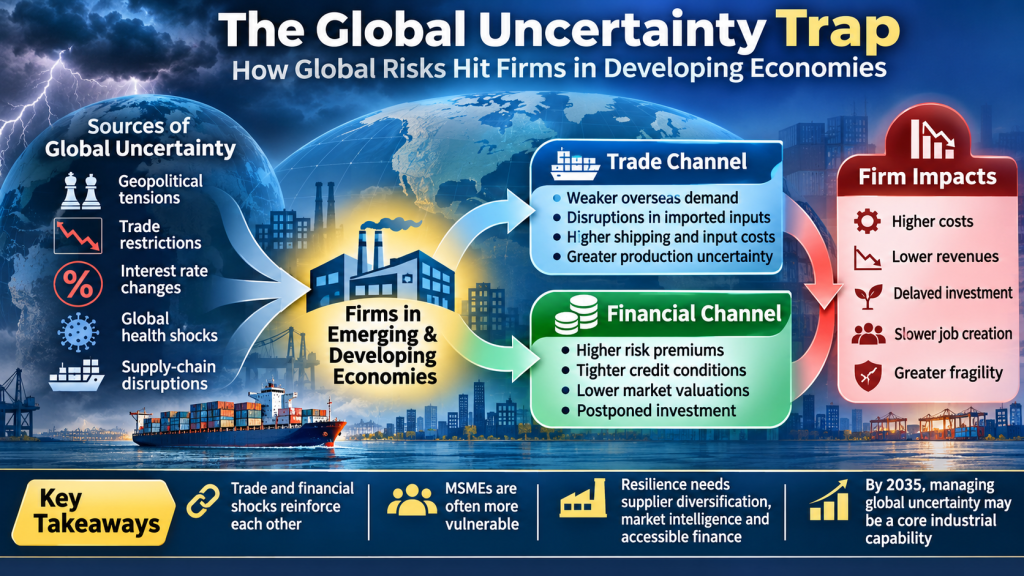
An economic analysis inspired by the World Bank research paper “The Effects of Global Uncertainty on Firms in Emerging and Developing Economies: Quantifying the Trade and Financial Channels” by Ergys Islamaj, Haiqin Liu, Jongrim Ha and Aaditya Mattoo (November 2026).
When Global Uncertainty Becomes a Local Economic Crisis
One of the most troubling contradictions of the modern global economy is that businesses in developing countries are increasingly exposed to economic disturbances originating far beyond their national borders. A manufacturing enterprise in India may have competitive products, efficient workers, reliable customers and adequate production capacity, yet its future can suddenly become uncertain because of a geopolitical confrontation, an unexpected trade restriction, changing global interest rates or financial instability in a distant economy.
This raises a fundamental economic question: Why should a productive enterprise in a developing country suffer because of uncertainty generated by decisions over which it has almost no influence?
A recent World Bank Policy Research Working Paper, released on 5 November 2026 and updated on 9 November, examines this question through the experience of publicly listed firms across 74 emerging and developing economies between 2000 and 2024.
The research offers an important perspective on globalisation. International economic integration does not merely transmit goods, services, technology and investment. It also transmits uncertainty.
For developing economies, this transmission can become a serious constraint on industrial development, investment and long-term competitiveness.
Historical Perspective: From Global Integration to Global Vulnerability
For much of the post-1990 period, international economic integration was promoted as an opportunity for developing countries to accelerate industrialisation. Access to international markets could expand production, foreign investment could supplement domestic savings, and global value chains could enable firms to participate in sophisticated manufacturing without developing every production capability independently.
This strategy produced substantial benefits, particularly in economies that successfully combined export expansion with domestic industrial capability development.
However, globalisation also created new forms of dependence.
The Asian financial crisis of 1997 demonstrated how financial disturbances could spread rapidly across national borders. The global financial crisis of 2008 revealed that even enterprises with relatively sound operating fundamentals could face severe difficulties when international credit markets contracted.
The COVID-19 pandemic exposed vulnerabilities in geographically fragmented production networks, while subsequent geopolitical tensions, trade restrictions and monetary tightening reinforced the importance of international risk transmission.
Historically, economists frequently distinguished between external trade shocks and financial shocks. Today, these channels increasingly interact.
A decline in international demand can weaken company revenues, reduce investor confidence, raise borrowing costs and force enterprises to postpone investment. What begins as a trade disturbance can therefore become a financial problem.
The reverse is equally possible. Financial uncertainty can restrict credit, discourage imports of essential components and undermine production.
The emerging challenge is not simply that shocks travel internationally, but that interconnected economic systems can multiply their consequences.
What the World Bank Research Contributes
The World Bank study provides a useful framework for examining how global uncertainty affects firms through trade relationships, production networks and financial markets.
Its coverage of 74 emerging and developing economies over 2000–2024 allows the researchers to examine differences in exposure across countries, industries and firms.
The research combines firm-level daily equity returns, corporate financial accounts, bilateral product-level trade data and the Asian Development Bank’s multiregional input-output tables. A panel structural vector-autoregression framework is used to analyse the transmission of uncertainty shocks.
An important methodological contribution is the integration of financial-market information with sectoral trade and production-network relationships. This makes it possible to examine how firms’ international economic connections relate to their vulnerability to uncertainty.
The study’s computational replication was independently verified, strengthening confidence in the reproducibility of its analysis.
Nevertheless, the distinction between statistical identification and definitive causality remains important. Structural modelling can provide disciplined estimates of shock transmission, but causal interpretations depend on the validity of the model’s identifying assumptions.
The broader economic significance lies in recognising that firms do not experience global uncertainty uniformly. Their exposure depends partly on where they obtain inputs, where they sell products, how their production networks are organised and how financial markets assess their risks.
The Trade Channel: When International Dependence Becomes an Economic Liability
Consider an Indian engineering components manufacturer supplying customers in Europe while importing specialised machinery and electronic components from East Asia.
Under normal conditions, this international arrangement may be efficient. The enterprise benefits from competitive imported inputs, specialised technologies and access to international demand.
However, global uncertainty can simultaneously affect several parts of its business.
European customers may postpone orders because they anticipate weaker demand. Overseas suppliers may revise prices or delivery schedules. Shipping companies may increase risk premiums. Exchange-rate volatility may complicate procurement decisions.
The manufacturer consequently faces uncertainty about sales, costs, delivery commitments and future profitability.
This illustrates a major limitation of conventional trade analysis.
Trade exposure is frequently measured through export and import values. Yet the economic consequences of uncertainty also depend on the position of an enterprise within international production networks.
A company importing a readily substitutable raw material may face relatively limited disruption. Another company depending on a single specialised component from one foreign supplier may encounter severe production difficulties even when that component represents only a small proportion of total manufacturing costs.
The strategic importance of an imported input can be far greater than its financial share in production.
For developing economies, this distinction is especially important because many industrial sectors remain dependent on imported technologies, machinery, precision components and specialised intermediate products.
The Financial Channel: When Uncertainty Raises the Cost of Survival
The financial consequences of uncertainty can be equally damaging.
Investors generally demand higher compensation for holding risky assets when uncertainty increases. Banks may become more cautious, international lenders may reassess emerging-market exposure, and firms may face tighter financing conditions.
Even businesses with profitable operations can experience declining market valuations if investors expect greater volatility in future earnings.
These effects can influence real economic decisions.
A company considering expansion may postpone machinery purchases. Another may preserve cash instead of recruiting workers. A third may abandon product development because future financing conditions appear unpredictable.
Such decisions can be individually rational but collectively damaging.
When thousands of firms simultaneously reduce investment, aggregate demand weakens, employment opportunities decline and productivity improvements slow.
This creates a potentially self-reinforcing process in which uncertainty reduces investment, weaker investment limits growth, and slower growth reinforces business pessimism.
The consequences can be particularly serious in developing economies where financial markets are relatively shallow, long-term industrial credit is limited and smaller enterprises depend heavily on short-term working capital.
The Hidden Interaction Between Trade and Finance
Perhaps the most important economic issue is that trade and financial disturbances rarely operate independently.
An exporter experiencing weaker overseas orders may also face declining cash flows. Banks observing deteriorating financial indicators may restrict working capital. Reduced credit availability can then prevent the enterprise from purchasing inputs needed to fulfil its remaining orders.
A temporary demand disturbance can therefore evolve into a prolonged production problem.
Similarly, an imported-input shock may increase manufacturing costs, weaken profitability and reduce the firm’s ability to service debt.
This interaction raises an uncomfortable possibility: international integration may transmit uncertainty through multiple channels at precisely the moment when enterprises have the least capacity to absorb it.
The relevant policy objective should not be to eliminate international integration. Rather, it should be to ensure that international integration does not create excessive economic fragility.
The MSME Paradox: The Firms Least Equipped to Manage Uncertainty May Be Among the Most Vulnerable
Although the World Bank study examines publicly listed firms, its analytical framework raises important questions about micro, small and medium enterprises.
Listed companies generally have better access to financial information, professional management, banking relationships and capital markets than smaller enterprises.
MSMEs often operate with narrower margins, limited cash reserves, concentrated customer relationships and weaker bargaining power.
An international buyer may respond to uncertainty by reducing orders or extending payment periods. A large supplier may revise prices. A bank may become more cautious about lending.
The MSME can consequently absorb risks originating across several stages of the value chain without possessing the financial capacity to manage them.
This suggests a critical research and policy question: Could global uncertainty have more severe consequences for unlisted MSMEs than the effects observed among publicly traded companies?
The World Bank study’s listed-firm evidence should not be treated as a direct estimate of MSME impacts. However, it provides a strong conceptual basis for investigating how uncertainty travels through supplier networks and affects smaller enterprises indirectly.
Future Outlook: By 2035, Managing Uncertainty May Become a Core Industrial Capability
Looking towards 2035, international competitiveness may increasingly depend on the ability of firms and countries to manage uncertainty rather than simply minimise production costs.
Businesses could place greater emphasis on supplier diversification, alternative export markets, flexible production systems, strategic inventories and reliable financing arrangements.
Large corporations may develop sophisticated systems to monitor geopolitical risks, trade restrictions, currency movements and supply-chain disruptions.
Smaller enterprises, however, may find these systems prohibitively expensive.
This could create a new competitive divide between firms capable of anticipating international disturbances and those that respond only after disruptions occur.
Artificial intelligence may improve demand forecasting, supply-chain monitoring and financial risk assessment. Yet access to data, analytical skills and affordable digital infrastructure will determine whether these benefits extend beyond large corporations.
There is also a significant economic trade-off.
Diversification, inventories and redundant production capacity can improve resilience, but they also impose costs. Excessive attempts to eliminate risk may undermine the efficiency gains associated with international specialisation.
The challenge will therefore be to develop economically efficient resilience, rather than pursue either maximum global dependence or complete self-sufficiency.
India Implications: Industrial Policy Must Move Beyond Production Incentives
India’s industrial strategy has increasingly emphasised manufacturing investment, infrastructure development, production-linked incentives, export expansion and integration into global value chains.
These objectives remain important, but the growing significance of uncertainty suggests that production capacity alone is an insufficient measure of industrial strength.
A manufacturing sector may expand rapidly while remaining vulnerable to disruptions in imported inputs, export demand, international finance and logistics.
India therefore needs to incorporate uncertainty exposure into industrial competitiveness assessments.
Industrial value-chain mapping should identify critical imported components, concentrated supplier relationships, dependence on particular export markets and financing vulnerabilities.
Such assessments would be particularly relevant for automotive components, electronics, pharmaceuticals, capital goods, textiles and renewable-energy manufacturing.
For MSME clusters, a practical institutional response would be the creation of shared economic intelligence and risk-management facilities.
Cluster institutions could monitor international demand, tariffs, product standards, freight conditions, exchange-rate developments and critical-input availability. They could also facilitate supplier diversification, common procurement arrangements, export-market development and access to trade finance.
These services could provide smaller enterprises with capabilities that they cannot economically develop individually.
The objective should be to transform industrial clusters from geographical concentrations of production into collective systems for competitiveness, intelligence and resilience.
India’s financial institutions also have an important role. Working-capital facilities, export-credit mechanisms and risk-sharing arrangements should distinguish between fundamentally unviable enterprises and otherwise competitive firms facing temporary external disruptions.
Without this distinction, financial tightening during periods of uncertainty can unnecessarily destroy productive capabilities that take years to rebuild.
A New Question for Economic Development
Traditional development economics has focused heavily on capital accumulation, labour productivity, technology, infrastructure and access to markets.
These remain essential determinants of economic progress.
However, an increasingly interconnected and politically fragmented global economy introduces another dimension: the ability to withstand uncertainty originating outside national boundaries.
A country may possess competitive labour, modern infrastructure and expanding manufacturing capacity, yet still experience repeated disruptions because its enterprises are deeply exposed to volatile international economic relationships.
The World Bank research provides a valuable basis for examining these vulnerabilities through firm-level evidence and interconnected trade and financial channels.
Its wider implication is that economic development strategies must increasingly consider not only how firms participate in global markets, but also how they survive instability within those markets.
The provocative question is this: Could the next major divide between successful and unsuccessful developing economies be determined less by their ability to attract investment and expand exports, and more by their ability to protect productive enterprises from global uncertainty they cannot control?
If so, the future of industrial competitiveness will depend not merely on producing more efficiently, but on building institutions, financial systems and production networks capable of sustaining economic activity when the international environment becomes unpredictable.
Research reference: Ergys Islamaj, Haiqin Liu, Jongrim Ha and Aaditya Mattoo, “The Effects of Global Uncertainty on Firms in Emerging and Developing Economies: Quantifying the Trade and Financial Channels,” World Bank Policy Research Working Paper, November 2026. This article is an original economic interpretation based on the study details provided; it does not attribute numerical effect estimates or specific empirical findings that have not been independently checked.


Leave a Reply