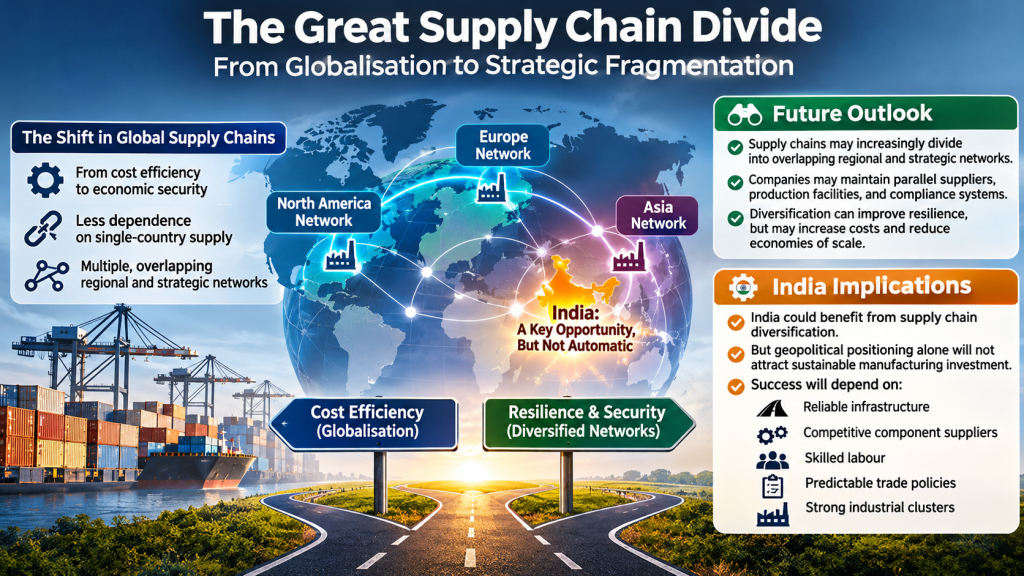
Why geopolitical tensions, industrial nationalism, and the search for economic security may reshape global manufacturing—and why India must look beyond the China+1 opportunity.
From Global Efficiency to Strategic Economic Security
For nearly four decades, globalisation operated on a powerful economic assumption: production should take place wherever costs were lowest, efficiency was highest, and markets were most accessible. Companies spread manufacturing across countries, creating complex international production networks that reduced costs, expanded trade, and accelerated industrial development.
China emerged as the world’s manufacturing powerhouse, Southeast Asia became an important production hub, and advanced economies increasingly concentrated on technology, design, finance, and high-value services.
But the foundations of this model are being questioned.
The COVID-19 pandemic exposed the vulnerability of geographically concentrated production. US–China trade tensions demonstrated how tariffs and technology restrictions could disrupt established business relationships. Conflicts, shipping disruptions, export controls, and competition over semiconductors and critical minerals have further reinforced the importance of supply chain security.
The emerging question is no longer simply where goods can be produced most cheaply. It is increasingly where production can continue reliably during geopolitical, economic, and technological disruptions.
This shift could fundamentally alter the geography of global manufacturing.
The Historical Contradiction: Globalisation Created Efficiency but Also Dependence
The expansion of global value chains during the 1990s and 2000s represented one of the most significant transformations in international economics.
Trade liberalisation, improvements in logistics, information technology, and foreign direct investment enabled companies to separate production into specialised activities distributed across countries.
A product designed in the United States could use semiconductors manufactured in Taiwan, machinery from Japan, components from China, and assembly operations in Vietnam.
This fragmentation increased productivity by allowing countries and firms to specialise according to their capabilities.
However, it also created an important contradiction.
The same production networks that generated efficiency became vulnerable to disruptions at a relatively small number of critical locations.
A shortage of semiconductors could interrupt automobile production across continents. Restrictions on critical minerals could affect renewable energy manufacturing. Disruptions in shipping corridors could increase costs for industries thousands of kilometres away.
Globalisation had reduced production costs, but it had not necessarily reduced systemic economic risks.
The world discovered that the cheapest supply chain was not always the most secure supply chain.
The Emerging Economic Order: One World, Multiple Supply Chains
The next phase of international trade may not involve the complete dismantling of globalisation. Instead, it could produce overlapping regional and strategic production networks.
American and European companies may increasingly diversify suppliers toward politically aligned or economically reliable countries. China may deepen manufacturing and commercial relationships across Asia and the Global South. Regional production arrangements could expand in North America, Europe, and Asia.
Companies may maintain parallel suppliers, duplicate certain production capabilities, and establish different compliance systems for different markets.
Such diversification can improve resilience, but it carries substantial economic costs.
Duplicated factories require additional capital. Multiple supplier networks increase coordination costs. Smaller production volumes may reduce economies of scale. Different technical standards and regulatory requirements can increase the cost of accessing international markets.
The resulting economic paradox is striking:
The world may spend more resources producing the same goods—not because production technology has become less efficient, but because geopolitical uncertainty has made economic security more expensive.
Ultimately, consumers may bear part of these additional costs through higher prices, while firms may experience pressure on profitability and investment.
The Hidden Danger: Fragmentation Could Widen the Development Divide
One of the least discussed consequences of supply chain restructuring concerns developing economies.
Historically, participation in global value chains provided opportunities for countries to industrialise without developing every stage of production domestically.
Countries could enter international markets through garment assembly, electronics components, automotive parts, or other specialised manufacturing activities before gradually upgrading their technological capabilities.
A more fragmented international economy could make this pathway increasingly difficult.
Large multinational corporations may prefer countries offering not only competitive costs but also political predictability, technological compatibility, reliable infrastructure, and regulatory alignment.
Developing countries without these capabilities could find themselves excluded from emerging production networks.
The danger is that global manufacturing investment becomes increasingly concentrated among countries already possessing strong industrial ecosystems.
Instead of narrowing international development gaps, supply chain restructuring could reinforce existing inequalities.
There is another possibility, however. Diversification could create opportunities for new manufacturing locations that previously struggled to compete with highly concentrated production centres. The outcome will depend on how effectively countries develop industrial capabilities.
The China+1 Illusion: Why Relocation Does Not Automatically Mean Industrial Development
The China+1 strategy has generated considerable optimism among countries seeking additional manufacturing investment.
Yet an important distinction is often overlooked.
Moving final assembly from one country to another does not necessarily mean transferring the entire manufacturing ecosystem.
A company may establish an assembly plant in India while continuing to import machinery, electronic components, specialised materials, tooling, and industrial technology from established international suppliers.
Such investment can generate employment and exports, but domestic value addition may remain limited.
The real economic transformation occurs when local enterprises begin supplying increasingly sophisticated components, developing technological capabilities, and participating in higher-value activities.
This requires far more than investment incentives.
It demands reliable industrial infrastructure, technically capable MSMEs, testing and certification facilities, skilled workers, efficient logistics, access to finance, and sustained relationships between large manufacturers and domestic suppliers.
A country does not become a manufacturing powerhouse simply by hosting multinational factories. It becomes one by developing the industrial capabilities that make those factories competitive and deeply integrated into the domestic economy.
India’s Strategic Opportunity: From Assembly Destination to Manufacturing Ecosystem
India has several advantages in the emerging international economic environment.
Its large domestic market, expanding infrastructure, entrepreneurial base, engineering capabilities, and growing international economic partnerships provide opportunities to attract manufacturing investment.
Supply chain diversification could create additional openings in electronics, pharmaceuticals, textiles, automotive components, engineering goods, chemicals, and renewable energy equipment.
However, India’s long-term success will depend less on geopolitical positioning than on industrial competitiveness.
Three structural challenges deserve particular attention.
First, India’s manufacturing ambitions require a deeper domestic supplier base. Many MSMEs struggle with technological upgrading, quality certification, productivity, access to affordable capital, and integration into international procurement systems.
Second, industrial competitiveness must be built at the cluster level. Manufacturing ecosystems require specialised suppliers, skilled labour markets, common infrastructure, technology institutions, logistics networks, and collaboration among enterprises. Isolated factories cannot substitute for functioning industrial clusters.
Third, trade policy must support predictable access to intermediate goods and international markets. Excessively costly imported inputs, uncertain regulations, and complex compliance requirements can undermine the competitiveness of domestic production even when final-product manufacturing receives government support.
India therefore faces a strategic choice.
It can compete primarily for relocated assembly operations, or it can use the present restructuring of global production to build deeper technological, supplier, and manufacturing capabilities.
The second pathway is more difficult, but it offers substantially greater long-term economic benefits.
Future Outlook: Resilience May Become the New Competitive Advantage
By 2035, global manufacturing could be organised around a combination of regional production hubs, strategic technology partnerships, diversified sourcing arrangements, and digitally coordinated supply networks.
Artificial intelligence, advanced robotics, additive manufacturing, and digital supply chain management may further change the economics of production location.
Automation could reduce the importance of low-cost labour in some industries, making infrastructure quality, energy reliability, technological capabilities, and proximity to markets increasingly significant.
At the same time, climate risks, carbon-related trade measures, cybersecurity requirements, and traceability standards could introduce additional conditions for participation in international value chains.
The future competitive advantage of a manufacturing location may therefore depend on its ability to deliver not merely low costs, but reliability, adaptability, compliance, and technological sophistication.
Nevertheless, complete regionalisation is unlikely to be economically attractive across all industries. Many production systems will continue to depend on internationally dispersed resources, specialised capabilities, and large global markets.
The most plausible outcome is not the end of globalisation, but its reorganisation around a more complicated balance between efficiency and security.
The Bigger Question: Can Economic Security Become a New Form of Protectionism?
The greatest danger is that legitimate concerns about supply chain resilience become a justification for excessive industrial protectionism.
Governments may increasingly subsidise domestic production, restrict foreign technology, impose local-content requirements, or favour politically aligned suppliers.
While some interventions may be justified by genuine security risks, poorly designed policies could weaken competition, raise costs, and reduce innovation.
Developing economies may face particular difficulties if access to markets becomes increasingly conditional on geopolitical alignment.
The international trading system therefore faces a fundamental challenge: how to accommodate legitimate national security concerns without undermining the economic benefits of international specialisation and open trade.
Conclusion: The Next Manufacturing Revolution Will Be About Capabilities, Not Geography
The emerging supply chain divide represents more than a change in international sourcing strategies. It signals a possible transformation in the relationship between economic efficiency, national security, industrial policy, and international development.
For India, the opportunity is significant—but it should not be exaggerated.
Geopolitical tensions may encourage multinational companies to explore alternative manufacturing locations. However, sustainable investment will flow toward economies capable of providing competitive, reliable, and technologically sophisticated production environments.
India must therefore move beyond the narrow ambition of attracting factories and focus on building internationally competitive industrial ecosystems.
This requires stronger MSME clusters, deeper domestic value chains, technological upgrading, skilled labour, predictable trade policies, and institutional mechanisms that connect local suppliers with global manufacturers.
The defining question for India is not how much manufacturing will move out of China. It is how much genuine manufacturing capability India can create within its own economy.
The countries that succeed in the next phase of globalisation will not necessarily be those that attract the largest number of relocated factories. They will be those that build the strongest, most adaptable, and most innovative production ecosystems.
And that may ultimately determine the winners and losers of the emerging global economic order.
Central argument: Global supply chain diversification creates opportunities, but sustainable industrial development depends on domestic technological capabilities, supplier competitiveness, and strong manufacturing ecosystems—not geopolitical advantage alone.
Themes: International Economics | Global Value Chains | Industrial Policy | MSME Cluster Development | India’s Manufacturing Competitiveness


Leave a Reply