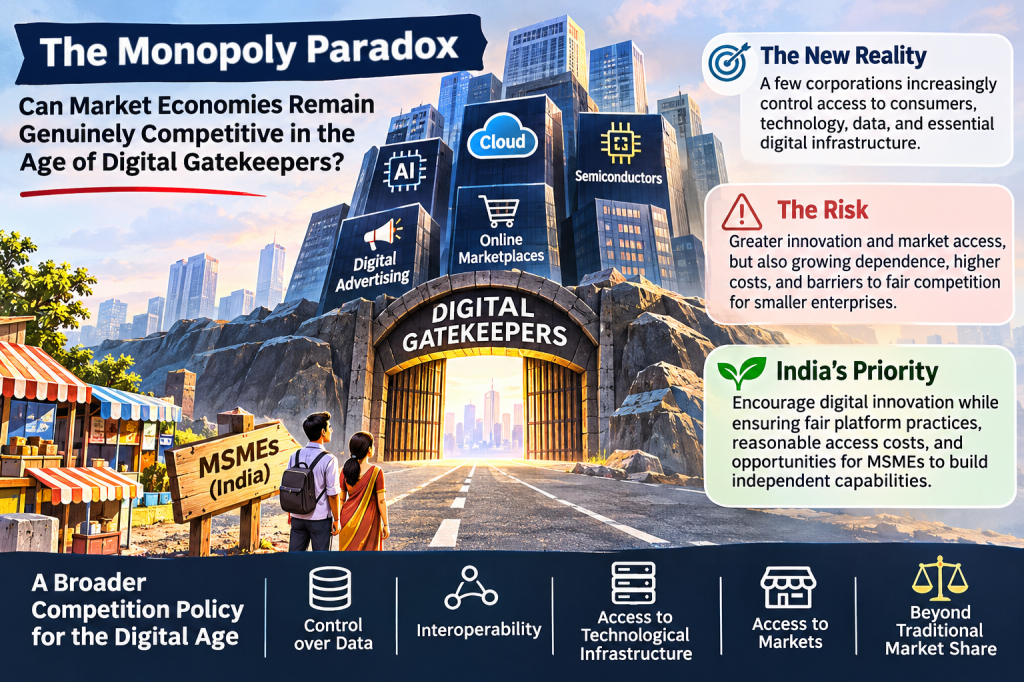
When a handful of corporations control the digital infrastructure of the global economy, does the free market remain genuinely free?
The New Economic Contradiction: Markets Are Expanding, but Competition May Be Shrinking
Capitalism has historically justified itself through a powerful economic principle: competition encourages innovation, improves efficiency, reduces prices, and gives consumers greater choice. The market economy assumes that businesses compete for customers, new enterprises challenge established firms, and inefficient producers eventually lose their position.
But the twenty-first-century economy is developing a troubling contradiction. Markets are becoming increasingly global, technologically sophisticated, and digitally connected, while control over essential economic infrastructure is becoming concentrated in relatively few corporations.
A small number of powerful companies operate major search engines, digital marketplaces, cloud computing systems, mobile operating systems, advertising networks, and increasingly the infrastructure supporting artificial intelligence.
These corporations do not merely compete within markets. In some cases, they also establish the rules through which other businesses enter and participate in those markets.
The central economic question is no longer simply whether monopolies charge higher prices. It is whether modern capitalism is creating private gatekeepers that determine who can compete, innovate, and reach consumers.
From Industrial Monopolies to Digital Gatekeepers: A Historical Perspective
Economic concentration is not new. During the late nineteenth century, industrial capitalism witnessed the emergence of enormous corporations controlling railways, petroleum, steel, and other strategic industries.
The Standard Oil monopoly in the United States demonstrated how control over transportation, refining, and distribution could create formidable barriers for competing enterprises. Governments responded through antitrust legislation, including the Sherman Antitrust Act of 1890.
During the twentieth century, competition policy increasingly focused on preventing market domination, restrictive business practices, and mergers that could substantially reduce competition.
However, the digital economy has fundamentally changed the nature of market power.
Traditional monopolies frequently controlled physical infrastructure, production capacity, or scarce natural resources. Today’s digital corporations can derive their strength from data, algorithms, network effects, technological ecosystems, and control over access to consumers.
A railway monopoly could restrict transportation. A digital platform can influence which products consumers discover, which businesses receive visibility, how transactions are processed, and how much sellers must spend to remain competitive.
The difference is profound. Economic power increasingly lies not only in producing goods but also in controlling the infrastructure through which other businesses conduct economic activity.
The Platform Economy: When the Marketplace Becomes the Competitor
Digital platforms have transformed global commerce by reducing geographical barriers and connecting millions of enterprises with consumers.
For smaller businesses, online marketplaces have created opportunities that were previously unimaginable. An artisan, garment manufacturer, or food-processing enterprise can potentially reach customers far beyond its local market without investing in an extensive physical distribution network.
Yet the same platforms can generate new forms of economic dependence.
A business may initially join an online marketplace because it offers affordable access to customers. Over time, however, its sales may become dependent on the platform’s search rankings, advertising systems, commissions, logistics arrangements, and customer data.
If the platform changes its algorithms or commercial conditions, the enterprise may experience a sudden decline in sales despite maintaining the same product quality and prices.
This creates an important distinction between access to a market and control over market participation.
A marketplace can expand opportunities while simultaneously accumulating substantial bargaining power over the businesses using it.
Where a platform operates the marketplace and competes with independent sellers, concerns can also arise over preferential treatment, information advantages, and conflicts of interest. Such concerns require evidence-based assessment rather than assuming every large platform behaves unfairly.
The deeper issue is whether enterprises can realistically switch platforms, negotiate terms, retain customer relationships, and build independent brands.
Artificial Intelligence Could Create a New Generation of Economic Concentration
Artificial intelligence is frequently presented as a technology that will democratise productivity. Small enterprises may gain access to sophisticated design, marketing, forecasting, translation, and production-management capabilities at relatively low costs.
However, the underlying economics of advanced AI could produce an opposing tendency.
Developing frontier AI systems can require substantial investment in computing infrastructure, specialised semiconductors, electricity, research talent, and large datasets.
These requirements may favour corporations with significant financial resources and established technological infrastructure.
Cloud computing adds another dimension. Enterprises increasingly depend on external providers for data storage, software applications, cybersecurity, and AI services. Switching providers may involve technical complexity, migration costs, contractual constraints, and operational risks.
Semiconductor technologies introduce further concentration risks because advanced chip manufacturing, equipment, and design capabilities are distributed across a limited number of highly specialised firms and locations.
The result could be a layered structure of economic dependence: businesses use AI applications that depend on cloud infrastructure, which depends on advanced chips and specialised technological supply chains.
At each layer, control over essential inputs can create economic influence.
Nevertheless, concentration is not inevitable. Open-source technologies, interoperable systems, new entrants, public research, and technological breakthroughs can reduce barriers.
The defining question is whether AI will become a general-purpose productivity tool available to millions of enterprises or an infrastructure through which a limited number of corporations capture a disproportionate share of economic value.
The Hidden Cost of Monopoly: Innovation That Never Happens
Traditional economic analysis often measures monopoly costs through higher prices, reduced output, and inefficient resource allocation.
But in the digital economy, some of the most significant costs may be difficult to observe.
A consumer may receive a digital service without paying a monetary price. Yet the service can still create competition concerns through data collection, restrictions on interoperability, reduced privacy, or limitations on consumer choice.
Similarly, a small enterprise may never enter a market because customer acquisition costs, platform dependence, technological restrictions, or access to essential infrastructure make entry commercially unattractive.
These are losses that conventional price-based analysis may fail to capture.
The economic cost of concentration therefore includes not only what consumers pay today but also the innovations, businesses, employment opportunities, and alternative technologies that may never emerge.
This does not mean large corporations are necessarily inefficient. Scale can support research, lower operating costs, improve reliability, and deliver services that smaller enterprises cannot economically provide.
The challenge is to distinguish efficiency created through scale from market power protected through exclusionary practices.
Competition policy must preserve the benefits of scale without allowing size to become an enduring barrier to innovation.
India’s Digital Economy: Empowerment or a New Form of MSME Dependence?
India presents an especially important case because its economic structure combines a rapidly expanding digital ecosystem with millions of micro, small, and medium enterprises.
Digital payments, e-commerce, online advertising, logistics platforms, and cloud-based services are creating opportunities for enterprises to improve efficiency and reach new customers.
For MSMEs, these technologies can reduce transaction costs, improve market information, facilitate payments, and overcome some traditional disadvantages of geographical isolation.
However, digital participation does not automatically translate into stronger economic independence.
A small manufacturer may gain access to national customers but become dependent on a marketplace for sales visibility. A handicraft producer may develop an online business but struggle with advertising expenditure, platform commissions, returns, and logistics costs. A local service provider may acquire customers through an application without controlling the resulting customer relationship.
The enterprise becomes digitally connected but may remain economically vulnerable.
This is particularly relevant for India’s industrial and artisanal clusters, where enterprises frequently face limited managerial resources, weak branding, inadequate technology, and insufficient bargaining power.
Digitalisation could reproduce traditional inequalities in a technologically advanced form if smaller firms remain dependent on intermediaries while larger firms control market information, customer relationships, and commercial infrastructure.
India’s policy response therefore needs to move beyond simply encouraging MSMEs to join digital platforms.
The objective should be to help enterprises become capable digital competitors.
This requires investment in enterprise-level digital skills, product differentiation, independent branding, data management, export readiness, cybersecurity, and the ability to operate across multiple sales channels.
Initiatives such as the Open Network for Digital Commerce (ONDC) and India’s digital public infrastructure offer potentially important approaches to reducing dependence on closed ecosystems. Their long-term effectiveness, however, must be judged by actual merchant participation, transaction economics, interoperability, service quality, and sustainable business outcomes.
The relevant policy question is not how many MSMEs have become digitally registered.
It is how many have gained greater productivity, stronger bargaining power, improved profitability, and genuine control over their commercial future.
Rethinking Competition Policy: Beyond Market Share
Competition regulation was largely developed around industrial markets where production capacity, prices, and market shares provided important indicators of economic power.
Digital markets require a broader analytical framework.
Regulators increasingly need to examine control over data, network effects, switching costs, interoperability, self-preferencing, technological dependencies, and access to essential digital infrastructure.
Market share remains relevant, but it cannot independently explain the full nature of competitive power.
The European Union’s Digital Markets Act represents one regulatory approach focused on designated digital gatekeepers and specific obligations intended to make digital markets more contestable.
India must similarly evaluate how its competition framework can address digital-market concerns while preserving innovation, investment, consumer benefits, and opportunities for domestic technological enterprises.
Excessively restrictive regulation could discourage innovation and reduce the benefits of economies of scale. Weak enforcement, however, could allow exclusionary practices to become deeply embedded before competitive alternatives emerge.
The objective should not be to penalise companies merely because they are successful or large.
It should be to ensure that success does not give firms the ability to unfairly prevent others from competing.
The Future Outlook: A World of Digital Economic Gatekeepers?
Over the next decade, economic concentration could become an increasingly important structural challenge for market economies.
AI infrastructure, advanced semiconductor manufacturing, cloud computing, digital advertising, and online marketplaces may reinforce one another through economies of scale, network effects, and accumulated technological capabilities.
One possible outcome is a highly productive global economy in which relatively few corporations control much of the technological infrastructure, while millions of smaller businesses operate within systems they do not govern.
Another possibility is a more open digital economy supported by interoperability, technological diffusion, effective competition enforcement, and greater access to advanced tools.
The outcome will depend on public policy, technological change, entrepreneurial competition, and institutional capacity.
For developing economies, the stakes are particularly high.
If digital infrastructure becomes a new source of economic dependence, countries may find themselves increasingly reliant on foreign technologies even while their domestic businesses become more digitally active.
Technological adoption alone will not guarantee technological capability.
India will therefore need to strengthen domestic innovation, semiconductor ecosystems, affordable computing access, digital skills, competitive cloud services, and the capacity of MSMEs to use technology independently.
The challenge is not to replace private innovation with state control, but to create conditions under which both established companies and new entrants can compete fairly.
Conclusion: Can Capitalism Survive Without Meaningful Competition?
The greatest long-term challenge to capitalism may not come from opposition to markets, but from the weakening of competition within markets themselves.
When a limited number of corporations control essential channels of economic participation, the distinction between market coordination and private economic governance can become increasingly blurred.
A market economy remains dynamic when entrepreneurs can enter, consumers can switch, innovators can challenge incumbents, and smaller businesses can grow without facing unjustified barriers.
For India, this principle has enormous implications. The country’s economic future cannot depend exclusively on creating a few globally competitive digital corporations. It must also enable millions of MSMEs to become productive, innovative, technologically capable, and commercially independent.
The real measure of a competitive economy is not how large its biggest corporations become, but how freely new enterprises can challenge them.
And that leads to the defining economic question of the digital age:
Are we building a market economy in which technology expands competition, or one in which competition itself becomes a service controlled by a few corporations?
The views expressed are an economic analysis intended to encourage discussion on competition, technological concentration, MSME development, and the future of market economies.
#DigitalEconomy #MarketCompetition #Monopoly #ArtificialIntelligence #MSME #IndiaEconomy #CompetitionPolicy #DigitalPlatforms #EconomicDevelopment #IndustrialPolicy


Leave a Reply