GLOBAL TRADE, ENVIRONMENT AND MSME COMPETITIVENESS | 30 OCTOBER 2026
The world is demanding greener products, cleaner supply chains and greater environmental accountability. But are international trade systems equipped to verify these requirements without creating another generation of invisible trade barriers?
Environmental Ambition Is Moving Faster Than Trade Infrastructure
International trade is entering a new phase in which the competitiveness of a product will increasingly depend not only on its price, quality and delivery schedule but also on the environmental information accompanying it. Carbon emissions, raw-material origins, resource consumption, waste management, recyclability and end-of-life treatment are becoming important considerations in cross-border commerce.
This transition represents a fundamental change in the architecture of international trade. Traditionally, customs systems were designed primarily to establish the origin, classification, valuation and legal admissibility of traded goods. Environmental requirements, where applicable, were often administered separately by environmental authorities, licensing agencies and other regulatory institutions.
Today, these two systems are increasingly expected to function together. A product may be commercially competitive and environmentally compliant, yet still face delays, additional documentation and higher transaction costs because the institutions responsible for verifying environmental information do not communicate effectively.
This creates an emerging contradiction: Governments are making environmental compliance more demanding without necessarily making compliance administration more efficient.
A recent OECD study provides important evidence of this institutional challenge.
The OECD’s New Findings: The Missing Infrastructure of Green Trade
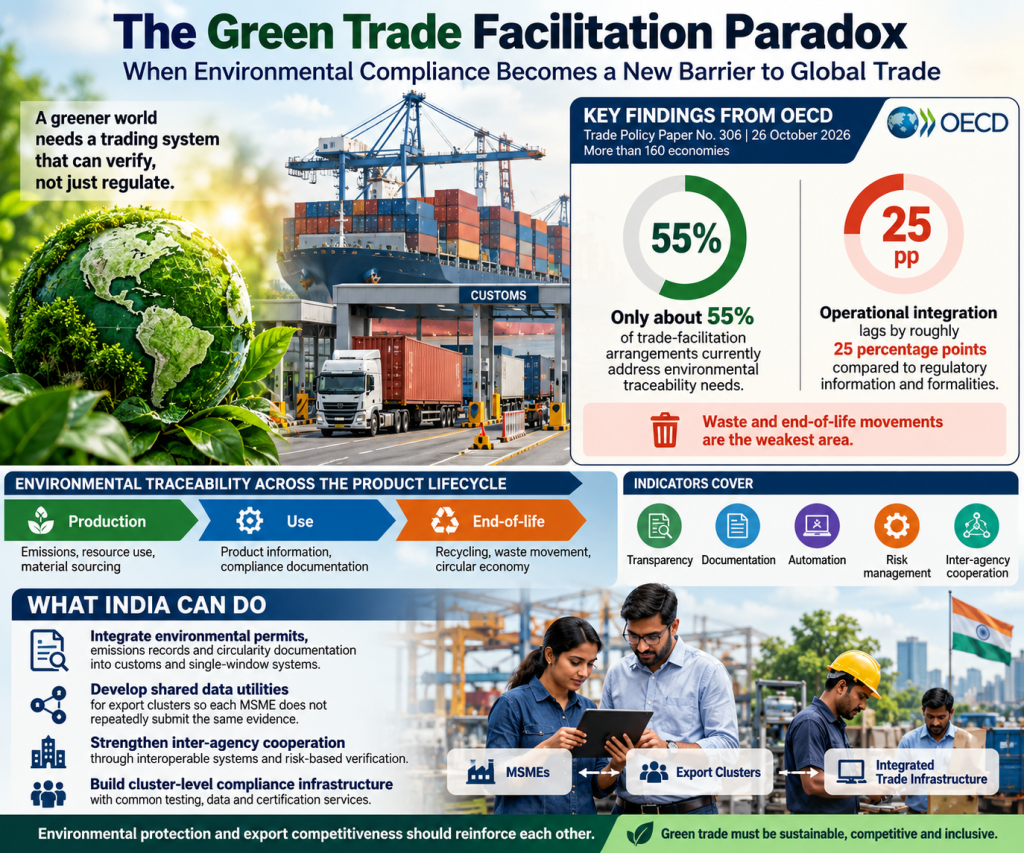
The OECD’s Expansion of the OECD Trade Facilitation Indicators in the Area of Environment, Trade Policy Paper No. 306, dated 26 October 2026, examines environment-related trade facilitation arrangements across more than 160 economies.
Its significance lies in shifting attention from the environmental ambitions of trade regulations to the administrative systems responsible for implementing them.
The study develops environment-related Trade Facilitation Indicators using factual variables covering regulatory transparency, documentation requirements, automation, risk management and cooperation between government agencies. It examines environmental traceability across production, use and end-of-life stages.
The findings reveal a substantial institutional gap.
ENVIRONMENTAL COVERAGE
55%
Approximate share of trade-facilitation arrangements addressing environmental traceability needs
IMPLEMENTATION GAP
25 pp
Approximate lag in operational integration relative to more advanced regulatory arrangements
Figures reported in OECD Trade Policy Paper No. 306, as supplied in the study summary. Percentage points (pp) are distinct from percentage changes.
Regulatory information and formal documentation appear relatively advanced. However, operational integration remains substantially weaker, particularly in data reuse, single-window coverage, inter-agency coordination and administrative appeals.
Waste shipments and end-of-life product movements emerge as especially weak areas.
The distinction is crucial. Governments may have environmental rules, prescribed certificates and designated authorities, but these arrangements do not necessarily constitute an integrated system capable of handling environmental information efficiently.
The next trade facilitation challenge is therefore not simply digitising customs procedures. It is connecting environmental governance with the infrastructure of international commerce.
Historical Perspective: From Reducing Tariffs to Managing Invisible Barriers
The evolution of international trade policy helps explain why this problem has become so important.
During the decades following the Second World War, international trade liberalisation focused heavily on reducing tariffs, quotas and other conventional restrictions. The General Agreement on Tariffs and Trade provided a framework for progressively lowering barriers, while the establishment of the World Trade Organization in 1995 strengthened the rules governing international commerce.
As tariff barriers declined in many markets, attention increasingly shifted toward non-tariff measures, including technical standards, product testing, certification, sanitary regulations and administrative procedures.
The WTO Trade Facilitation Agreement, which entered into force in 2017, represented an important attempt to simplify and harmonise procedures governing the movement, release and clearance of goods.
Yet this framework emerged largely from a world in which border administration focused on the movement of merchandise and the information needed to process it.
Environmental governance is changing that requirement.
A modern trading system increasingly needs to understand what happens before a product reaches the border, how it is produced and, in certain regulated product chains, what happens after its useful life ends.
A conventional customs declaration may establish the value and origin of a shipment. Environmental traceability can require information about production processes, emissions, material composition, recycling and waste treatment.
Consequently, trade facilitation is gradually evolving from the efficient movement of goods toward the efficient movement and verification of information about goods.
This transition could become as important for future trade competitiveness as tariff liberalisation was for earlier generations.
The New Trade Barrier May Be the Cost of Proving Compliance
Environmental standards serve legitimate public purposes. They can reduce pollution, encourage resource efficiency, improve waste management and support more sustainable production.
However, the economic burden of complying with these standards depends not only on their technical requirements but also on the administrative arrangements through which compliance is demonstrated.
Consider a small garment exporter supplying international buyers.
The enterprise may be required to provide information on fabric composition, chemical use, production processes, energy consumption, recycled content and waste disposal. Different buyers, certification agencies and public authorities may request overlapping information in different formats.
Even when the enterprise meets the relevant environmental requirements, demonstrating compliance can become expensive.
The problem is not necessarily the environmental standard itself. It is the duplication, fragmentation and lack of interoperability in the compliance system.
Large corporations can invest in specialised software, environmental compliance departments, consultants and integrated reporting systems. Smaller enterprises often cannot.
The resulting competitive disadvantage can be substantial.
A well-designed environmental regulation may therefore produce an unintended outcome: firms with greater administrative and financial capacity gain easier access to international markets, while smaller producers face disproportionately high costs.
This raises a difficult question.
Will green trade create a more sustainable global economy, or will fragmented environmental compliance systems reinforce the dominance of large corporations and advanced economies?
The answer will depend partly on whether governments treat administrative infrastructure as an essential component of environmental policy.
The Circular Economy Cannot Function Through Fragmented Border Systems
One of the OECD study’s particularly important findings concerns the relatively weak arrangements for waste and end-of-life movements.
This weakness has consequences beyond conventional waste trade.
The global transition toward a circular economy depends on the movement, recovery, refurbishment, recycling and reuse of materials and products. Used electronics, industrial scrap, recyclable textiles, batteries and other materials may require cross-border processing because recovery capabilities are unevenly distributed.
However, such movements also present genuine environmental risks. Hazardous waste, illegal dumping and misclassification require effective controls.
The policy challenge is therefore not simply to remove administrative restrictions.
It is to distinguish legitimate circular-economy activities from environmentally harmful movements through reliable traceability, risk-based inspection and coordinated regulatory systems.
When customs authorities, environmental agencies and recycling regulators operate through disconnected databases, legitimate enterprises can face uncertainty while enforcement agencies may struggle to identify high-risk shipments.
The future competitiveness of circular industries will depend partly on whether governments can combine rigorous environmental safeguards with efficient verification.
An economy cannot build an internationally competitive recycling industry solely by investing in processing technology. It also needs the institutional capacity to move recyclable materials lawfully, predictably and transparently.
Why This Matters for Developing Countries
Developing economies face a particularly difficult balancing act.
They must improve environmental performance to remain competitive in international markets. At the same time, they often operate with weaker digital infrastructure, fragmented institutions, limited technical capacity and large populations of small enterprises.
The resulting compliance burden can become regressive.
A large multinational enterprise may spread the fixed cost of environmental reporting across thousands of shipments. A small exporter may have to recover similar administrative costs from a much smaller volume of trade.
This difference matters because environmental compliance frequently involves fixed costs that do not decline proportionately with enterprise size.
There is also a wider developmental concern.
International buyers and regulators may increasingly demand sophisticated environmental evidence from producers in developing countries, even where the necessary measurement, certification and digital infrastructure is not readily accessible.
This can create a new form of inequality in global value chains.
Countries possessing advanced environmental data systems, accredited laboratories and interoperable regulatory platforms may enjoy an advantage unrelated to the intrinsic quality of their products.
Meanwhile, producers in less-developed institutional environments may be excluded despite having the technical capacity to manufacture competitively and improve their environmental performance.
Environmental traceability could thus become an additional determinant of international industrial competitiveness.
India: From Customs Digitalisation to Environmental Data Integration
India has made important progress in customs digitalisation and trade facilitation through initiatives such as ICEGATE, electronic documentation and the Indian Customs Single Window Project.
However, the emerging environmental trade agenda requires a broader institutional response.
The next stage should connect customs administration with relevant environmental permits, emissions information, waste-management records, product traceability and circular-economy documentation.
This does not imply that every environmental record should be made universally accessible. Commercial confidentiality, data security, regulatory jurisdiction and proportionality must remain central considerations.
The objective should be to ensure that information already verified by one authorised institution can, where legally appropriate, be reused by another without forcing exporters to reproduce the same evidence repeatedly.
India could pursue three interconnected reforms.
First, environmental documentation should be progressively integrated into trade-related digital systems, beginning with sectors where regulatory requirements are substantial and data standards are sufficiently mature.
Second, inter-agency cooperation should move beyond procedural consultation toward interoperable systems, common data definitions and risk-based verification.
Third, environmental compliance infrastructure should be developed at the industrial-cluster level rather than leaving every enterprise to build its own reporting capabilities.
The third reform may be particularly important for India’s MSME-dominated manufacturing economy.
Industrial Clusters Could Become the Foundation of Green Trade Competitiveness
India’s industrial clusters provide an institutional opportunity to address the environmental compliance challenge collectively.
Consider a textile cluster containing hundreds of small dyeing, processing, weaving and garment-manufacturing enterprises.
Individual enterprises may lack the resources to install sophisticated environmental monitoring and reporting systems. However, a cluster-level institution could provide shared environmental data services, technical assistance, accredited testing access and standardised documentation.
Such a system could collect and validate relevant information on energy consumption, water use, chemical management, waste treatment and other sector-specific indicators.
Participating firms could then use verified records, subject to buyer requirements and applicable regulations, for multiple reporting purposes.
The same principle could apply to leather, engineering, chemicals, pharmaceuticals, electronics, food processing and other export-oriented clusters.
The economic advantage would arise from reducing duplicated fixed costs, improving data reliability and allowing smaller enterprises to access capabilities that would otherwise remain beyond their financial reach.
This would represent an important evolution in cluster development methodology.
Traditionally, common facility centres have focused on physical infrastructure such as testing laboratories, machinery, processing equipment and production facilities.
The next generation of common facilities may need to include shared digital compliance infrastructure, environmental data management and traceability services.
In other words, cluster competitiveness will increasingly depend not only on what enterprises can produce collectively, but also on what they can credibly demonstrate collectively.
This could become an important new area for MSME policy, export promotion institutions and industrial development programmes.
A Critical Limitation: Administrative Readiness Is Not Environmental Performance
The OECD study offers a useful benchmark, but its findings should not be interpreted as proof that better trade facilitation indicators automatically produce better environmental outcomes.
An economy may have sophisticated electronic documentation, integrated databases and efficient administrative procedures while still experiencing significant pollution or weak environmental enforcement.
Similarly, a high indicator score does not establish that exporters actually face lower compliance costs.
The indicators assess the presence and design of administrative arrangements. They do not, by themselves, measure causal effects on emissions, biodiversity, resource efficiency, shipment delays or enterprise profitability.
This distinction matters for policymakers.
Success should ultimately be evaluated through practical outcomes: lower administrative duplication, reduced processing times, reliable traceability, improved enforcement, lower compliance costs and measurable environmental benefits.
Without such evidence, digitalisation could simply reproduce existing bureaucratic requirements in electronic form.
A poorly designed digital system can be just as burdensome as a paper-based one.
Future Outlook: Environmental Data May Become a New Trade Infrastructure
Over the coming decade, environmental information could become an increasingly important component of global trade infrastructure.
Artificial intelligence, digital product passports, automated verification, interoperable databases and risk-based inspection systems may make environmental traceability more efficient.
However, technology alone will not solve the institutional problem.
If countries develop incompatible reporting systems, firms may confront an expanding universe of digital compliance requirements. A product accepted under one framework may require substantial additional documentation under another.
The world could therefore face two contrasting futures.
In the more constructive scenario, governments coordinate environmental data standards, recognise reliable verification systems, simplify procedures and create affordable compliance mechanisms for smaller enterprises. Environmental regulation then supports sustainability while facilitating legitimate trade.
In the less favourable scenario, environmental rules become increasingly fragmented, reporting obligations multiply and compliance costs rise. Large firms consolidate their advantage while smaller exporters struggle to remain connected to global value chains.
A third possibility is a divided international trading system in which advanced economies and major multinational corporations establish interoperable environmental data networks, while less-developed economies remain outside these networks.
Such a division could create a new form of technological and institutional dependence.
For India, the strategic response should be to develop domestic environmental verification capabilities while participating actively in international efforts to improve interoperability and mutual recognition.
Conclusion: The Next Global Trade Divide May Be Between Those Who Can Prove and Those Who Cannot
The OECD’s latest work points toward a fundamental transformation in international trade governance.
For decades, competitiveness was largely associated with production costs, technology, infrastructure, logistics and market access.
These factors will remain essential. But the ability to produce reliable, verifiable and internationally usable environmental information is becoming an additional competitive capability.
The danger is that environmental governance may advance faster than the institutional systems needed to implement it fairly and efficiently.
For developing economies, particularly those dependent on MSMEs, the policy challenge is not to resist environmental standards. It is to ensure that legitimate environmental objectives do not become unnecessarily expensive administrative barriers.
India should therefore treat environmental data infrastructure as part of its industrial competitiveness strategy, not merely as an extension of regulatory compliance.
The future of green trade will depend on more than how cleanly products are manufactured. It will also depend on how efficiently, affordably and credibly their environmental characteristics can be established.
The defining paradox of green globalisation may be that the world becomes increasingly capable of demanding environmental responsibility while remaining institutionally unprepared to make that responsibility accessible to everyone.
And the next major divide in international trade may not be between countries that produce green products and those that do not, but between enterprises that can afford to prove compliance and those that cannot.
Reference: OECD (2026), Expansion of the OECD Trade Facilitation Indicators in the Area of Environment, OECD Trade Policy Paper No. 306, 26 October 2026.
This article is an original critical interpretation based on the supplied OECD study findings, historical trade-policy developments and their implications for India, MSMEs and industrial clusters. The India-specific recommendations are analytical proposals, not findings directly established by the OECD indicators.


Leave a Reply