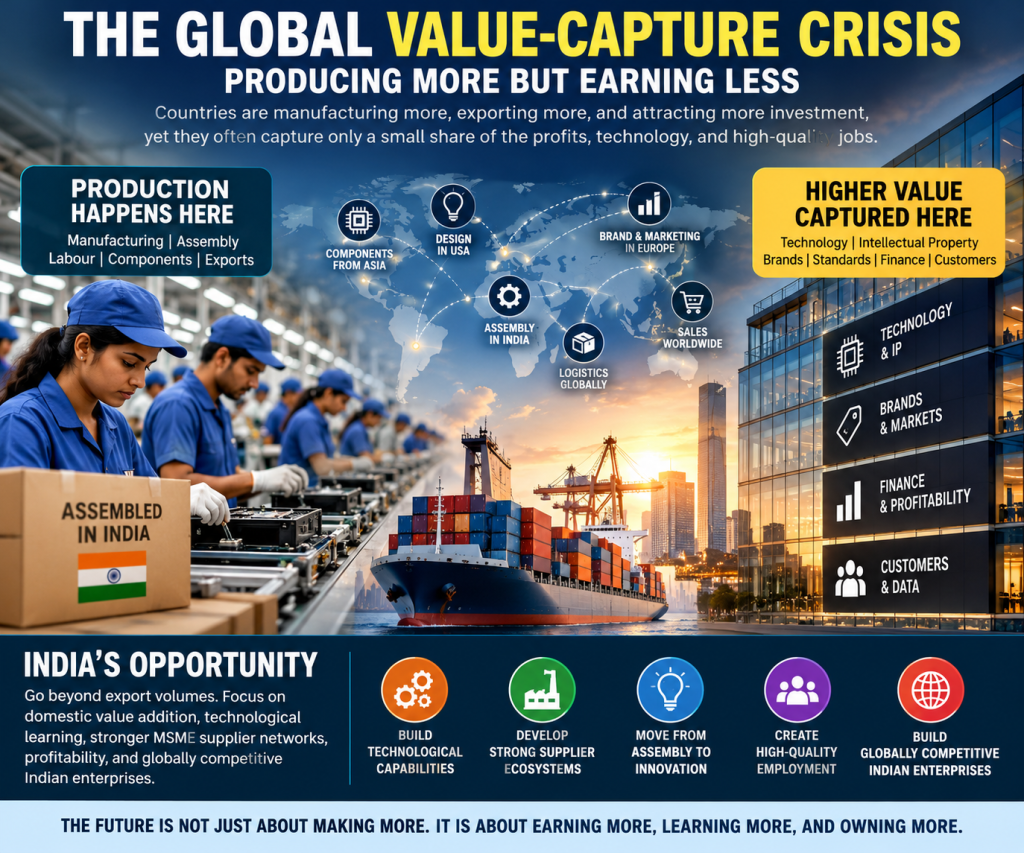
Why the next great economic divide will be between countries that manufacture products and countries that control the value created by them.
The world economy is entering a new contradiction: countries are producing more, exporting more, attracting more foreign investment, and building more factories, yet these achievements do not necessarily translate into proportionately higher profits, technological independence, better employment, or lasting economic power. The central question of international development is gradually changing. It is no longer sufficient to ask how much a country produces. We must increasingly ask how much economic value it retains, who controls that value, and whether today’s production creates tomorrow’s competitive capabilities.
This contradiction challenges one of the most influential assumptions of modern development economics: that integration into international production networks will gradually lead countries towards industrial upgrading and prosperity. Participation in global production can create extraordinary opportunities, but participation and economic control are fundamentally different achievements.
A country may manufacture millions of smartphones without controlling their operating systems, advanced chips, intellectual property, or global distribution. It may export garments to the world’s largest retailers while earning only a modest share of the final retail price. It may process agricultural commodities without owning internationally recognised food brands. It may assemble electric vehicles while depending on foreign technology for batteries, specialised components, and critical software.
The problem is not that these activities are economically meaningless. They generate employment, exports, skills, and industrial experience. The deeper problem emerges when countries remain confined to these activities for decades without developing the ability to capture a greater share of the economic rewards.
From Industrial Production to Global Value Chains: How Economic Power Changed
During the nineteenth and much of the twentieth century, industrial development was closely associated with the establishment of factories, expansion of domestic manufacturing, and accumulation of productive capital. Industrialised economies generally controlled substantial parts of their production systems, although international dependence on raw materials, technologies, and markets remained significant.
The industrial transformation of Japan, followed by South Korea and Taiwan, demonstrated that manufacturing could become a foundation for technological advancement, domestic enterprise development, and rising incomes. However, these economies did not succeed merely because they manufactured goods. Their industrial strategies increasingly emphasised technological learning, supplier capabilities, engineering expertise, and the emergence of internationally competitive domestic enterprises.
The globalisation wave beginning in the late twentieth century transformed this relationship.
Advances in telecommunications, container shipping, information technology, and international investment made it possible to separate different stages of production geographically. Product design could take place in the United States, specialised components could be manufactured in East Asia, assembly could occur in another developing economy, and final products could be distributed through global retail networks.
This international fragmentation created unprecedented opportunities for countries that lacked the capital and technology required to develop complete industries independently.
Instead of manufacturing an entire automobile, a country could specialise in wiring harnesses. Instead of developing a complete electronics industry, it could assemble devices. Instead of creating an international fashion brand, it could manufacture garments for established retailers.
For many economies, this represented an important route into industrialisation.
Yet the same system also created a new form of economic hierarchy. Countries could become indispensable manufacturing locations without becoming powerful participants in the decisions governing technology, pricing, branding, and market access.
Globalisation distributed production more widely than it distributed control over economic value.
The Hidden Economics of Value Capture: Why Export Value Is Not the Same as Economic Gain
Consider a hypothetical smartphone sold internationally for US$1,000. Its final price incorporates components, software, research, design, assembly, logistics, distribution, marketing, retail services, and business profits.
The country performing final assembly may record a substantial gross export value even though many components were imported and much of the product’s intellectual property belongs to foreign enterprises.
The assembly operation still creates domestic value through wages, local services, depreciation, and operating surplus. However, that domestic contribution may be considerably smaller than the recorded export value.
This distinction is fundamental.
Gross exports measure the value of goods crossing international borders. Domestic value added measures the contribution generated within the exporting economy. Profit retention, meanwhile, depends on who owns the enterprises and productive assets, how profits are distributed, and where income ultimately accrues.
These measures are related but not interchangeable.
Even domestic value added does not fully reveal who captures the resulting income. Foreign-owned enterprises may generate substantial domestic wages and tax revenues while distributing part of their profits to overseas shareholders. Conversely, domestically owned firms may earn valuable intellectual-property or service income through activities performed internationally.
A country therefore needs to distinguish between three economic achievements: producing goods, creating domestic value, and retaining strategic control over future income-generating capabilities.
The greatest danger arises when policymakers treat the first achievement as sufficient evidence of the other two.
The Low-Margin Industrialisation Trap
Traditional development thinking often assumes that countries begin with labour-intensive production and gradually move towards higher-value activities as wages, productivity, and technological capabilities improve.
This progression is possible, but it is not automatic.
In global value chains, lead firms often control product specifications, quality requirements, supplier selection, purchasing contracts, distribution networks, and customer relationships. These capabilities give them considerable influence over the distribution of commercial opportunities and risks.
Manufacturing suppliers, particularly smaller enterprises, may operate in highly competitive markets where buyers can shift orders between countries. When multiple suppliers offer similar products, competition frequently concentrates on price, delivery speed, compliance, and production flexibility.
This can create a difficult economic situation.
A supplier invests in modern machinery, improves productivity, reduces defects, and increases output. Yet a powerful buyer may negotiate lower prices during the next contract cycle. Some productivity gains benefit the supplier, but others are passed to buyers and consumers.
Consequently, rising production efficiency does not always produce a proportionate improvement in supplier profitability.
The same problem can appear at the national level. Export volumes rise, industrial employment expands, and foreign investment increases, but domestic firms may continue operating with limited margins and weak bargaining power.
This is not inevitable. Competitive manufacturing can generate substantial domestic value, and long-term relationships with lead firms can support technological learning. However, without deliberate capability development, participation can become a stable commercial arrangement rather than a pathway towards higher-value economic functions.
The low-margin trap is not simply about producing inexpensive goods. It is about lacking the capabilities and bargaining power needed to earn more from increasingly sophisticated production.
The New Economic Hierarchy: Who Controls Technology, Standards, Finance and Customers?
The emerging global economy may be organised less around a simple distinction between manufacturing and services and more around control over critical economic functions.
Technology ownership allows enterprises to earn income from innovation, patents, proprietary software, specialised engineering, and industrial know-how.
Control over standards and certification can determine which products qualify for international markets. These requirements may improve safety, reliability, and sustainability, but they can also create costly entry barriers for smaller producers.
Control over finance influences which enterprises can expand, withstand commercial uncertainty, and invest in technological upgrading.
Brand ownership and customer relationships provide another source of economic advantage. A company that understands consumer demand and controls distribution may have greater pricing power than a manufacturer supplying interchangeable products.
Digital platforms add a further dimension. Enterprises controlling market access, customer data, software ecosystems, and digital infrastructure can influence commercial relationships without necessarily owning the physical factories producing goods.
These developments do not make manufacturing irrelevant. On the contrary, advanced manufacturing, process engineering, materials science, and specialised production knowledge remain major sources of economic power.
The crucial distinction is between manufacturing as a replaceable activity and manufacturing supported by capabilities that competitors cannot easily replicate.
A technologically advanced component supplier may capture more durable value than a consumer-facing brand with weak competitive advantages. Similarly, a specialised industrial manufacturer may command substantial margins through precision, reliability, patents, and engineering expertise.
The future economic hierarchy will therefore not simply separate producers from designers. It will distinguish enterprises and countries possessing scarce, defensible capabilities from those competing primarily through low costs.
Foreign Investment: A Necessary Opportunity, Not a Guarantee of Upgrading
Foreign direct investment is often celebrated as evidence of economic confidence and industrial success. Governments compete to attract multinational corporations through infrastructure, incentives, industrial parks, and regulatory reforms.
Such investment can provide employment, export opportunities, management practices, technology exposure, and access to international markets.
However, the long-term development impact depends heavily on what happens beyond the initial investment.
A foreign-owned factory operating largely with imported components, foreign technology, and limited local supplier relationships may generate useful economic activity without substantially transforming the surrounding industrial ecosystem.
By contrast, investment that supports domestic component manufacturers, engineering services, workforce training, local research, and technological collaboration can create broader economic benefits.
The difference lies in the depth of domestic linkages.
A country should therefore evaluate foreign investment not only by the amount of capital committed or the number of jobs announced, but also by the quality of local economic integration.
The critical questions concern whether domestic firms are becoming qualified suppliers, whether local engineers are acquiring advanced capabilities, whether research activities are expanding, and whether domestic enterprises can eventually compete beyond their initial multinational customers.
Investment incentives should be assessed against these outcomes rather than assuming that every additional factory represents an equivalent development gain.
India’s Export Ambition: From Manufacturing Scale to Economic Ownership
India’s industrial strategy faces precisely this challenge.
The country has important strengths in pharmaceuticals, automotive components, engineering, information technology, textiles, chemicals, and a growing range of electronics-related activities. Its large domestic market, engineering workforce, entrepreneurial base, and expanding infrastructure create significant opportunities for industrial development.
However, export expansion alone cannot establish whether India is moving towards stronger control over technology, product development, and international markets.
In electronics, the key question is not simply how many devices are assembled or exported. It is whether domestic firms are developing competitive component ecosystems, product engineering, semiconductor-related capabilities, embedded software, and commercially valuable intellectual property.
In textiles and apparel, export growth should be accompanied by improvements in design, technical textiles, productivity, sustainable manufacturing, merchandising, and international market relationships.
In pharmaceuticals, the distinction between high-volume generic manufacturing and higher-value innovation illustrates the importance of research capabilities, intellectual property, specialised production, and regulatory expertise. Both activities have economic value, but they involve different commercial risks and sources of competitive advantage.
In automotive components and machinery, India’s opportunity lies in moving beyond cost-based subcontracting towards specialised engineering, precision manufacturing, testing, product development, and internationally recognised supplier capabilities.
None of this requires India to manufacture every component domestically.
Attempting complete self-sufficiency across complex industries could raise costs, weaken export competitiveness, and divert investment from areas where Indian enterprises can build genuine advantages.
The objective should be strategic capability rather than indiscriminate localisation.
India should import efficiently where necessary, manufacture competitively where it has or can develop advantages, and progressively build domestic ownership of technologies, enterprises, and market relationships that generate durable economic returns.
The Missing Link: MSME Clusters and Domestic Supplier Development
One of the most overlooked dimensions of the value-capture debate is the role of micro, small, and medium enterprises.
Large export-oriented factories may attract international attention, but their long-term contribution to domestic industrial development depends partly on the networks of suppliers, service providers, toolmakers, testing institutions, and specialised enterprises that develop around them.
Industrial clusters can become important mechanisms for increasing domestic value capture.
However, geographical concentration alone does not guarantee upgrading.
A cluster containing hundreds of small enterprises may remain technologically weak if firms lack access to advanced machinery, product development, quality infrastructure, skilled technicians, finance, and reliable international market information.
Traditional cluster development programmes often concentrate on common facilities, infrastructure, training, and market promotion. These interventions can be useful, but they are insufficient when the central challenge is weak participation in higher-value industrial functions.
The next generation of cluster development should focus on technological and commercial upgrading.
For example, an apparel cluster should not measure success only through increased production capacity. It should examine whether enterprises are developing design capabilities, managing international orders independently, improving material sourcing, and creating commercially viable brands or specialised manufacturing services.
An engineering cluster should assess whether local enterprises are moving from basic fabrication towards precision components, industrial automation, testing, prototyping, and product engineering.
A food-processing cluster should examine whether producers can improve product differentiation, certification, traceability, packaging technology, and access to higher-value distribution channels.
This approach requires cluster institutions to become centres of technological learning and market intelligence rather than merely channels for distributing government assistance.
The most successful cluster development strategy may ultimately be the one that reduces firms’ dependence on continuous public support by strengthening their ability to compete independently.
The Green and Digital Transitions Could Deepen the Value-Capture Divide
The next phase of industrial transformation may make the problem more complicated.
Decarbonisation, artificial intelligence, automation, advanced materials, digital traceability, and environmental compliance are changing the conditions under which firms participate in international production.
These changes can create opportunities for developing economies, but they may also increase the cost of entry into higher-value markets.
A small manufacturer may need sophisticated carbon accounting, digital production records, product testing, cybersecurity, and certification simply to remain eligible for international orders.
Meanwhile, enterprises controlling the relevant software, equipment, standards, and certification services may acquire additional commercial advantages.
Artificial intelligence presents a similar contradiction.
Automation can improve productivity and help developing-country manufacturers overcome shortages of specialised skills. But it may also reduce the importance of inexpensive labour, historically one of the main advantages used by poorer economies to enter global production.
If technological capabilities remain concentrated among a limited number of countries and corporations, developing economies could face rising technological dependence even while their physical manufacturing capacity expands.
This creates a new development challenge: countries must invest not only in factories but also in the institutional and technological systems required to keep those factories competitive.
Beyond GDP and Exports: A New Framework for Measuring Industrial Success
Economic policymakers need a more sophisticated framework for assessing industrial progress.
Traditional indicators such as manufacturing output, export growth, foreign investment, and employment remain important. However, they should be complemented by measures that reveal the quality and sustainability of economic participation.
A useful national value-capture framework would examine domestic value added in exports, local supplier participation, productivity growth, technological capabilities, profitability, research expenditure, intellectual-property ownership, workforce earnings, and the international competitiveness of domestically controlled enterprises.
It should also distinguish between the value created domestically and the income ultimately retained by domestic residents.
For example, a country experiencing rapid export growth alongside stagnant supplier margins and limited technological learning may face a different development trajectory from a country with slower export growth but expanding domestic engineering capabilities and internationally competitive enterprises.
This does not mean that export growth should be dismissed. It means that the interpretation of export performance must become more economically meaningful.
Industrial development should be evaluated as a process of capability accumulation rather than simply an increase in production statistics.
The World Economy in 2035: Two Possible Futures
Looking towards 2035, two broad development pathways can be imagined.
In the first, developing economies continue expanding manufacturing capacity but remain heavily dependent on externally controlled technologies, brands, financing arrangements, and market channels. Their exports grow, yet much of their competitive advantage remains tied to labour costs, investment incentives, and access to foreign buyers.
As automation spreads and international competition intensifies, these economies may face increasing pressure on wages, supplier margins, and public finances.
In the second pathway, countries use global production networks as platforms for technological learning and enterprise development. They strengthen domestic suppliers, develop specialised engineering capabilities, invest in research, build internationally competitive businesses, and progressively enter higher-value commercial functions.
The difference between these pathways will not be determined by protectionism versus free trade alone.
It will depend on education, industrial institutions, competition, infrastructure, access to technology, entrepreneurial capabilities, finance, and the quality of relationships between domestic firms and international production networks.
There is also a danger in pursuing value capture too narrowly. A government that focuses exclusively on domestic ownership or local content could undermine efficiency and raise costs. A foreign-owned enterprise may generate substantial domestic benefits, while a domestically owned enterprise may remain technologically stagnant.
The objective should therefore be to increase productive capabilities and broadly shared economic benefits, not merely to change the nationality of ownership.
Conclusion: The Next Economic Revolution Is About Who Earns, Not Just Who Produces
For decades, developing economies have been encouraged to manufacture more, export more, attract more investment, and integrate more deeply into global markets.
These objectives remain relevant, but they are no longer sufficient as a complete development strategy.
The next phase of international economic competition will increasingly concern who owns commercially valuable technologies, who develops critical components, who determines industrial standards, who controls customer relationships, and who possesses the capabilities required to retain economic value.
India and other developing economies should not withdraw from global value chains. They should participate more intelligently, using international production relationships to develop domestic capabilities rather than accepting permanent dependence on low-margin activities.
The real measure of industrial success will not be the number of factories established or the gross value of products exported. It will be the extent to which industrial activity creates technological learning, profitable domestic enterprises, stronger supplier ecosystems, higher-quality employment, and sustainable economic opportunities.
A country that produces more without learning more may remain vulnerable. A country that exports more without developing competitive domestic capabilities may remain dependent. And a country that attracts investment without strengthening its industrial ecosystem may struggle to translate short-term production gains into long-term prosperity.
The defining economic question of the coming decade may therefore be neither how much a country manufactures nor how much it exports, but how much lasting economic power it builds from what it produces.
The global economy has spent decades learning how to distribute production across borders. The next development challenge is to ensure that the benefits of production are distributed more widely as well.
Because in the emerging world economy, producing more will matter only if countries also develop the capacity to create, capture, and sustain greater value.
Original economic commentary | International Trade, Industrial Development, Global Value Chains and MSME Competitiveness
Global value chains, domestic value addition, value capture, industrial upgrading, India manufacturing, export competitiveness, MSME clusters, technology ownership, global economic inequality, economic development.


Leave a Reply